How to Study for the PRINCE2 Certification
A practical PRINCE2 Foundation and Practitioner study guide covering principles, themes, processes, and practice question strategy.
Table of Contents
- What PRINCE2 Tests and How It Differs From PMP
- Key Principles, Themes, and Processes to Master for PRINCE2
- Foundation vs. Practitioner: What Changes
- Practice Question Strategy for PRINCE2 Foundation and Practitioner
- A Realistic Study Timeline for PRINCE2
- How to Memorize PRINCE2 Terminology
- Using LongTerMemory for PRINCE2 Certification Prep
- Common Mistakes PRINCE2 Candidates Make
- Final Tips for Exam Day
PRINCE2 is one of the most recognized project management certifications in the world, especially in Europe, Australia, and parts of Asia. Whether you are aiming for the Foundation level or the more advanced Practitioner level, the exam tests your understanding of a structured, process-driven approach to managing projects.
If you are coming from a less formal project management background, PRINCE2 can feel bureaucratic at first. The language is specific, the processes are detailed, and the exams expect you to apply the methodology in precise ways. But with the right study approach, PRINCE2 is very passable. This guide will show you how to study efficiently and pass both levels.
What PRINCE2 Tests and How It Differs From PMP
Before you start studying, it helps to understand what PRINCE2 actually is. PRINCE2 stands for Projects IN Controlled Environments. It is a process-based project management methodology originally developed by the UK government. Unlike PMP, which is based on the PMBOK guide and covers a broad body of knowledge, PRINCE2 is a specific methodology with clear principles, themes, and processes.
PMP asks what a project manager should consider across ten knowledge areas. PRINCE2 asks what should happen at each stage of a project according to its prescribed methodology. Both certifications are valuable, but they test different mindsets.
| Aspect | PRINCE2 | PMP |
|---|---|---|
| Origin | UK government methodology | PMI global standard |
| Structure | Principles, themes, processes | Knowledge areas and process groups |
| Exam style | Scenario-based and definitional | Situational and broad |
| Levels | Foundation and Practitioner | Single certification |
| Best for | Structured, governance-heavy environments | General project management practice |
If you are already familiar with PMP, do not assume PRINCE2 will be easy. The terminology and logic are different, and the exam rewards people who can think inside the PRINCE2 framework.
Key Principles, Themes, and Processes to Master for PRINCE2
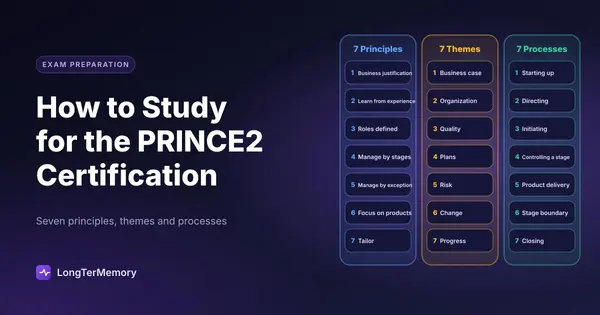
PRINCE2 is built on seven principles, seven themes, and seven processes. These are not optional background reading. They are the core of the exam.
The seven principles are the guiding obligations of the methodology:
- Continued business justification
- Learn from experience
- Defined roles and responsibilities
- Manage by stages
- Manage by exception
- Focus on products
- Tailor to suit the project environment
You need to know each principle well enough to recognize when it is being violated in a scenario. The Practitioner exam especially loves questions that present a project manager who ignores one of these principles.
The seven themes answer the question of what must be addressed throughout the project:
- Business case
- Organization
- Quality
- Plans
- Risk
- Change
- Progress
For each theme, know its purpose, the key roles involved, and the main management products it produces. Practitioner questions often ask which theme applies to a given situation.
The seven processes describe the project lifecycle from start to finish:
- Starting up a project
- Directing a project
- Initiating a project
- Controlling a stage
- Managing product delivery
- Managing stage boundaries
- Closing a project
For the Foundation exam, you need to know the purpose and main activities of each process. For the Practitioner exam, you need to understand how the processes interact and which management products are produced or updated in each one.
Foundation vs. Practitioner: What Changes
The Foundation exam is straightforward compared to the Practitioner. It tests whether you understand the terminology, principles, themes, and processes. Questions are mostly definitional and multiple choice. With focused study, most people can pass Foundation in a few weeks.
The Practitioner exam is scenario-based. You are given a project scenario and asked questions that require you to apply PRINCE2 knowledge. This is where many candidates struggle because they memorized definitions but never practiced application.
To pass Practitioner, you need to do more than recite the seven themes. You need to read a scenario, identify the relevant PRINCE2 concept, and choose the answer that best fits the methodology.
Practice Question Strategy for PRINCE2 Foundation and Practitioner
Practice questions are the most important part of PRINCE2 preparation. The official manual is dense, and reading it without testing yourself is inefficient.
For Foundation, use practice questions to confirm that you know the definitions and can identify the correct term in context. Aim to understand why each wrong answer is wrong. This deepens your knowledge much faster than just marking correct answers.
For Practitioner, scenario practice is essential. Read the scenario carefully. Identify the theme or process involved. Eliminate answers that contradict PRINCE2 principles. Then choose the answer that best applies the methodology to the situation.
A common trap on Practitioner questions is choosing the answer that sounds like good general project management advice. That is often wrong. The exam wants the PRINCE2 answer, even if it feels overly formal or rigid.
A Realistic Study Timeline for PRINCE2
A typical PRINCE2 Foundation study plan takes two to four weeks if you can study five to ten hours per week. A combined Foundation and Practitioner plan usually takes four to eight weeks.
Here is a sample four-week Foundation plan:
| Week | Focus |
|---|---|
| Week 1 | Read the manual overview; learn the seven principles |
| Week 2 | Study the seven themes and create summary notes |
| Week 3 | Study the seven processes; begin practice questions |
| Week 4 | Intensive practice questions; review weak areas |
For Practitioner, add two to four weeks of scenario-based practice. Spend extra time on application questions, especially around tailoring, roles and responsibilities, and management products.
How to Memorize PRINCE2 Terminology
PRINCE2 has a lot of specific terms: project mandate, project brief, business case, exception report, issue register, risk register, lessons log, and many more. These terms are easy to confuse if you try to memorize them in isolation.
The best approach is to learn each term in context. Ask yourself: which process produces this document? Which theme does it belong to? Who is responsible for creating or approving it? When you learn terms as part of a system, they become much easier to remember.
Flashcards work well for this. Put the term on the front and ask yourself to identify its purpose, process, and responsible role on the back. Review these cards using spaced repetition so the terminology stays fresh.
Using LongTerMemory for PRINCE2 Certification Prep
PRINCE2 study involves a lot of structured memorization. You have principles, themes, processes, roles, and management products, all of which need to be available during the exam. LongTerMemory can speed this up by generating flashcards from your PRINCE2 manual or course notes automatically.
Instead of manually writing hundreds of cards, you can upload your materials and let the AI create active recall questions that test understanding, not just memorization. For Practitioner-level study, the cards can focus on scenario-based application, which is exactly what the exam rewards.
This is especially useful if you are studying while working full-time. The less time you spend on card creation, the more time you have for practice questions and review.
Common Mistakes PRINCE2 Candidates Make
The first mistake is treating PRINCE2 like PMP. The two certifications share some vocabulary, but the frameworks are different. Learn PRINCE2 on its own terms.
The second mistake is skipping practice questions. Some candidates read the manual multiple times but never test themselves. Reading creates familiarity. Practice questions reveal whether you actually know the material.
The third mistake is neglecting the Practitioner application style. If you are taking Practitioner, do not stop at definitions. Spend at least half your study time on scenario questions.
Final Tips for Exam Day
On exam day, read each question carefully. The Foundation exam is not trying to trick you, but small wording differences matter. For Practitioner, take notes on the scenario as you read it. Identify the project context, the roles mentioned, and the current stage.
Manage your time. Practitioner scenarios can be long, and it is easy to spend too much time on early questions. If you are unsure, mark the question and move on. You can return to it later.
Finally, trust your preparation. PRINCE2 is a structured methodology, and if you have studied the principles, themes, and processes deeply, you will recognize the patterns in the questions.
PRINCE2 certification is a valuable credential for project managers, especially in organizations that value structured governance. Study the methodology systematically, practice with realistic questions, and focus on application for the Practitioner level. With consistent effort, you can add PRINCE2 to your professional profile and move forward in your project management career.