How to Study for the Certified Public Health (CPH) Exam
Your complete study guide for the CPH exam. Learn what to expect, which topics matter most, and how to pass on your first attempt.
Table of Contents
- What the CPH Exam Tests Across Public Health Competencies
- The Eight CPH Exam Domains
- The Competency-Based Testing Approach
- Who Takes the CPH?
- High-Yield Topic Areas for CPH Exam Preparation
- Evidence-Based Approaches to Public Health
- Public Health Biology and Human Disease Risk
- Program Planning and Evaluation
- Leadership
- Law and Ethics
- Practice Question Strategy and Study Resources for CPH Readiness
- The Right Mindset for CPH Questions
- Primary Study Resources
- Spaced Repetition for CPH Content
- Creating a CPH Study Timeline
- The Day of the Exam
- Making the CPH Count in Your Career
The Certified in Public Health (CPH) credential is the gold standard for public health professionals, and if you’re pursuing it, you’re already thinking strategically about your career. The CPH is administered by the National Board of Public Health Examiners (NBPHE) and is recognized across government agencies, nonprofits, health departments, and academic institutions as a marker of core professional competence.
But here’s the thing: a lot of people walk into CPH prep without a clear sense of what the exam actually tests, which leads to scattered, inefficient studying. You end up reviewing everything without actually being ready for anything. This guide cuts through that by giving you an honest picture of the exam, the high-yield areas you need to prioritize, and a practice question strategy that will actually get you ready.
What the CPH Exam Tests Across Public Health Competencies
The CPH is a 200-question exam (180 scored, 20 unscored pretest items) with a 3-hour time limit. It’s offered as a computer-based test at Prometric testing centers, which means you’ll navigate it on screen with a timer running in the corner.
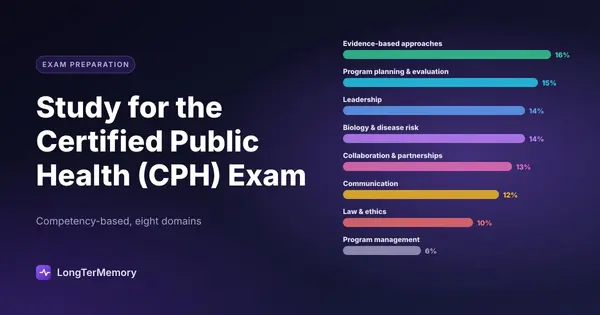
The exam is organized around eight domain areas drawn from the Core Competencies for Public Health Professionals developed by the Council on Linkages. These competencies reflect what public health professionals actually need to know and be able to do, regardless of their specific specialty.
The Eight CPH Exam Domains
| Domain | Approximate Weight |
|---|---|
| Evidence-Based Approaches to Public Health | 16% |
| Communication | 12% |
| Leadership | 14% |
| Law and Ethics | 10% |
| Public Health Biology and Human Disease Risk | 14% |
| Collaboration and Partnerships | 13% |
| Program Planning and Evaluation | 15% |
| Program Management | 6% |
These percentages aren’t published by the NBPHE with exact precision, but they reflect the general distribution based on the official content outline and candidate experience. The point is: not all domains are equal. Evidence-Based Approaches, Program Planning and Evaluation, Public Health Biology, and Leadership together account for roughly 59% of the exam. If you’re studying under time pressure, these are your priority zones.
The Competency-Based Testing Approach
The CPH doesn’t just test recall. Like most modern professional certification exams, it emphasizes application of competencies to realistic public health scenarios. You’ll see questions that describe a community health situation and ask you to identify the appropriate analytical approach, the correct ethical response, or the most effective communication strategy.
This means that memorizing definitions is necessary but not sufficient. You need to understand why certain practices exist and how they apply in context. A candidate who has read every word of their study guide but never thought about how to actually use the knowledge in a real program is going to struggle with the situational questions.
Who Takes the CPH?
The CPH is open to public health professionals and students. Graduate students in accredited public health programs can sit for the exam before graduation. Working professionals typically have a few years of field experience by the time they pursue it.
This matters for your preparation because your background shapes where your gaps are. If you’re a student, you likely have strong epidemiology and biostatistics knowledge from coursework but may feel less grounded in leadership and program management. If you’re a practitioner, the reverse is often true.
High-Yield Topic Areas for CPH Exam Preparation
Let’s go domain by domain and identify what you really need to know.
Evidence-Based Approaches to Public Health
This is the largest single domain and covers epidemiology, biostatistics, and research methods. For most candidates, this is either their strongest area (if they came from an epi or research background) or their most intimidating one (if they didn’t).
High-yield topics:
- Study designs: Know the differences between cohort studies, case-control studies, cross-sectional studies, and randomized controlled trials. Know which is appropriate for which research questions, and know the strengths and limitations of each.
- Key epidemiological measures: Incidence, prevalence, relative risk, odds ratio, attributable risk, number needed to treat. You need to be able to calculate these and interpret them.
- Bias and confounding: Selection bias, information bias, and confounding are tested repeatedly. Know how to identify and address each.
- Statistical concepts: p-values, confidence intervals, statistical vs. clinical significance. You don’t need to run analyses, but you need to interpret outputs correctly.
Practice calculating basic epi measures by hand, not just recognizing them in multiple choice options. Calculation practice forces genuine understanding rather than just familiarity.
Public Health Biology and Human Disease Risk
This domain covers the biological mechanisms underlying public health threats: infectious disease transmission, environmental health exposures, chronic disease risk factors, and the biological plausibility behind public health interventions.
High-yield areas:
- Modes of disease transmission (direct, indirect, airborne, vector-borne, vehicle-borne)
- Herd immunity and vaccination thresholds
- Epidemiological triangle (agent, host, environment)
- Common screening tests, their sensitivity and specificity, and the implications of false positives and negatives
- Environmental health: exposure pathways, dose-response relationships, toxicology basics
If biology isn’t your background, don’t skip this domain. The questions tend to be conceptual rather than deeply technical, but you need enough foundation to reason through disease risk scenarios correctly.
Program Planning and Evaluation
This is where public health practitioners tend to feel comfortable, but the exam version of program planning can still surprise you. The NBPHE tests specific frameworks and models, not just general competence.
Know these thoroughly:
- Logic models: inputs, activities, outputs, short-term outcomes, long-term outcomes. Be able to identify components and explain how they connect.
- Evaluation types: formative, process, outcome, and impact evaluation. Know when each is appropriate.
- Program planning models: PRECEDE-PROCEED, social ecological model, RE-AIM. The PRECEDE-PROCEED model comes up frequently.
- Needs assessment methods: community health assessment, key informant interviews, focus groups, surveys.
A useful study approach here: take a real public health program you’re familiar with from your work or coursework and map it onto these frameworks. Making the abstract concrete accelerates retention significantly.
Leadership
This domain is often underestimated by candidates who feel like “leadership” is something you either have or don’t have. The CPH approach to leadership is about organizational systems thinking, not personal charisma.
Key concepts:
- Change management models (Kotter’s 8-Step Change Model is particularly high-yield)
- Organizational culture and how it affects public health program implementation
- Systems thinking and how complex systems respond to interventions
- Conflict management and negotiation
- Advocacy and policy change processes
Law and Ethics
Public health law and ethics is tested in ways that require you to understand both legal frameworks and ethical reasoning. On the law side, know the constitutional basis for public health authority, key federal public health statutes, and the tension between individual rights and collective public health powers. On the ethics side, the four bioethical principles (autonomy, beneficence, non-maleficence, justice) and their application in public health contexts are essential.
Scenario-based questions in this domain often present situations where individual rights and public health needs are in tension. There’s usually a defensible “public health best practice” answer that balances both.
Practice Question Strategy and Study Resources for CPH Readiness
Having good content knowledge is necessary. Knowing how to take this exam is equally important.
The Right Mindset for CPH Questions
The CPH is not a recall exam. When you encounter a question, resist the temptation to immediately search your memory for a fact. Instead:
- Read the question stem carefully. What is actually being asked? Identify the key action verb: identify, evaluate, recommend, calculate, interpret.
- Consider the public health context. What population, what setting, what goal?
- Eliminate clearly wrong answers first. Usually two options can be eliminated quickly, leaving a genuine choice between two reasonable options.
- Choose the most comprehensive, evidence-based, and equity-conscious response. Public health values matter in how answers are framed.
Primary Study Resources
NBPHE Study Guide: Available through the NBPHE website. The official content outline is your bible. It tells you exactly what topics are in scope.
Certified in Public Health (CPH) Exam Study Guide (Springer): The main commercial study guide. Dense but comprehensive. Many candidates use this alongside the NBPHE materials.
PHAB’s Competency frameworks and the Council on Linkages Core Competencies: Free, official documents that provide the conceptual backbone of what the exam tests.
Practice question banks: NBPHE offers official practice questions. Third-party question banks (check APHA and public health exam prep forums for current recommendations) are valuable for volume practice.
Your MPH coursework: If you completed a graduate public health program, your syllabi, textbooks, and notes are already mapped to the same competency framework as the CPH. Review what you learned rather than starting from scratch.
Spaced Repetition for CPH Content
The breadth of the CPH content across eight domains means that retention is a genuine challenge. Key facts, definitions, frameworks, and model steps all benefit from systematic review.
Using spaced repetition effectively for CPH prep:
- Create flashcards for epidemiological formulas and when to use them
- Flashcard each major program planning model with its steps and use cases
- Add key legal frameworks (statutory authority for public health, constitutional provisions) with their applications
- Review daily, even on days when you don’t have a dedicated study block
Tools like LongTerMemory can automatically generate flashcard decks from your study notes and CPH materials, which saves time and keeps your cards aligned with the content you’re actually prioritizing. A 20-minute daily review session throughout your prep period will maintain retention across all eight domains without requiring you to restart from scratch every study session.
Creating a CPH Study Timeline
Most candidates allocate 2 to 4 months for CPH preparation. Here’s a structure that works:
Month 1: Diagnostic and Foundation
- Take a practice exam cold (if available) to benchmark your baseline
- Read through the content outline and rate your strength in each domain
- Begin studying your weakest domains first
- Start a spaced repetition deck for key facts across all domains
Month 2: Systematic Domain Coverage
- Work through each domain systematically using the Springer study guide or equivalent
- Complete practice questions for each domain as you finish it
- Focus more time on your priority domains (Evidence-Based Approaches, Program Planning, Biology, Leadership)
Month 3: Integration and Practice
- Take full-length practice exams under timed conditions
- Review all missed questions for understanding, not just correct answers
- Work through scenario-based practice questions for situational judgment development
- Refine your daily spaced repetition deck to focus on remaining weak areas
Week Before Exam
- Light review only. Your brain needs time to consolidate.
- One final practice exam for confidence.
- Rest, sleep, and show up ready.
The Day of the Exam
The CPH is three hours for 200 questions, which averages to 54 seconds per question. That feels tight until you realize most questions will take you 20 to 30 seconds once you’ve prepared well. The harder questions might take a minute or more, which is fine if you’ve banked time on the easier ones.
Time management on exam day:
- If a question is taking too long, flag it and move on.
- Answer every question. There’s no penalty for guessing.
- Use the last 15 minutes to revisit flagged questions.
- Trust your first instinct more often than you think you should. Second-guessing without new information typically hurts more than it helps.
Making the CPH Count in Your Career
Passing the CPH is a professional milestone, but its value extends beyond the credential itself. The process of preparing for it builds a genuinely comprehensive foundation in public health practice, one that integrates domains you may have previously thought of as separate: epidemiology, leadership, program management, ethics, communication.
Many practitioners report that CPH preparation revealed gaps in their knowledge they didn’t realize they had, and that addressing those gaps made them noticeably better at their jobs. The exam becomes a forcing function for professional development that day-to-day work never quite provides.
Go in prepared, go in with a strategy, and trust the work you’ve put in. The CPH is a rigorous exam, but it is absolutely passable with the right preparation.