How to Decide Between Two Plausible Exam Answers
When two exam answers both seem right, use these proven strategies to pick the correct one, think like an examiner, and boost your exam score.
Table of Contents
- Why Exams Present Two Plausible Answers
- The Reasoning Process for Narrowing Down Two Similar Options
- Step 1: Identify What's Different Between the Two Options
- Step 2: Ask What the Question Is Really Testing
- Step 3: Apply Your Knowledge to the Specific Distinction
- Step 4: Use the Question Stem as Your Final Filter
- How Certification and Licensing Exams Design Plausible Distractors
- The Adjacent Concept Distractor
- The Right Answer, Wrong Context Distractor
- The Partially Correct Distractor
- The Overly Specific or Overly General Distractor
- The "Most Correct" Answer: Thinking Like an Examiner
- Priority 1: The More Specific Answer Usually Wins
- Priority 2: The Process-Appropriate Answer Wins
- Priority 3: The More Conservative Answer Often Wins in Clinical Fields
- Priority 4: The Answer That Answers the Question Wins
- Avoiding the Two Classic Decision Traps
- Trap 1: Changing Your Answer Without Reason
- Trap 2: The Longer Answer Is Usually Right Heuristic
- Practice Methodology for Improving Two-Answer Decision-Making
- The Calm Decisiveness of the Prepared Test-Taker
You’ve studied hard, you know the material, and then this happens: you read the question, eliminate two obviously wrong answers, and you’re left staring at two options that both seem right. One feels slightly more right, but you can’t quite articulate why. You go back and forth. The clock is ticking. You pick one, move on, and spend the rest of the exam wondering if you made the right call.
This scenario accounts for more exam score loss than almost any other single factor, including genuine content gaps. Because the candidate who can consistently choose correctly between two plausible answers is going to significantly outscore the candidate with identical content knowledge who guesses randomly.
The good news: there’s nothing random about it. Choosing correctly between two plausible exam answers is a skill with learnable techniques.
Why Exams Present Two Plausible Answers
First, let’s understand why this happens. Exam question writers, particularly for high-stakes professional licensing exams, certification tests, and rigorous standardized assessments, specifically design what are called plausible distractors.
A plausible distractor is an incorrect answer choice that a knowledgeable candidate might reasonably choose if they have a shallow or slightly incomplete understanding of the material. It’s not designed to fool idiots. It’s designed to distinguish between candidates who understand something superficially and those who understand it deeply.
If you find yourself stuck between two plausible options, that’s not bad luck. That’s the exam working as intended. The question writer expected you to end up at those two final options and deliberately crafted the question to test whether you can make the right distinction.
Understanding this changes your approach. Instead of feeling like you’re dealing with a poorly written question, you can approach it as a puzzle with a specific solution: figure out exactly what distinction the question writer is testing.
The Reasoning Process for Narrowing Down Two Similar Options
When you’re down to two options, the instinct is to keep going back to the question and options in hopes that something will reveal itself. Sometimes it does. More often, what you need is a more structured reasoning process.
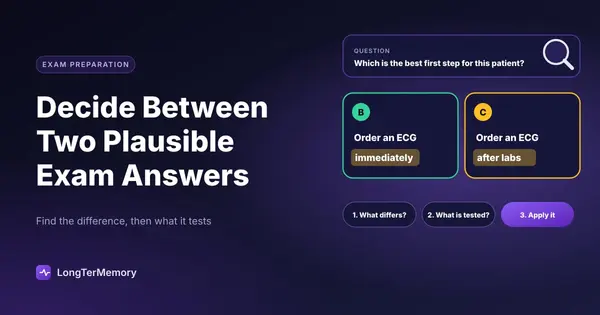
Step 1: Identify What’s Different Between the Two Options
Don’t keep reading both options as whole statements. Instead, identify the specific element where they differ. Often, two plausible options will be identical or nearly identical in their structure, with one word or phrase that differs between them.
That difference is the key. The question writer chose those specific two options precisely because one of them contains the correct version of that specific detail and the other contains a close but incorrect version.
So: what exactly is different? Isolate it. Write it down if you need to.
Step 2: Ask What the Question Is Really Testing
With the specific difference identified, now ask: what concept or distinction does this difference represent? If one option says “assess” and the other says “intervene,” the question is testing whether you know whether assessment or intervention is appropriate at this stage. If one option refers to short-term memory and the other to working memory, the question is testing whether you know the distinction between those two constructs.
When you name the underlying concept being tested, you can bring your knowledge to bear on that specific concept rather than continuing to re-read both full options looking for a feeling of rightness.
Step 3: Apply Your Knowledge to the Specific Distinction
Now that you know what’s being tested, apply what you know. Not everything you know about the general topic, just the specific distinction you identified.
If you know the distinction well, this step usually resolves the question. If you’re genuinely uncertain about the distinction, you’re now in a more intellectually honest position: you know exactly what you don’t know, which is more useful than a vague sense that both answers feel plausible.
Step 4: Use the Question Stem as Your Final Filter
Go back to the question stem with fresh eyes after doing the above reasoning. Specifically, look at:
- The action verb: are they asking you to identify, select, prioritize, recommend, implement, evaluate?
- Any qualifiers: FIRST, BEST, MOST APPROPRIATE, PRIMARY, MOST LIKELY
- Specific conditions: client characteristics, setting constraints, or stage of a process
Often, the question stem contains information that is more directly compatible with one of your two remaining options than the other. The specific verb or qualifier may map more naturally onto one option. A question asking for the “first” action is resolved by asking which option represents an earlier stage in a process.
How Certification and Licensing Exams Design Plausible Distractors
Understanding the mechanics of distractor design gives you a systematic advantage when you encounter one.
Exam writers use several consistent patterns when creating plausible distractors:
The Adjacent Concept Distractor
This is an incorrect option that uses a concept from the same domain as the correct answer, at the same level of specificity. If the correct answer is “proprioception,” the distractor might be “kinesthesia,” because these are related but distinct concepts that many candidates confuse.
How to beat it: These distractors are your clearest signal that the question is testing a specific conceptual distinction. You need to know the precise difference between those two concepts, not just that they’re both sensory systems or whatever the broader category is.
The Right Answer, Wrong Context Distractor
This is an option that would be correct in a different scenario. If the question is about a patient in the acute care setting, an option that’s appropriate for outpatient rehabilitation might be technically correct elsewhere but wrong here.
How to beat it: Always bring yourself back to the specific conditions of the scenario. Ask: is this option correct for this particular context, not just in general?
The Partially Correct Distractor
This option contains some correct information but misses a crucial component, applies a true principle incorrectly, or gets most of it right while getting one specific element wrong.
How to beat it: Read the full option and evaluate every component, not just the beginning. The error in a partially correct distractor is often at the end of the statement, where your attention tends to drift.
The Overly Specific or Overly General Distractor
One option is pitched at exactly the right level of generality for what the question is asking. The other is either too broad (encompassing more than the scenario requires) or too narrow (more specific than the evidence or scenario supports).
How to beat it: Match the level of specificity. If the question presents a clear, specific scenario, the correct answer will be specific to that scenario. If the question is asking about a general principle, an overly specific option is probably wrong.
The “Most Correct” Answer: Thinking Like an Examiner
This is the mindset shift that resolves more two-option dilemmas than any other single technique.
High-stakes exams in healthcare, law, education, finance, and similar fields are not looking for the correct answer in an absolute sense. They’re looking for the most defensible answer given the information provided in the question. These are often the same thing, but not always. The difference matters.
Thinking like an examiner means asking: if I were the question writer and I had to justify to a review committee why one of these options is the correct answer and the other is not, what would my argument be?
This typically comes down to a few consistent priorities that most professional licensing exams share.
Priority 1: The More Specific Answer Usually Wins
When one option is vague (“assess the patient”) and the other is specific (“assess the patient’s current functional status using a validated outcome measure”), the specific one is usually the intended correct answer. Specificity indicates deeper understanding.
Priority 2: The Process-Appropriate Answer Wins
Questions about sequences, stages, or processes are looking for process-appropriate answers. If you haven’t assessed yet, you don’t intervene. If you haven’t diagnosed yet, you don’t treat. If you haven’t established rapport, you don’t confront. These process logic principles resolve a lot of two-option questions.
Priority 3: The More Conservative Answer Often Wins in Clinical Fields
On clinical exams (medical, nursing, allied health, mental health), when in doubt, the more conservative, safe, and client-centered answer is generally the correct one. An answer that involves doing more without clear justification will usually lose to an answer that involves gathering more information, ensuring safety first, or prioritizing the client’s stated goals.
Priority 4: The Answer That Answers the Question Wins
This sounds obvious, but it’s often the resolution. One of your two options answers exactly what the question asked. The other answers a related but slightly different question. The option that directly responds to the specific question being asked is the correct one.
Avoiding the Two Classic Decision Traps
When you’re choosing between two plausible options, two specific traps catch a disproportionate number of candidates.
Trap 1: Changing Your Answer Without Reason
There is considerable research on answer changing in exam settings. The consistent finding: changing a considered first answer to a different answer, without a specific reason, reduces score more often than it improves it.
Your first instinct, when based on genuine knowledge, is usually correct. The second-guessing that leads to changes often comes from anxiety and overthinking rather than additional insight.
The exception: if you find a specific, articulable reason to change your answer during review (you realize you misread the question, you recall a specific piece of information you’d forgotten), then changing is justified. But “I’m no longer as confident in A, B feels a bit more right now” is not a reason. That’s anxiety talking.
Trap 2: The Longer Answer Is Usually Right Heuristic
A popular piece of advice among exam-taking lore: when in doubt, pick the longer answer because exam writers need more words to make a correct answer complete and defensible.
Sometimes this is true. But it’s not a reliable rule, and applying it as a tiebreaker makes you lazy about doing the actual reasoning. If you’re using answer length as a selection criterion, you’ve stopped thinking about the content and started using a shortcut that will fail you unpredictably.
Use length as a minor factor if everything else is genuinely equal. Don’t use it as a substitute for the reasoning process above.
Practice Methodology for Improving Two-Answer Decision-Making
This is a skill, and like all skills, it improves with targeted practice.
When you do practice tests, don’t just note whether you got each question right or wrong. For every question where you narrowed down to two options before choosing, make a note:
- What were the two options?
- What reasoning did you use to choose?
- If you got it wrong, what was the specific difference between the two options that you misjudged?
Over a few weeks of this tracking, you’ll start to see patterns. Maybe you consistently struggle with process-sequence questions, always picking the intervention before the assessment is complete. Maybe you consistently confuse two related concepts. Maybe you systematically undervalue specificity.
Identifying your pattern lets you practice directly on your specific weakness rather than just doing more general question practice.
LongTerMemory can support this kind of targeted practice by helping you build a question bank around your specific weak concepts, with the ability to upload your study materials and generate questions that test exactly the distinctions you’ve struggled with. When you know your weakness is in two similar concepts, having a system that drills you on those two concepts until you know them cold is far more efficient than generic question practice.
The Calm Decisiveness of the Prepared Test-Taker
There’s one final element worth naming. Top exam performers don’t agonize. They work through the reasoning process, they make a decision, and they move on. They don’t keep second-guessing themselves. They don’t spend five minutes on a single question.
This isn’t overconfidence. It’s a product of having a process they trust. When you have a clear method for resolving two-option dilemmas (identify the difference, name the concept being tested, apply knowledge to that concept, use the question stem as a filter), you can make decisions efficiently because you’ve done the right kind of thinking rather than just cycling through anxiety.
The more you practice this process under realistic exam conditions, the more automatic it becomes. And when it’s automatic, it takes 30 seconds instead of five minutes, leaving you more time for questions that genuinely require extended reasoning.
Two plausible answers is not a coin flip. It’s an invitation to think more precisely than the candidate in the next seat.