How to Read Exam Questions Correctly and Avoid Traps
Learn how to read exam questions correctly, spot common traps, and improve accuracy with slow-reading habits that top scorers use.
Table of Contents
- Common Question Stem Features That Trap Unprepared Candidates
- The Negative Qualifier
- The Qualitative Intensifier
- The Specific Qualifier That Changes Everything
- All of the Above / None of the Above
- Underlining and Annotating Question Text for Better Accuracy
- What to Mark and How
- The One-Sentence Summary Technique
- Slow Reading Habits That Improve Overall Exam Performance
- The Read-Twice Rule for Difficult Questions
- Practice Reading Slowly Under Timed Conditions
- Reading Strategy Adapted to Different Exam Formats
- Multiple Choice Exams
- Constructed Response and Essay Questions
- True/False Questions
- Building the Habit Before the Exam
Here’s a frustrating scenario that happens more often than most students want to admit: you walk out of an exam, go over the questions in your head, and realize you got one wrong, not because you didn’t know the answer, but because you misread the question. You saw “which is NOT” as “which is.” You answered what you thought was being asked rather than what was actually being asked.
It stings in a particular way because it feels like it shouldn’t happen. But it does happen, to smart, well-prepared candidates, more than content gaps do.
Reading exam questions correctly is a skill, and like most skills, it can be learned, practiced, and consistently applied. This post is about how to do that.
Common Question Stem Features That Trap Unprepared Candidates
The people who write professional licensing exams, standardized tests, and university assessments aren’t trying to trick you for the sake of it. But they are trying to distinguish between candidates who have surface familiarity with content and those who genuinely understand it. The way they do that is often through careful question construction that punishes fast, careless readers.
Here are the most common traps and what they actually look like.
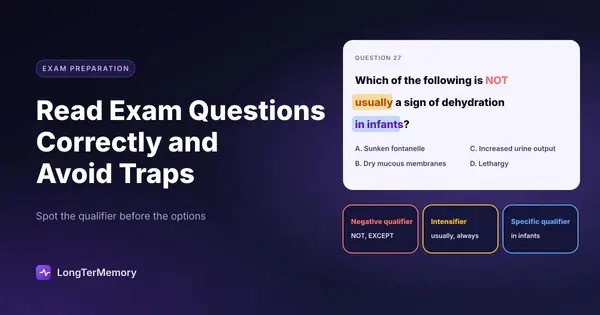
The Negative Qualifier
“Which of the following is NOT an example of…” “Which answer LEAST supports…” “Which option would be CONTRAINDICATED in…”
These are among the most frequently missed question types. Your brain is primed to look for the right answer, the thing that fits, the thing that belongs. A negative qualifier flips the logic: you need the one that doesn’t fit. And if you’re moving quickly through a long exam, your eye can slide right past the NOT and you’ll answer the wrong question entirely.
The fix: Make it a habit to underline or mentally highlight negative qualifiers every single time. Don’t just register them passively. Actively mark them in your mind before you look at the answer choices.
The Qualitative Intensifier
“Which answer BEST describes…” “The MOST appropriate intervention is…” “The FIRST step should be…”
These look like normal multiple-choice questions, but they’re not. In a “best” or “most” question, multiple answer choices might be technically correct. They’re not looking for something true. They’re looking for the most correct thing, the most appropriate, the most prioritized.
This is where candidates who know the content still get questions wrong, because they pick an answer that’s correct but not optimal. They see a true statement and choose it without checking whether another option is more true, more appropriate, or more directly responsive to the specific scenario.
The fix: When you see “best,” “most,” or “first,” don’t stop when you find a correct answer. Read all four options before choosing. Ask yourself: is this the most correct of these four options, or just one of the correct options?
The Specific Qualifier That Changes Everything
“A 45-year-old with no previous exercise history…” “In a resource-limited setting…” “Given that the patient has recently been discharged…”
These scenario details aren’t decoration. They’re there because the correct answer changes depending on them. A test-writing team has included specific client characteristics, contextual constraints, or clinical details precisely because they rule out or change the priority of certain answer options.
Fast readers skip these details and answer from general principles. Careful readers incorporate them into their reasoning.
The fix: Before you look at the answer choices, pause and ask: what are the specific conditions in this scenario that matter? What do these details tell me about what the question is really testing?
All of the Above / None of the Above
These options deserve their own category because they require a completely different reading strategy. For “all of the above,” you need to evaluate each option independently before concluding. If you find one option that’s wrong, “all of the above” is wrong. For “none of the above,” you need to be confident that every listed option is incorrect, which requires reading and evaluating each one separately.
The trap: candidates choose “all of the above” because the first two options look right and they assume the rest follow. Or they choose “none of the above” because they’re uncertain and it feels safer than committing to a specific answer.
The fix: Treat each component of an “all of the above” question as an individual true/false statement. Evaluate them independently before looking at what your conclusion means for the overall answer.
Underlining and Annotating Question Text for Better Accuracy
This isn’t about fancy technique. It’s about slowing down and making the reading active.
Active annotation of exam questions serves two purposes. First, it forces a slower, more deliberate reading pace. Second, it creates a visual record of what you understood the question to be asking, which helps you catch yourself if you start answering the wrong question.
What to Mark and How
You don’t need a complex system. A simple approach that works:
- Underline the action verb: “identify,” “evaluate,” “select,” “prioritize,” “calculate,” “explain”
- Circle qualifiers: NOT, BEST, MOST, FIRST, LEAST, EXCEPT, ALWAYS, NEVER
- Box the specific conditions: the patient characteristics, the setting, the constraints that define this particular scenario
- Put a question mark next to information you’re not sure how to use: don’t ignore unfamiliar details, flag them
If you’re working on a paper exam, use a pencil to mark the question. If you’re on a computer-based exam, many platforms have a highlight or markup function. If yours doesn’t, read more slowly and summarize the question in your own words before looking at the answers.
The One-Sentence Summary Technique
Before reading the answer choices, write or mentally form a one-sentence summary of what the question is asking. “This question is asking me to identify the most appropriate first step in assessment for this specific patient profile.”
If you can summarize the question clearly in one sentence, you understand it. If your summary is vague, “it’s asking about what to do,” you don’t have a clear enough grip on what they want, and you should re-read the question stem before proceeding to the options.
This technique takes a few extra seconds. Those seconds are nearly always worth it.
Slow Reading Habits That Improve Overall Exam Performance
We live in a world that rewards skimming. Social media, news feeds, email inboxes, all of them have trained you to extract meaning from content at speed, filtering for what’s important and moving on. This is a useful everyday skill. It is actively harmful in a high-stakes exam.
The single most impactful thing most candidates can do for exam accuracy is slow down on the first read of each question.
This sounds obvious and it is, but it’s almost impossible to actually do without deliberate practice, because the anxiety of a timed exam creates natural pressure to move fast. You feel like you don’t have time to read carefully. The irony is that fast-reading errors cost you far more time than careful first reads would.
Here’s the math: reading a question carefully takes maybe 30 extra seconds. Going back to re-read a question you answered too quickly, reconsidering your answer, changing it, and moving on takes two to three minutes. And sometimes you don’t go back, you just get it wrong. The slow reading approach is both more accurate and, in many cases, more time-efficient.
The Read-Twice Rule for Difficult Questions
For questions that feel ambiguous or complex, read twice before looking at the answers.
First read: what is this scenario? Who is the patient, what is the context, what is happening?
Second read: what is the actual question being asked? What do I need to provide, and what conditions constrain my answer?
This split approach keeps you from conflating the scenario with the question. In complex clinical vignettes especially, it’s easy to get absorbed in the case details and then answer based on what the scenario made you think about rather than what the question specifically asked.
Practice Reading Slowly Under Timed Conditions
Here’s the catch: you can’t develop this habit just by knowing about it intellectually. You have to practice it under conditions that mimic exam pressure, because the anxiety of timed testing is exactly what causes the sloppy fast reading in the first place.
When you work through practice questions as part of your exam prep, treat each question stem as something to be read carefully, not just scanned. Set a minimum time per question and don’t let yourself go below it. If the exam gives you 90 seconds per question on average, don’t be finishing in 30 seconds and assuming that’s evidence of mastery. It might be evidence of careless reading.
Tracking your error patterns is a powerful tool here. When you review practice questions you got wrong, ask each time: did I miss this because I didn’t know the content, or because I misread the question? If misreading is a consistent pattern, the fix isn’t more content review. It’s slower, more deliberate question reading.
Tools like LongTerMemory can help you build a rigorous practice system by generating exam-style questions from your study materials, tracking which question types you tend to miss, and scheduling review of your weak areas. The pattern-recognition piece, seeing that you consistently miss negative qualifier questions or “most appropriate” questions, can help you target your specific reading weaknesses.
Reading Strategy Adapted to Different Exam Formats
The core principles above apply across exam types, but the specific application varies.
Multiple Choice Exams
Cover the answer choices while reading the question stem. This forces you to understand the question on its own terms before the options influence your interpretation. Then form your own answer before looking at the choices. This approach dramatically reduces the number of times you’re “led” toward a plausible-sounding but wrong option.
Constructed Response and Essay Questions
Read the instruction verb first, before the topic. “Analyze,” “compare,” “evaluate,” “argue,” and “describe” require different types of responses. Answering an “analyze” question with a description is a common mistake that costs marks regardless of how much content knowledge you have.
Then read the full question twice before planning your answer. Note what specific aspects of the topic are being asked about, and whether there are multiple parts to the question that each require separate attention.
True/False Questions
These are deceptively difficult. Universal qualifiers like “always,” “never,” “all,” and “none” often signal false statements, because almost nothing in complex domains is always or never true. Specific qualifiers like “usually,” “often,” “in most cases,” and “generally” often signal true statements. But don’t apply these heuristics mechanically, use them as prompts to think carefully rather than substitutes for thinking.
Building the Habit Before the Exam
The most important thing this post can leave you with is simple: the time to develop careful reading habits is during your study sessions, not during the actual exam.
Every practice question you do is an opportunity to practice reading carefully. Every time you mark qualifiers, summarize the question before looking at answers, and review why you got something wrong, you’re building a habit that will transfer to the real exam.
Don’t just do practice questions to practice content. Do them to practice reading exam questions. Treat the reading as the skill being practiced, not just a gateway to the content.
The students who read exam questions carefully under pressure have almost always practiced doing exactly that, repeatedly, until it became the natural way they approach a question. It can become your natural approach too. It just takes deliberate repetition.
Start with your next practice set. Read every question twice. Mark every qualifier. Check your summary against what the question actually asked before you choose an answer. It will feel slower. And it will produce better results.