How to Use Exam Calendars to Plan Backwards
Backward planning from your exam date is the most effective way to organize study time. Here's how to build a calendar that actually works.
Table of Contents
- Why Forward Planning Fails (And What Backward Planning Fixes)
- The Planning Fallacy
- The Compression Trap
- What Backward Planning Gives You
- Starting With the Exam Date and Working Backward to Today
- Step 1: Anchor Your Calendar on the Exam Date
- Step 2: Define the Phases of Preparation
- Step 3: Map Content to Phases
- Step 4: Assign Daily Study Blocks
- Assigning Milestones, Phase Transitions, and Practice Test Dates
- What Good Milestones Look Like
- Practice Test Date Strategy
- Phase Transition Checkpoints
- Building Contingency Time Into Backward-Planned Exam Calendars
- The 20% Buffer Rule
- Weekly Check-Ins
- What to Do When You Fall Behind
- The Mindset That Makes Backward Planning Work
Most study plans fail before they start. Not because the person writing them is disorganized or unmotivated, but because they’re built in the wrong direction. They start with today: “I’ll study Chapter 1 on Monday, Chapter 2 on Tuesday…” and hope it all adds up to readiness by exam day.
It almost never does. Material expands to fill the time available. The chapters near the end of the guide get rushed. Practice exams get squeezed into the final two days. Panic sets in around week three.
Backward planning solves this by starting at the exam date and working toward today. Instead of hoping you arrive at readiness, you design readiness first and then build the path backward. It’s the planning approach used by military planners, project managers, and elite athletes, and it works for exam preparation for exactly the same reasons: it forces you to be honest about time and to make deliberate choices about what gets prioritized.
This guide will show you exactly how to do it.
Why Forward Planning Fails (And What Backward Planning Fixes)
Before we build your calendar, it’s worth understanding why the alternative keeps producing bad results.
The Planning Fallacy
Cognitive psychologists Daniel Kahneman and Amos Tversky identified what they called the planning fallacy: the systematic tendency to underestimate how long tasks will take, even when we have experience with similar tasks. We assume we’ll be faster than we are, that distractions won’t happen, that a chapter that took four hours last time will take two this time.
The result: study schedules that look ambitious, feel achievable on the day you write them, and become increasingly fiction as real life intervenes.
Forward planning is especially vulnerable to the planning fallacy because it’s built entirely on optimistic projections from your current position. There’s no structural pressure to be realistic about total available time.
Backward planning forces the reckoning upfront. When you count backward from your exam date and see that you have exactly 63 days, you can’t pretend you have 90. The constraint is visible from the first moment of planning.
The Compression Trap
In forward planning, difficult content gets squeezed toward the end. Why? Because early in your study period, you’re fresh and optimistic. You spend appropriate time on the first few topics. As the calendar progresses, you realize you’re behind schedule and start compressing. The hardest material, the stuff you haven’t encountered yet, gets the least time, precisely when it should get the most.
Backward planning assigns time to content before you start, based on how much time each topic actually needs, not on whatever is left over after everything else.
What Backward Planning Gives You
- Visibility: You can see, from day one, whether your timeline is realistic.
- Priority clarity: When time is limited, backward planning forces explicit choices about what to cut.
- Contingency space: You can deliberately build buffer time rather than hoping nothing goes wrong.
- Confidence: Knowing you’ve planned carefully reduces the low-level anxiety that unfocused preparation creates.
Starting With the Exam Date and Working Backward to Today
Here’s the actual process.
Step 1: Anchor Your Calendar on the Exam Date
Write down your exam date. Not vaguely, the specific date. This is your anchor.
Now count backward to today and write down the total number of days available. Don’t round up or be optimistic. If it’s 73 days, it’s 73 days.
Next, identify days where studying is genuinely not possible: a family event, a work deadline, a trip. Mark those as unavailable. Now count again. If it’s 73 calendar days but 12 are unavailable, you have 61 study days.
This number is your real planning constraint. Everything else flows from it.
Step 2: Define the Phases of Preparation
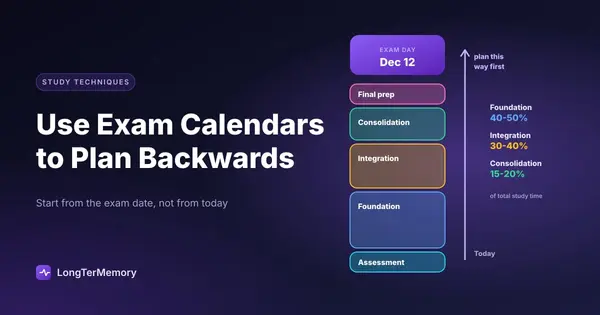
Almost every successful exam preparation follows a similar phase structure, regardless of the exam type:
| Phase | Purpose | Typical Duration |
|---|---|---|
| Assessment | Understand the exam, identify gaps | 3-7 days |
| Foundation | Build core content knowledge | 40-50% of total time |
| Integration | Connect concepts, work problems, practice | 30-40% of total time |
| Consolidation | Review weak areas, full practice exams | 15-20% of total time |
| Final prep | Light review, mental readiness | 5-7 days |
Adapt these proportions to your situation. If you’re retaking an exam after a failed attempt, your assessment phase is shorter (you already know your gaps) and your integration phase should be longer. If you’re an expert in several domains and weak in one, your foundation phase can be compressed for the strong areas and extended for the weak one.
Map these phases backward from your exam date. Your final prep phase occupies the last 5 to 7 days. Your consolidation phase goes in the block before that. And so on back to today.
Step 3: Map Content to Phases
Now take your exam content outline (every major exam publishes this, find it and download it if you haven’t) and map each topic or domain to the appropriate phase.
Foundation-phase content: core concepts that everything else builds on. These go early. Integration-phase content: practice problems, case studies, cross-topic questions. These come after you have the foundation. Consolidation content: your weakest areas plus full-length practice exams.
Within each phase, assign topics to specific weeks, not days yet. Working at the week level first prevents you from over-optimizing individual days before you can see whether the total allocation is reasonable.
A simple allocation table:
| Week | Phase | Primary Focus | Secondary Focus |
|---|---|---|---|
| Week 1-2 | Foundation | Domain A | Start Domain B |
| Week 3-4 | Foundation | Domain B + C | Review Domain A |
| Week 5-6 | Integration | Practice questions all domains | Weak domain review |
| Week 7 | Consolidation | Full practice exams | Weak areas |
| Week 8 | Final prep | Light review | Mental preparation |
This is a rough template. Your version will reflect your specific exam’s structure and your personal gap analysis.
Step 4: Assign Daily Study Blocks
With your weekly allocation in hand, work down to the day level.
Identify how many hours per day you can realistically study. Not how many you’d like to study, not how many you studied during a particularly motivated week in the past. The realistic, sustainable number you can maintain for the full duration.
For most working professionals or students with other responsibilities, this is 1 to 2 hours per weekday and 3 to 4 hours on weekend days. Be conservative. Consistent 1.5-hour sessions sustained across 10 weeks produce far better results than 4-hour sessions for 3 weeks followed by burnout.
Assign specific topics to each day based on your weekly allocation. Leave each Friday or one day per week as a review day: revisit what you covered that week rather than starting new material.
Assigning Milestones, Phase Transitions, and Practice Test Dates
A study calendar without milestones is just a list of tasks. Milestones are checkpoints that tell you whether you’re on track, and they’re the structural feature that makes backward planning genuinely powerful.
What Good Milestones Look Like
A milestone isn’t “finish Chapter 5.” It’s a measurable outcome that tells you something meaningful about your readiness.
Examples of effective milestones:
- “Score 70% or above on a domain-specific practice question set for Domain A by end of Week 2”
- “Complete one full-length practice exam by Week 6, review all wrong answers within 2 days”
- “Demonstrate ability to explain the three main frameworks for [topic] without notes by Week 4”
- “Finish content review for all exam domains by end of Week 6”
These milestones serve as early warning systems. If you reach Week 4 and can’t explain the frameworks without notes, that tells you something needs to change in Weeks 5 and 6. You’ve discovered the problem with enough time to address it.
Without milestones, you discover the problem the week before the exam.
Practice Test Date Strategy
Practice exams deserve specific calendar dates, not just a vague “sometime in the last few weeks.” Here’s why: practice exams are both diagnostic tools and performance training.
As diagnostic tools, they reveal gaps you didn’t know you had. But that’s only useful if you have enough remaining prep time to address those gaps. A practice exam two days before the real thing is too late to be diagnostic.
As performance training, they build the stamina and exam-day routines you need. Taking a full-length exam under timed conditions is physiologically and psychologically different from studying, even intense studying. You need multiple reps of this experience before the real thing.
Recommended practice exam schedule:
For an 8-week plan:
- First practice exam: End of Week 4 (roughly halfway through). This is your baseline.
- Second practice exam: End of Week 6. This measures your progress after integration work.
- Third practice exam: Week 7. Final diagnostic before consolidation ends.
- No practice exam in the final week. Mental consolidation only.
Compare your scores across the sequence. Are you improving? Stagnating? Declining in certain domains? Each result should shape the remaining prep time.
Phase Transition Checkpoints
At the transition between each phase, conduct a brief honest review:
Foundation to Integration:
- Have I covered all the core content?
- Are there domains I still don’t feel competent in at a basic level?
- If so, do I extend the foundation phase (and compress integration) or proceed and address those gaps in integration?
Integration to Consolidation:
- What are my lowest-scoring domains on practice exams?
- Where am I making the most conceptual errors vs. careless errors?
- What specific content or skills do I need to prioritize in consolidation?
Consolidation to Final Prep:
- Am I within a realistic passing range on practice exams?
- Have my weakest areas improved sufficiently?
- Am I confident in my exam-day routine and timing?
These checkpoints are moments to adjust your plan based on evidence rather than guessing. A backward-planned calendar is a living document, not a rigid contract. What matters is arriving at exam day ready, not following the original plan perfectly.
Building Contingency Time Into Backward-Planned Exam Calendars
This is where most people’s study plans fall apart. They build their calendar to use every available hour, and then life happens.
Work runs over. A family member gets sick. A topic takes three times longer to understand than planned. The first practice exam reveals three domains you thought you understood but clearly don’t.
Without contingency time, any one of these events breaks the entire plan.
The 20% Buffer Rule
When you allocate content to phases, target completing your planned content in 80% of the available time. The remaining 20% is contingency.
For an 8-week plan, this means you’re planning 6.4 weeks of content review, leaving roughly 1.5 weeks of buffer distributed across the plan.
This doesn’t mean the buffer days are empty. They’re designated for:
- Reviewing anything that took longer than planned
- Revisiting material you covered but don’t feel confident about
- Extended practice question sets in weak areas
- Rest, if everything is on track
If you reach a buffer day and everything is on schedule, use it for extra practice or rest. If you’re behind, it’s your catch-up mechanism. The buffer exists specifically to prevent a bad week from derailing the entire plan.
Weekly Check-Ins
Schedule a 15-minute weekly review of your own progress. Look at your calendar and honestly answer:
- What was I supposed to cover this week?
- What did I actually cover?
- What’s my assessment of how well I understand what I studied?
- Does my remaining schedule need to be adjusted?
This kind of regular, small adjustment is far less disruptive than a major crisis recalibration in week seven. Tiny course corrections maintained weekly add up to arriving on track.
What to Do When You Fall Behind
Everyone falls behind at some point. The question is how you respond.
What doesn’t work: Trying to cover missed content at double speed. When you rush material you haven’t had time to process, you create shallow, unreliable knowledge that fails under exam pressure.
What works:
- Identify what specifically got skipped or skimmed.
- Assess whether it’s high-yield (prioritize catching up) or lower-yield (accept the gap and move on).
- Cut something else from the plan to make space. Be deliberate about what you’re cutting rather than trying to compress everything proportionally.
- Focus the next practice exam analysis on whether the gap is causing real scoring problems.
Being willing to make hard choices about content priority is the sign of a mature exam planner. You cannot study everything perfectly. The question is always: what do I need to know most?
Once your milestones are set, use our guide to the study schedule to decide how to fill each week with spaced, focused sessions.
The Mindset That Makes Backward Planning Work
The practical mechanics of backward planning are straightforward. The harder part is the mindset shift.
Backward planning requires honesty. When you count backward from your exam date and map content to the available days, you may discover that your timeline is genuinely tight. That’s useful information. A study plan that works on paper but ignores reality will fail you when it matters. A plan that’s honest about constraints lets you make real decisions.
Backward planning requires commitment. The calendar only works if you actually follow it. Not perfectly, every plan gets adjusted, but consistently enough that your daily study sessions are guided by the structure you built, not improvised based on mood.
Backward planning reduces anxiety. Many people feel vaguely anxious throughout their exam prep because they’re not sure whether they’re studying the right things, spending enough time, or going to be ready. A well-constructed backward calendar replaces that vague anxiety with clarity. You know exactly what you’re supposed to be doing today, why you’re doing it, and how it connects to readiness on exam day.
That clarity is one of the most underrated benefits of good exam planning. It’s the difference between studying with focus and studying while worrying about whether you’re studying with focus.
Build the calendar now, while the exam feels far away and planning decisions are still low-pressure. Future you, sitting down to study two weeks before exam day with a clear roadmap in hand, will be genuinely grateful.
LongTerMemory can support your backward-planned schedule by automatically generating daily flashcard review sessions from your study materials, so your spaced repetition practice stays in sync with your content calendar. When your calendar says “Foundation Phase, Domain A,” your daily review queue reflects that, keeping retention high across everything you’ve covered so far.
The exam is fixed. Your preparation can be designed. Start designing.