
How to Study for the FINRA SIE Exam
Everything you need to pass the FINRA Securities Industry Essentials exam: what it tests, highest-yield topics, and the best practice question strategy.
Table of Contents
- What the SIE Exam Tests
- High-Yield Topics to Prioritize
- Securities Products
- Trading and Account Rules
- Practice Question Strategy
- Start With Official FINRA Practice Questions
- Use a Third-Party Question Bank
- Topic Drills First, Then Mixed Practice
- Read Every Explanation
- Track Your Weak Areas Systematically
- Understanding the Passing Score
- Recommended Study Timeline
- Weeks 1 to 2: Content Foundation
- Weeks 3 to 4: Complete Remaining Content Areas
- Weeks 5 to 6 (or Week 4 for a Faster Prep): Practice Exam Focus
- Final Days
- How to Study Each Product Type Efficiently
- Common SIE Mistakes to Avoid
- After the SIE: The Top-Off Exams
- The Bottom Line
If you’re entering the securities industry, the FINRA Securities Industry Essentials exam is your starting point. Before you can get licensed as a broker, adviser, or registered representative, the SIE is the gateway. It’s a co-requisite for most of FINRA’s top-off exams (the Series 6, 7, 63, 65, and others), and passing it demonstrates foundational knowledge of the securities industry to employers and regulators alike.
The good news is that the SIE is designed to be accessible. It covers broad industry fundamentals rather than the deep specialized knowledge of the top-off exams. With the right preparation approach, most candidates can pass it in 4 to 8 weeks of focused study. But underestimating it is a mistake plenty of candidates regret.
This guide covers exactly what the SIE tests, which topics deserve your most focused attention, how to use practice questions effectively, and what the passing score requirement actually means for your strategy.
What the SIE Exam Tests
The SIE is a 75-question exam (85 with 10 unscored pilot questions) with a 105-minute time limit. FINRA administers it through Prometric testing centers. You must score at least 70% on the scored questions to pass.
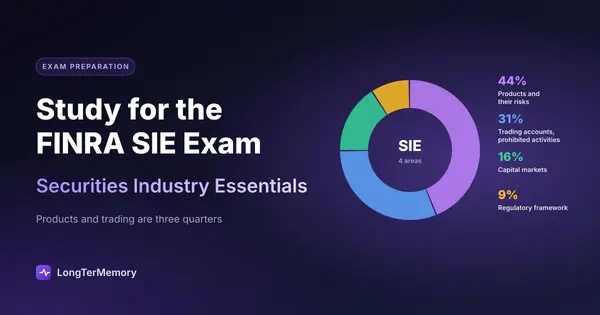
The content is organized into four major knowledge areas:
| Knowledge Area | Approximate Weight |
|---|---|
| Knowledge of Capital Markets | 16% |
| Understanding Products and Their Risks | 44% |
| Understanding Trading, Customer Accounts and Prohibited Activities | 31% |
| Overview of Regulatory Framework | 9% |
The Products and Their Risks section is the largest and most important. It covers equities, debt securities, options, investment companies (mutual funds, ETFs, closed-end funds), variable products, and alternative investments. If you understand these products deeply, including their structures, risks, returns, and regulatory treatment, you’re well positioned to pass.
The Trading and Accounts section covers order types, market structure, customer account types (joint, custodial, margin), and prohibited practices like insider trading, market manipulation, and churning. This section has a lot of concrete, testable rules that lend themselves well to flashcard-based review.
The Capital Markets section covers the primary vs. secondary market distinction, the role of market participants (broker-dealers, investment advisers, underwriters), and the basics of how securities are issued and traded.
The Regulatory Framework section is the smallest but requires understanding the roles of SEC, FINRA, SIPC, and MSRB, as well as basic investor protection rules.
High-Yield Topics to Prioritize
Given the weight distribution, here are the content areas where your study effort delivers the most return.
Securities Products
The SIE tests your ability to identify characteristics, risks, and regulatory treatment across a full range of securities products. For each of the following, you should know: what it is, how it works, its primary risks, and how it’s regulated.
Equities: Common vs. preferred stock, dividends, rights and warrants, ADRs, stock splits. Know the difference between cumulative and non-cumulative preferred. Know how dividends work for different stock types.
Debt securities: Corporate bonds, government securities (T-bills, T-notes, T-bonds, TIPS, agency bonds), municipal bonds (GO vs. revenue bonds, tax treatment), and zero-coupon bonds. The inverse relationship between bond prices and interest rates is tested repeatedly, so understand it deeply, not just as a formula but as a concept.
Options: Basic call and put mechanics, the four options positions (long call, short call, long put, short put), basic profit/loss scenarios, and key terminology (strike price, premium, exercise, expiration). Options questions are consistently among the most difficult on the SIE.
Investment companies: Mutual funds (open-end vs. closed-end), ETFs, UITs, and money market funds. Understand how NAV is calculated, how shares are bought and sold in each type, and the regulatory requirements under the Investment Company Act of 1940.
Variable products: Variable annuities and variable life insurance. Know the accumulation and payout phases of annuities, the separate account structure, and the rider options.
Trading and Account Rules
This section has a lot of specific, testable rules. Flashcards work extremely well here.
Order types: Market orders, limit orders, stop orders, stop-limit orders. Know how each type is triggered and executed, and what happens in a fast market.
Short selling: How it works, its risks, and regulatory requirements.
Account types: Joint accounts (tenants in common vs. joint tenants with right of survivorship), custodial accounts (UGMA/UTMA), margin accounts (margin requirements, Regulation T), and retirement accounts (IRA types and contribution rules).
Prohibited activities: This is heavily tested. Know the definitions and distinctions between insider trading, front running, churning, marking the close, painting the tape, and wash trading. These questions reward precise knowledge of what each term means.
Practice Question Strategy
The SIE is a knowledge test with a strong emphasis on practical application. You need to understand concepts well enough to apply them to scenario-based questions, not just recall definitions.
Start With Official FINRA Practice Questions
FINRA provides sample questions on its website. Work through these early in your prep to understand the question style, the level of difficulty, and which content areas you need to develop further.
Use a Third-Party Question Bank
The most commonly used SIE question banks are:
- Pass Perfect
- ExamFX
- Kaplan Financial
- Securities Institute of America
All of them provide hundreds of practice questions organized by topic area and difficulty. Choose one and use it consistently. Jumping between question banks isn’t as valuable as going deep with a single high-quality source.
Topic Drills First, Then Mixed Practice
Early in your prep, drill questions by content area. Once you’ve covered all major topics, switch to mixed practice that simulates real exam conditions. The SIE exam is not organized by topic, so practicing in mixed mode is important for building the kind of rapid categorization that the exam requires.
Read Every Explanation
The value of practice questions isn’t just in getting answers correct. It’s in the explanations that follow. The explanation for a wrong answer shows you exactly what distinguishes the correct answer from the plausible-looking alternatives. Read these carefully and flag any concept you didn’t fully understand.
Track Your Weak Areas Systematically
Most practice platforms organize your performance by topic area. Check your accuracy percentages by content domain after every full practice session. Any domain where you’re below 70% needs targeted review before exam day.
Understanding the Passing Score
A passing score on the SIE is 70% of the scored questions (not counting the 10 pilot questions). With 75 scored questions, you need to answer at least 53 correctly to pass.
What this means strategically is that you don’t need to master every topic. If you’re strong in the high-weight sections (Products and Risks, Trading and Accounts), you can pass the exam even with imperfect performance in the smaller sections. This isn’t a reason to skip the lighter sections entirely, since every question counts, but it does help with prioritization.
Practical score targets for practice exams:
| Practice Score | What It Means |
|---|---|
| Below 65% | Significant additional study required across multiple content areas |
| 65 to 72% | Marginal range, target specific weak areas before scheduling |
| Above 72% | Likely ready to sit the exam; continue maintaining through regular review |
Don’t schedule the real exam until you’re consistently scoring above 72% on full practice exams. One strong practice result isn’t enough to be confident. You want consistent performance across multiple attempts.
Recommended Study Timeline
For most candidates working full time, 4 to 8 weeks of consistent study is sufficient to pass the SIE. Here’s a basic structure:
Weeks 1 to 2: Content Foundation
Focus on the Products and Their Risks section since it’s the largest content area and requires the most depth. Read through a structured prep guide (Kaplan or ExamFX have good ones), take notes, and create flashcards for key product characteristics, risks, and regulatory distinctions.
Weeks 3 to 4: Complete Remaining Content Areas
Work through Trading and Accounts, Capital Markets, and Regulatory Framework. These sections have more rule-based content that responds well to flashcard review and Q&A practice.
Weeks 5 to 6 (or Week 4 for a Faster Prep): Practice Exam Focus
Shift the majority of your study time to practice questions and full mock exams. Identify your weakest domains and dedicate focused sessions to those areas. Run at least 2 to 3 full-length timed practice exams before your actual exam date.
Final Days
Review your most frequently missed question types, do a final pass through your flashcards, and avoid cramming new content the day before the exam. Sleep is your most valuable asset in the final 48 hours.
How to Study Each Product Type Efficiently
Products are the heart of the SIE, and most candidates find this section the most time-consuming. Here’s how to approach studying each product type effectively.
For equities and bonds: Build comparison flashcards. Put two product types on opposite sides (common vs. preferred, GO bond vs. revenue bond) and practice articulating the differences. The SIE frequently tests your ability to distinguish between similar instruments.
For options: Use scenario-based practice from day one. “A long call with a $50 strike and $3 premium, what is the breakeven and maximum loss?” Work dozens of these until the calculations feel automatic. Options cannot be mastered through definitions alone.
For mutual funds and ETFs: Understand the structural differences deeply. How are shares bought and sold in each? What is NAV and when is it calculated? How do expenses work? These operational details are frequently tested.
For variable products: The insurance wrapper matters a lot. Variable annuities combine features of insurance and investment products, which means they have unique regulatory treatment. Know that the separate account is how the investment component works, and understand the regulatory requirements under both securities law and insurance law.
Common SIE Mistakes to Avoid
Memorizing definitions without understanding concepts. The SIE tests application, not recall. If you only know that a put option gives the buyer the right to sell, but you can’t work through a profit/loss scenario, you’ll struggle on exam questions.
Ignoring options because they feel complicated. Options questions appear regularly and tend to be harder than average. Skipping them in your prep means leaving points on the table. Spend disproportionate time on options relative to their question count.
Not using timed practice exams. Many candidates do plenty of topic-by-topic practice but never simulate the actual exam experience. Running a full 75-question timed exam before your scheduled test date is essential for pace management and mental preparation.
Studying inconsistently. The SIE rewards cumulative, consistent study far more than cramming. If you study 30 minutes per day for 6 weeks, you’ll retain far more than if you study 8 hours per day for 5 days. Build a daily habit, even a modest one.
After the SIE: The Top-Off Exams
Passing the SIE is the beginning, not the end. To get licensed and work in a registered capacity, you’ll need to pass one or more FINRA top-off exams in addition to the SIE:
- Series 6: Limited representative license for mutual funds and variable products
- Series 7: General securities representative license (the broadest)
- Series 63: Uniform securities agent state law exam (required in most states)
- Series 65: Investment adviser representative license
The knowledge you build for the SIE directly supports your top-off exam preparation. The products, trading rules, and regulatory framework covered on the SIE are prerequisites for the more specialized content in the Series 7 and Series 65.
If you want to retain what you learned for the SIE while you prepare for your top-off exam, using a spaced repetition system to maintain the foundational knowledge makes a significant difference. Tools like LongTerMemory can help you convert your SIE notes and study materials into an active recall system that keeps the fundamentals sharp while you move to more advanced licensing content.
The Bottom Line
The SIE is a real exam that rewards genuine understanding of securities industry fundamentals. The candidates who pass it on the first attempt share a few things in common: they learn the products deeply (not just surface definitions), they understand the key rules precisely, and they do substantial practice question volume before sitting the real exam.
Give it the preparation it deserves. Understand the products. Know the rules. Practice relentlessly. And you’ll walk into that Prometric testing center ready to earn your foundational securities credential.
The financial industry has a steep learning curve. The SIE is your first step up that curve, and getting it right sets you up for everything that follows.