How to Use Grammarly to Improve Academic Writing
Learn how to use Grammarly as a learning tool, not just a fixer, to genuinely improve your academic writing skills and essay scores.
Table of Contents
- What Grammarly Actually Does (And Doesn't Do)
- Setting Up Grammarly for Academic Work
- The Right Way to Use Grammarly: Learn From Suggestions, Don't Just Accept Them
- Using Grammarly for Timed Essay Practice
- Learning From Grammarly Suggestions Rather Than Accepting Them
- Avoiding the Dependency Trap
- Grammarly's Plagiarism Checker: A Note
- Developing Your Own Writing Skills Alongside the Tool
- Practical Summary
If you’ve ever pasted an essay draft into Grammarly and clicked “accept all suggestions,” you’ve experienced one of the most efficient ways to miss the entire point of the tool.
Grammarly can genuinely improve your academic writing. But only if you use it as a learning device rather than a correction machine. The difference matters more than most students realize.
When you accept all suggestions without reading them, you’re outsourcing your writing to an algorithm and submitting the result as your own thinking. You don’t learn anything, you don’t improve as a writer, and you often end up with text that’s mechanically correct but somehow flatter and less expressive than what you started with. Grammarly’s tone suggestions in particular can push writing toward generic, corporate-sounding neutrality if you let them.
Used thoughtfully, though, Grammarly is a genuinely useful tutor for academic writing, one that’s available at 2 a.m. before a deadline, doesn’t get tired of your questions, and can identify patterns in your errors that a busy professor simply doesn’t have time to point out.
This guide is about using it the right way.
What Grammarly Actually Does (And Doesn’t Do)
Let’s start with an honest picture of what you’re working with.
What Grammarly is genuinely good at:
- Catching typos, misspellings, and mechanical errors
- Flagging grammatical issues like subject-verb disagreement, comma splices, and dangling modifiers
- Identifying passive voice overuse
- Catching wordiness and unnecessarily complex sentences
- Spotting missing articles or preposition errors (especially helpful for non-native English speakers)
- Basic punctuation issues like comma placement and apostrophes
What Grammarly struggles with:
- Understanding the argument your essay is making
- Evaluating whether your evidence actually supports your claim
- Assessing the logical structure of your paragraphs
- Catching discipline-specific errors (a statistics paper and a history essay follow different conventions)
- Understanding intentional stylistic choices
This means Grammarly is excellent at the sentence level and largely useless at the essay level. It can tell you that a sentence is grammatically weak but not that your third paragraph doesn’t actually advance your thesis.
Keep this in mind throughout: Grammarly is a sentence-level writing coach, not an essay evaluator. Use it for what it does well, and don’t expect it to tell you whether your argument is convincing.
Setting Up Grammarly for Academic Work
Before you start using Grammarly on any piece of academic writing, spend thirty seconds on setup. The default settings are calibrated for general business writing, which differs meaningfully from academic writing.
Go to the goals panel (the target icon in Grammarly’s toolbar) and set:
- Domain: Academic
- Tone: Formal
- Intent: Inform (for expository writing) or Persuade (for argumentative essays)
- Audience: Expert (if writing for an academic audience)
These settings change which suggestions Grammarly prioritizes. Without them, you may get suggestions to replace technical vocabulary with simpler alternatives, which is exactly wrong for academic writing, or to make formal phrasing more casual, which could hurt your grade.
For non-native English speakers, Grammarly Premium’s dialect setting is also worth configuring. American English and British English have different conventions around punctuation (the Oxford comma, quotation marks, spelling variations), and if your institution follows one standard, you want Grammarly aligned with it.
The Right Way to Use Grammarly: Learn From Suggestions, Don’t Just Accept Them
This is the core of using Grammarly effectively for genuine improvement.
Every time Grammarly flags something, before you accept or reject the suggestion, do three things:
- Read the explanation Grammarly provides for why it’s flagging the issue
- Decide whether the suggestion actually improves your sentence
- If you accept it, note what the underlying rule is
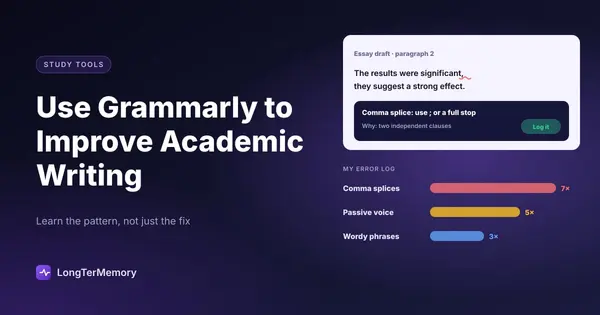
That third step is what transforms Grammarly from a correction tool into a learning tool. If Grammarly repeatedly flags the same type of error across your drafts, and you notice that pattern, you’ve identified a specific weakness in your writing to work on deliberately.
For example, if you notice Grammarly flagging comma splices in every essay you write (two independent clauses joined by just a comma, without a coordinating conjunction or semicolon), that tells you something specific to practice. You now know to look for that pattern before you even open Grammarly, and you can start fixing it in the draft before it surfaces.
This is exactly how you use a tool to build actual skill rather than just produce cleaner outputs.
A practical exercise: For your next essay, before you run it through Grammarly, read through it yourself and try to predict what it will flag. Then compare your predictions to the actual suggestions. The gap between what you catch yourself and what Grammarly catches reveals the specific areas where your editing skills need the most development.
Using Grammarly for Timed Essay Practice
One of the most underused applications of Grammarly for students is using it to improve their performance on timed essay exams.
If your exam includes an essay component (law school exams, history finals, professional certification written sections), timed practice is essential. But just practicing timed writing without feedback is only half the value. For a full study system, see our guide on how to study for an essay exam.
The process:
- Give yourself the same time limit as the actual exam
- Write the essay without any assistance, under realistic conditions
- Submit, then run the draft through Grammarly
- Review every suggestion and decide whether to accept or reject
- Read your revised draft and assess whether the argument still sounds like you
Doing this repeatedly serves two purposes. First, you improve the quality of what you can produce under time pressure. Second, you start internalizing the corrections so your first drafts improve, reducing how much revision you need to do.
Most students are shocked by how many mechanical errors creep into timed writing. Pressure makes you skip words, create accidental run-ons, and default to sloppy punctuation. Seeing this through Grammarly’s analysis after each practice session creates awareness that carries forward into the next one.
Learning From Grammarly Suggestions Rather Than Accepting Them
There’s an important discipline to practice here: when Grammarly suggests changing your vocabulary or restructuring a sentence, evaluate the suggestion critically.
Grammarly sometimes suggests replacing a precise technical term with a more familiar synonym. In academic writing, this is usually wrong. If you’ve written “epistemological,” replacing it with “knowledge-based” because it’s simpler is not an improvement. Precise vocabulary in academic contexts signals command of the field. Don’t let Grammarly sand it away.
Similarly, Grammarly sometimes flags long sentences as too complex. In academic writing, long sentences can be exactly appropriate when you’re expressing a genuinely complex relationship between ideas. A short sentence that oversimplifies isn’t better than a long sentence that’s accurate.
The rule: Grammarly suggestions are starting points for your judgment, not commands. A good suggestion is one that improves clarity without sacrificing precision or your voice. A bad suggestion is one that makes a sentence technically cleaner but intellectually weaker.
Getting comfortable with this judgment is, itself, part of becoming a better academic writer.
Avoiding the Dependency Trap
The biggest risk with Grammarly is becoming dependent on it in a way that prevents you from developing your own editorial eye.
Some warning signs that you’ve crossed into unhealthy dependency:
- You can’t submit anything without running it through Grammarly first, even casual emails or notes
- You accept suggestions without reading them
- You feel anxious about writing in an exam environment where Grammarly isn’t available
- Your writing quality in timed exams is significantly worse than in assignments where you can use tools
If you’re a student who has to write under exam conditions without assistance, the ability to self-edit is not optional. Grammarly should be one tool among several, not a crutch.
The most effective approach is to use Grammarly heavily when you’re in a learning phase, paying close attention to what it flags and why. Then periodically write and edit drafts without it, to check that the improvements you’ve made in Grammarly-assisted writing are actually transferring to your independent writing.
Think of it like training wheels. Useful at the right stage. Counterproductive if you never take them off.
Grammarly’s Plagiarism Checker: A Note
Grammarly Premium includes a plagiarism detection feature that checks your text against published web content. For academic writing, this is worth using before submission, not because you’re intentionally plagiarizing, but because accidental paraphrasing that’s too close to the source is genuinely common, especially when you’re working fast or heavily consulting a source.
A clean plagiarism check gives you confidence before submission. More importantly, if the checker flags something, reviewing why it flagged it, looking at what sentence structure you used that too closely mirrors the source, teaches you something about proper paraphrasing and attribution.
Universities take academic integrity seriously. A plagiarism checker that catches unintentional issues before submission is protecting you, not just the institution.
Developing Your Own Writing Skills Alongside the Tool
The ultimate goal of using Grammarly for academic writing is that you need it less over time, not more. That happens only if you’re actively learning from what it shows you.
Here’s a useful practice: keep a short personal error log. Every time Grammarly flags a category of error you consistently make, write it down. Once a week, review the log and deliberately practice avoiding those errors. Over a semester, you’ll have a personalized roadmap of exactly what your writing weaknesses are and clear evidence of whether you’re improving.
Combining Grammarly with the kind of deliberate practice that builds independent skill is what makes the tool valuable long-term. Without that combination, you’re just producing polished assignments without getting any better at writing them.
For students preparing for professional certification exams with written components (CFA Level III, bar exam essays, Project Management written sections), strong independent writing ability is a competitive advantage. LongTerMemory can help you review the content knowledge that informs your arguments, while Grammarly helps you express that knowledge clearly and correctly. The two tools complement each other for exam preparation.
Practical Summary
| Use Case | How to Use Grammarly |
|---|---|
| Regular essay writing | Read every suggestion, accept selectively, note patterns |
| Timed exam practice | Write without it, analyze after, track improvement |
| Non-native English writing | Enable dialect setting, focus on grammar over tone suggestions |
| Pre-submission check | Catch mechanics and run plagiarism check |
| Self-improvement | Keep an error log, work on your top recurring issues |
Grammarly is a good tool used badly by most of its users. The same software that one student uses as a passive correction machine, another uses as a rigorous feedback loop for genuine writing improvement.
The version that actually makes you a better academic writer is the one where you slow down, read every suggestion, and ask yourself: “Why is this an improvement? And what rule does this teach me?”
That version of Grammarly use doesn’t just clean up your current essay. It raises the baseline quality of every essay you write afterward.