How to Memorize What You Want with LongTerMemory
Learn how to memorize what you want using active recall, spaced repetition, and LongTerMemory's AI flashcards that turn any material into lasting knowledge.
Table of Contents
- How to Memorize What You Want: The Core Idea
- Step 1: Select Exactly What Matters
- Define Your Target Material
- Use the 80/20 Rule
- Step 2: Encode with Purpose
- Active Recall First
- Use Elaboration
- Leverage Mental Imagery
- Step 3: Build a Retrieval Practice Habit
- The Right Retrieval Schedule
- Use Flashcards Wisely
- Let LongTerMemory Handle the Scheduling
- Step 4: Match the Technique to the Material
- Lists and Sequences
- Vocabulary and Definitions
- Numbers and Formulas
- Speeches and Presentations
- Step 5: Protect What You Have Learned
- Sleep Is Part of the Process
- Test Under Realistic Conditions
- Keep It Practical
- Common Mistakes That Sabotage Intentional Memorization
- The Bottom Line
Most people approach memorization the wrong way. They read, highlight, and re-read, then hope the important parts stick. The result is familiar but frustrating: you recognize the material when you see it, yet you cannot produce it when it counts.
The better way is to learn how to memorize what you want deliberately. That means choosing your targets, encoding them with techniques that match how memory works, and reviewing them on a schedule that prevents forgetting. This works for exams, languages, presentations, names, formulas, scripts, and any other material you decide is worth keeping.
This guide walks you through the full system. By the end, you will know exactly how to turn any material you choose into durable memory, and how LongTerMemory can automate the hardest parts of the process.
How to Memorize What You Want: The Core Idea
Memorization is not a recording. It is construction. Every memory you form is built from attention, connections, and repeated retrieval. The strength of a memory depends on three things:
- How deeply it was encoded
- How many mental connections it has
- How often you have successfully retrieved it
This is why passive review fails. Re-reading creates familiarity, which feels like knowing but is not the same as recall. Exams do not ask whether you recognize an answer. They ask whether you can produce it from a blank page.
If you want to memorize what you want, you need a simple four-step loop: select, encode, retrieve, and space. The rest of this guide explains each step in detail.
Step 1: Select Exactly What Matters
You cannot memorize everything, and you should not try. The first step is deciding what deserves your limited memory effort.
Define Your Target Material
Be specific about what you are memorizing. Vague targets produce vague results.
| Bad target | Better target |
|---|---|
| Chapter 5 | The twelve cranial nerves and their functions |
| Spanish vocabulary | Fifty common irregular verbs |
| History | The causes and dates of the French Revolution |
| Presentation | Opening, three main points, and closing |
Specificity matters because it shapes every step that follows. When you know exactly what you are trying to memorize, you can break it into the right pieces, choose the right technique for each piece, and test yourself against a clear standard.
Use the 80/20 Rule
In almost every subject, a small portion of the content carries most of the value. Identify that portion first. In a textbook chapter, the high-leverage material usually includes:
- Key definitions and terminology
- Repeated frameworks or models
- Core arguments or principles
- Anything the instructor emphasized
Memorize the high-leverage material first. Only after that is solid should you expand to secondary details.
This selective approach also prevents overwhelm. Students who try to memorize everything often end up remembering very little. Students who focus on the right 20 percent usually outperform them.
Step 2: Encode with Purpose
Encoding is the moment information moves from short-term exposure toward long-term storage. The way you encode determines how easy the material is to retrieve later.
Active Recall First
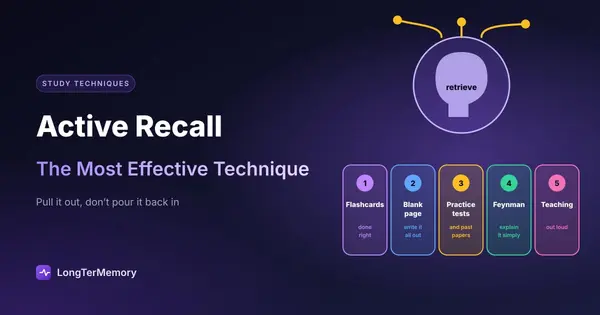
The single most effective encoding strategy is attempting to recall the material before you feel ready. Close the book, look away from the screen, and try to produce the answer from memory.
The struggle of retrieval is the signal that real learning is happening. If you cannot recall something, that is useful information. It tells you exactly where to focus your next study minute.
Use active recall for different types of material:
- Facts and definitions: cover the answer and say it out loud
- Processes and sequences: write the steps from memory
- Concepts: explain them as if teaching someone else
- Formulas: reconstruct them from meaning, not from rote repetition
Active recall is the foundation of how to memorize what you want. Every other technique builds on top of it.
Use Elaboration
Elaboration means connecting new information to what you already know. The more connections a memory has, the more ways you have to find it later.
Ask yourself these questions while studying:
- How does this relate to something I already understand?
- Can I explain this in my own words?
- What is a real-world example of this idea?
- What would happen if this were not true?
- How would I explain this to a beginner?
These questions force deeper processing than simple repetition. They turn isolated facts into networked knowledge.
Leverage Mental Imagery
Your brain remembers images more easily than abstract words. Turn key facts into vivid mental pictures. Exaggerate them, add color and movement, and connect them to familiar places or people.
For ordered lists, the memory palace technique is especially powerful. You place each item along a familiar route, such as the path from your front door to your kitchen, and mentally walk through it when you need to recall the sequence.
For vocabulary and definitions, the keyword method creates fast hooks. Find a sound-alike word you already know, then link it to the meaning with a strange or funny image.
Step 3: Build a Retrieval Practice Habit
Retrieval practice is not a one-time event. It is a habit. If you want to know how to memorize what you want and actually keep it, you need a system for repeated retrieval.
The Right Retrieval Schedule
Retrieval works best when it is spaced out. A single intense session produces short-term familiarity. Distributed practice produces durable memory.
| Review | When to do it | Why it matters |
|---|---|---|
| First retrieval | Immediately after learning | Converts short-term exposure into a real memory trace |
| Second retrieval | 1 day later | Catches gaps before they form |
| Third retrieval | 3 days later | Strengthens the memory through successful recall |
| Fourth retrieval | 1 week later | Moves the memory toward long-term storage |
| Maintenance | Every few weeks or before use | Prevents natural decay over time |
Each successful retrieval strengthens the memory. Each failed retrieval tells you where to re-encode.
Use Flashcards Wisely
Flashcards are a convenient way to organize retrieval practice, but only if you use them correctly. The common mistake is flipping the card too quickly and reading both sides. That is recognition, not recall.
The correct approach is simple:
- Read the prompt
- Commit to an answer in your mind or say it out loud
- Only then check the back
- Rate your difficulty honestly
- Review the difficult cards more often
This manual approach works, but it has two problems. It takes time to create the cards, and it takes discipline to schedule the reviews.
Let LongTerMemory Handle the Scheduling
This is where LongTerMemory becomes the practical solution. Instead of building flashcards by hand and guessing when to review them, you upload your notes or PDF and LongTerMemory generates review cards automatically. The system schedules each card based on how well you recalled it, so you review the right material at the right time.
The result is that the hardest part of how to memorize what you want, the scheduling and discipline, is handled for you. You can focus on actual learning while the system manages the forgetting curve.
Step 4: Match the Technique to the Material
Different material responds to different techniques. Choosing the right method is part of how to memorize what you want efficiently.
Lists and Sequences
Use the memory palace or the story method. Both take advantage of spatial or narrative memory, which are naturally strong. Place each item in a location or turn the list into a short, strange story where each item causes the next.
Vocabulary and Definitions
Use the keyword method for foreign words, finding a sound-alike in your native language and linking it to the meaning with a vivid image. For technical definitions, create a concrete example or analogy rather than memorizing the textbook wording.
Numbers and Formulas
Turn numbers into meaningful patterns or images. For formulas, understand what each symbol represents physically so you can reconstruct the formula from reasoning rather than relying on rote repetition. A formula you understand is far easier to remember than one you have only memorized by shape.
Speeches and Presentations
Build a memory palace with one key idea per location. Practice retrieving the structure rather than word-for-word sentences, so your delivery stays natural. Audiences respond better to a speaker who knows the flow than one who recites a script.
Step 5: Protect What You Have Learned
Even well-encoded memories decay if they are not used or reviewed. The final step is protecting your gains.
Sleep Is Part of the Process
Memory consolidation happens during sleep. Studying right before bed can improve retention because the brain processes recent learning overnight. Skipping sleep to cram more material usually backfires, because tired brains encode poorly and consolidate even worse.
Aim for consistent sleep, especially on the nights after heavy study sessions.
Test Under Realistic Conditions
If you need to recall the material under pressure, practice under pressure. Time yourself, remove your notes, and simulate the real context. This builds retrieval fluency, which is what you actually need in an exam or presentation.
Keep It Practical
The best memorization system is the one you actually use. Start with one technique, apply it to one small piece of material, and build from there. A ten-minute daily retrieval habit beats a two-hour passive review session.
Common Mistakes That Sabotage Intentional Memorization
Most people fail to memorize what they want because of a few predictable mistakes. Here is how to avoid them.
| Mistake | Why it fails | What to do instead |
|---|---|---|
| Trying to memorize too much at once | Overloads working memory and produces shallow encoding | Break material into small chunks and retrieve each chunk before moving on |
| Relying on recognition instead of recall | Familiarity feels like knowing but does not survive a blank page | Test yourself constantly without looking at the answer first |
| Ignoring the forgetting curve | Without review, most learning fades within days | Schedule spaced reviews before the material decays |
| Studying in a distracted environment | Attention is the gatekeeper of memory | Remove your phone and close unrelated tabs before you start |
| Skipping sleep to study more | Sleep is when consolidation happens | Protect sleep as part of your study strategy |
Fixing these mistakes alone will improve your retention more than any single memory trick.
The Bottom Line
Knowing how to memorize what you want is a skill, not a gift. It comes down to choosing your material, encoding it actively, retrieving it repeatedly, and spacing those retrievals over time.
You do not need to master every memory technique. You need one reliable method and the discipline to use it consistently. Start with your next study session: pick one specific thing you want to remember, encode it with a vivid image or active recall, and test yourself tomorrow.
If you want a system that handles the scheduling and card creation for you, LongTerMemory is built for exactly this. Upload your notes or PDF, and the platform turns them into automatically scheduled flashcards using active recall and spaced repetition. It removes the busywork so you can focus on learning.
For a compressed version of the same system, see our guide on how to memorize fast in 30 minutes. For a deeper look at why passive studying fails, read our article on active vs passive learning.
Try it today. Choose what you want to memorize, encode it deliberately, retrieve it before bed, and let LongTerMemory remind you when to review it next. You will remember more tomorrow than you would from an hour of passive review.