How to Study Architecture History and Theory for Exams
Master architecture history and theory exams with timeline-based organization, image-based active recall, and proven essay strategies for top scores.
Table of Contents
- Timeline-Based Organization of Architectural Movements and Periods
- Using Image Recognition as an Active Recall Technique for Architecture
- Building a Personal Image Bank
- Essay Preparation for Architectural Theory and Criticism Exams
- The Essay Skeleton Method
- Common Essay Themes to Prepare
- Connecting Theory to Buildings
- The Bottom Line
Architecture history and theory exams are a unique beast. You are not just memorizing facts. You are expected to recognize buildings from photographs, place movements in historical context, and construct coherent arguments about space, form, and meaning, all under exam conditions. If you approach this like a standard history test, you will drown in buildings, dates, and -isms. If you approach it with the right system, it becomes one of the most satisfying subjects to master.
The key is understanding that architecture exams test three distinct skills: visual recognition, chronological reasoning, and analytical writing. Each requires a different study strategy. This guide breaks down exactly how to prepare for all three without losing your mind in a pile of flashcards.
Timeline-Based Organization of Architectural Movements and Periods
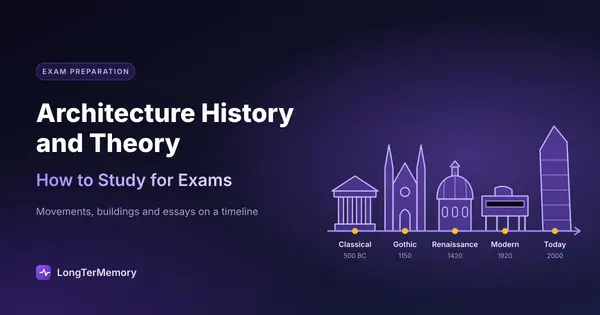
The single most important framework for architecture history is the timeline. Buildings do not exist in isolation. They respond to what came before, react against it, and set the stage for what follows. If you study buildings as isolated objects, you will remember fragments. If you study them as part of a chronological conversation, you will remember narratives.
Start by building a master timeline divided into major periods:
| Period | Key Characteristics | Representative Architects | Must-Know Buildings |
|---|---|---|---|
| Ancient / Classical | Proportion, column orders, civic monumentality | Vitruvius, Imperial Roman builders | Parthenon, Pantheon, Colosseum |
| Medieval / Gothic | Verticality, light, structural expression | Abbot Suger, master builders | Notre-Dame de Paris, Chartres Cathedral |
| Renaissance | Revival of classical orders, human scale, symmetry | Brunelleschi, Alberti, Palladio | Florence Cathedral dome, Villa Rotonda |
| Baroque / Rococo | Drama, movement, ornate decoration | Bernini, Borromini, Mansart | St. Peter’s Square, Versailles |
| Neoclassical | Return to austere classical forms | Soufflot, Ledoux, Jefferson | Panthéon Paris, Virginia State Capitol |
| Modern / International Style | Function, new materials, rejection of ornament | Le Corbusier, Mies van der Rohe, Gropius | Villa Savoye, Barcelona Pavilion, Bauhaus |
| Postmodern / Contemporary | Pluralism, irony, sustainability, digital design | Venturi, Gehry, Hadid, Koolhaas | Vanna Venturi House, Guggenheim Bilbao |
For each period, know the big idea in one sentence. For the Renaissance, it is the rediscovery of classical proportion applied to human-centered spaces. For Modernism, it is the belief that form should follow function and that new materials enable new social possibilities. These one-liners become anchors. When you see an unfamiliar building on an exam, you can place it by asking which big idea it embodies.
Using Image Recognition as an Active Recall Technique for Architecture
Architecture exams are visual. Your study method should be too. You cannot prepare for an image recognition slide test by reading about buildings. You need to train your eye the same way a language student trains their ear.
Here is the active recall method that works:
- Collect 50 to 100 high-quality images of the buildings on your syllabus. One image per building is enough if it shows the characteristic view.
- Put them into a spaced repetition system as image cards. The front of the card is the image. The back is the building name, architect, date, period, and one-sentence significance.
- Review daily. When an image appears, name the building, the architect, and the period before you flip the card. Do not just recognize it. Verbalize it.
- For buildings you miss, spend 30 seconds analyzing the image. What specifically identifies it? Is it the dome profile? The facade rhythm? The material? Connect the visual feature to the name.
This process trains visual memory directly, which is what the exam tests. Text-based flashcards are useful for theory and terminology, but image cards are non-negotiable for architecture history.
Building a Personal Image Bank
Create folders on your computer or phone organized by period. Scroll through them during commutes or breaks. The goal is to see each building so many times that recognition becomes automatic. When you walk into the exam and see a slide, your brain should fire the name before you even think about it.
Essay Preparation for Architectural Theory and Criticism Exams
Theory essays require you to move beyond identification into interpretation. The exam will ask you to compare buildings, analyze the impact of a movement, or evaluate a theoretical position. Good essays are not written from scattered facts. They are written from structured arguments supported by specific examples.
The Essay Skeleton Method
For every major theme on your syllabus, prepare a skeleton outline:
- Thesis statement: Your one-sentence position.
- Example 1: A building that supports your thesis, with 3 specific details.
- Example 2: A contrasting or complementary building, with 3 specific details.
- Counterpoint: A valid alternative view and your response to it.
- Conclusion: Restatement of thesis and broader significance.
Practice writing these skeletons from memory. In the exam, you will not have time to invent arguments. You need pre-built frameworks that you can adapt to the specific question.
Common Essay Themes to Prepare
- Classicism vs. innovation across periods
- The relationship between technology and architectural form
- Architecture as political or social expression
- The role of the architect vs. the master builder / engineer
- Regionalism vs. universalism in modern and contemporary work
For each theme, have two buildings ready as evidence, one from an earlier period and one from a later period. This shows chronological breadth, which examiners love.
Connecting Theory to Buildings
Architecture theory is abstract by design. But exams reward students who can ground theory in physical examples. When you read a theoretical text, whether it is Viollet-le-Duc on structure or Venturi on complexity, immediately connect it to a building you know.
Ask yourself: what would this theorist say about the Villa Savoye? About the Pompidou Centre? The habit of connecting abstract ideas to concrete buildings makes theory memorable and makes your essays specific rather than vague.
If you are juggling hundreds of buildings, architects, and theoretical positions, LongTerMemory can build the review deck for you. Upload your lecture slides, readings, or notes, and it generates question and answer flashcards and schedules them with spaced repetition, so styles, dates, and arguments stay connected.
The Bottom Line
Architecture history and theory reward students who think in images, timelines, and arguments. Memorize the timeline so you know what responds to what. Train image recognition with daily active recall. Prepare essay skeletons around major themes so you are never starting from a blank page.
The buildings have already been built. Your job is to understand the conversation they are having with each other. Once you see that conversation, the exam becomes a lot less intimidating.