How to Study for Open-Book Exams Differently
Open-book exams require a different strategy. Learn how to organize materials, practice fast retrieval, and prepare for application questions.
Table of Contents
- Why Open-Book Exams Still Require Substantial Preparation
- Know the Rules Before You Prepare
- How to Organize Your Materials for Fast Retrieval Under Exam Time Pressure
- Physical Materials
- Digital Materials
- Practice With a Timer
- Building Your Cheat Sheet or Quick Reference
- The Types of Questions That Separate Prepared From Unprepared Candidates
- Application Questions
- Comparison and Evaluation Questions
- Synthesis Questions
- Trick Questions and Time Traps
- Time Management During the Exam
- What to Do If You Panic
- Study Tactics Specific to Open-Book Success
- Make It Easier With LongTerMemory
Open-book exams sound like a gift. You can bring your notes, your textbook, or even your laptop. Surely that means less studying, right? In reality, open-book exam study often requires just as much preparation as a closed-book test, and sometimes more. The challenge is not remembering every detail. It is finding the right detail quickly and using it to answer complex, unfamiliar questions.
The students who do well on open-book exams are not the ones with the thickest binders. They are the ones who know their materials so well that they can locate exactly what they need in seconds. That level of familiarity only comes from deliberate preparation.
Why Open-Book Exams Still Require Substantial Preparation
An open-book format changes what the exam can test. Because you have access to facts, the questions move away from simple recall and toward application, analysis, and evaluation. You might be asked to compare two theories, diagnose a problem using a framework, or explain why a procedure is appropriate in one situation but not another.
These questions require you to understand the material deeply, not just recognize it. If you have not thought about how concepts connect, you will waste precious minutes flipping through pages while the clock runs down. Worse, you may find the right fact but use it in the wrong way.
The illusion of safety is the real danger. Students who assume the book will save them often under-prepare, then discover during the exam that they cannot navigate the material fast enough. The result is a lower score than they would have earned on a closed-book test with focused memorization.
Know the Rules Before You Prepare
Not all open-book exams are the same. Some allow any printed material, others restrict you to a single page, and still others use a locked browser with only specified digital files. Before you build your reference kit, read the exam instructions carefully. Knowing what you can and cannot bring will shape how you organize and what you prioritize.
How to Organize Your Materials for Fast Retrieval Under Exam Time Pressure
Your goal is to make every piece of information findable in under 30 seconds. That means organization, labeling, and familiarity. The exact system depends on whether your exam allows physical notes, a digital device, or both.
Physical Materials
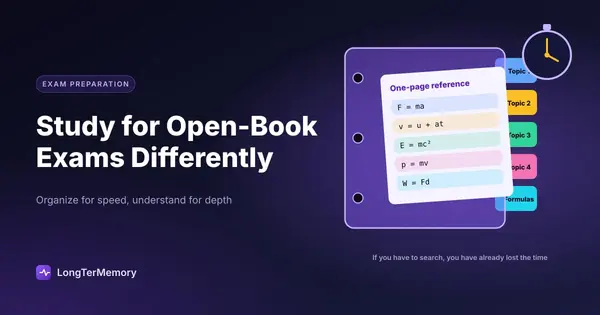
If you are allowed a binder or notebook, start by creating a detailed table of contents. Use color-coded tabs for each major topic or unit. Within each section, arrange notes in a logical order, such as chronological, conceptual, or alphabetical. Include a one-page “quick reference” sheet with formulas, definitions, key cases, or procedures you expect to need often.
Avoid the temptation to bring everything you have ever written. A massive binder is harder to search than a lean, well-organized one. Curate your notes down to the essentials. If a page does not contain something you might realistically need, leave it at home.
Digital Materials
For digital open-book exams, organization is even more important because the search box can become a trap. You want to be able to find a term, but you also need to understand the context around it. Use clear filenames and a folder structure that mirrors the course syllabus. If you use a note-taking app, tag notes by topic and create an index page that links to the most important documents.
Bookmark key sections in PDFs and add comments or highlights that summarize the main point. If your exam uses a locked browser, make sure you know exactly which files and tabs will be accessible before the test begins.
Practice With a Timer
The best way to test your system is to do practice questions under exam conditions. Time yourself searching for the relevant information and writing the answer. If you cannot find what you need in 30 seconds, your organization needs improvement. This kind of rehearsal also builds the mental map you will rely on during the real exam.
The following table summarizes how to organize different material types:
| Material Type | Organization Strategy | Why It Works |
|---|---|---|
| Lecture notes | Topic-based tabs or folders | Mirrors how questions are likely to be structured. |
| Textbook chapters | Highlighted key pages with sticky tabs | Lets you jump to major concepts quickly. |
| Formulas and equations | One-page quick reference sheet | Prevents hunting through pages during calculations. |
| Cases and examples | Thematic index with short summaries | Helps you match examples to question types. |
| Digital PDFs | Searchable text with bookmarks and comments | Combines fast search with context. |
Building Your Cheat Sheet or Quick Reference
If you are allowed a cheat sheet, treat it as both a reference tool and a study device. The process of deciding what to include forces you to identify the most important information. A good cheat sheet contains formulas, definitions, procedural steps, and a small number of key examples. It does not contain entire paragraphs or explanations you should already understand.
Write clearly and use white space. A crowded cheat sheet is hard to read under pressure. Use headings, boxes, or color coding to separate topics. Then practice using it while solving problems. If you cannot locate what you need within a few seconds, revise the layout.
The Types of Questions That Separate Prepared From Unprepared Candidates
Open-book exams reward a specific kind of thinking. The questions usually fall into a few categories, and each one requires a different approach.
Application Questions
These questions give you a scenario and ask you to apply a concept or method. For example, you might be given a business case and asked to choose the correct accounting treatment, or given a patient description and asked to identify the most likely diagnosis. To answer these well, you need to understand the rules well enough to recognize which one fits the situation.
Comparison and Evaluation Questions
You may be asked to compare two theories, evaluate the strengths and weaknesses of an argument, or choose between alternative approaches. These require you to see relationships between ideas. Simple keyword searches will not save you if you do not already understand the differences.
Synthesis Questions
Some open-book exams ask you to pull together information from multiple sources or topics. These are the hardest questions for unprepared students because the answer is not located on a single page. A well-organized set of notes with clear connections between concepts is your best defense.
Trick Questions and Time Traps
Some questions are designed to look like simple lookups but actually require judgment. For example, a question might list several true statements and ask which one is most relevant to the problem at hand. Students who rely only on search skills often pick the first true statement they find instead of the best answer.
Time Management During the Exam
Even with perfect notes, you can run out of time if you are not disciplined. Start by scanning the entire exam and allocating time per question based on points. Mark the questions that look straightforward and do those first to build momentum. Save complex, multi-part questions for when you are warmed up.
If a question sends you searching for more than a minute, mark it and move on. It is better to answer most questions well than to get stuck on one while the clock runs out. Use your quick reference sheet for the items you access repeatedly, and rely on your organized notes only when you need deeper context.
What to Do If You Panic
If you open the exam and your mind goes blank, take a few slow breaths and look at the questions you marked as easy during your initial scan. Starting with a question you can answer builds confidence and momentum. Remember that you prepared your materials precisely for this moment, and you know how to use them.
Study Tactics Specific to Open-Book Success
Beyond organizing your materials, you should study differently. Focus on understanding relationships, creating summaries, and practicing under time pressure.
Start by making a concept map that shows how the major topics connect. This helps you see the big picture, which is exactly what synthesis questions require. Next, write practice questions that force you to apply concepts rather than just define them. Finally, do at least one timed practice exam using only the materials you plan to bring.
Another useful technique is to create your own index. Go through your notes and write a list of every important term, concept, and example with the page number where it appears. The act of creating the index is itself a powerful review, and the finished index becomes a valuable tool during the exam.
Make It Easier With LongTerMemory
Open-book exams reward deep understanding and fast retrieval, both of which are exactly what LongTerMemory is built to develop. By turning your PDFs, notes, and web content into AI-generated flashcards and spaced repetition quizzes, LongTerMemory helps you build the familiarity that makes open-book searching unnecessary. When you already know where the key concepts live in your memory, you spend less time flipping pages and more time writing strong answers. Try it free and prepare for your next open-book exam with confidence.