How to Memorise Chapters for an Exam in One Day
Need to memorise chapters for an exam in one day? This guide shows you how to prioritise high-yield content, use active recall, and make every hour count.
Table of Contents
- The Mindset Shift You Need First
- The 1-Day Study Sprint: How to Structure 8 to 10 Hours of Focused Work
- Prioritizing Testable Content Over Comprehensive Coverage
- How to Triage Your Material in the First Hour
- The Three Categories of Material
- Use Past Exam Questions as Your Compass
- How to Apply Triage to Textbook Chapters
- What to Do During Deep Study Blocks
- The 20-Minute Read-Then-Recall Cycle
- Do Not Skip Examples and Practice Questions
- Make Summary Cards As You Go
- Active Recall: The Most Important Part of Your Day
- Practice Retrieval Methods for a One-Day Sprint
- Recovery and Rest: Building Consolidation Into a One-Day Plan
- The Night Before: What To Do With the Final Hour
- The Morning of the Exam
- FAQ: Memorising Chapters for an Exam in One Day
- How many chapters can you memorise for an exam in one day?
- What should you skip when you only have one day?
- Is it better to re-read the chapters or test yourself?
- Should you pull an all-nighter to memorise more chapters?
- The Bottom Line
Let me guess. The exam is tomorrow, and you are somewhere between mildly behind and full panic. Maybe the semester got away from you. Maybe this certification has been on your calendar for weeks and somehow it is suddenly the night before. Whatever the reason, you are here now, with one day left, and you need to make it count.
Good news first: one focused day is more useful than you probably think. Bad news: only if you spend it the right way. And the right way looks almost nothing like what most people default to when they are panicked and short on time.
This guide is about using the next twenty-four hours as effectively as possible. No false promises about covering everything, no pretending that one day is ideal (it is not), but real strategies that work under genuine time pressure.
If you are trying to memorise chapters for an exam in one day, the same principles apply: you cannot read every page with equal care, so you need a system that identifies the highest-value chapters, sections, and ideas first and then encodes them through retrieval rather than re-reading. For a realistic estimate of your actual limit, see our guide on how many pages can you memorize in a day.
The Mindset Shift You Need First
Before getting into the tactics, there is a mental reframe that makes everything else more effective: stop trying to cover everything and start trying to cover the right things.
When people study under time pressure, they often spend the first several hours going through material in order, from the beginning, reading carefully, making notes. This feels responsible. It is actually a disaster for your exam score. By the time you get three hours in, you have covered maybe 30% of the material, you have spent a lot of time on things you might already know, and you have not even looked at the harder sections yet.
The approach that actually works under time pressure is triage first, deep work second. You need to know before you start what the highest-leverage material is, and you need to go there first.
This is uncomfortable because it requires making explicit decisions about what you are willing to leave behind. But those decisions are going to be made either way, whether consciously or by running out of time. Better to make them on purpose.
The 1-Day Study Sprint: How to Structure 8 to 10 Hours of Focused Work
A full day of studying does not mean ten hours at a desk with your notes. It means structured intervals of focused work alternating with genuine rest, because your brain’s ability to encode new information degrades sharply when you are mentally fatigued.
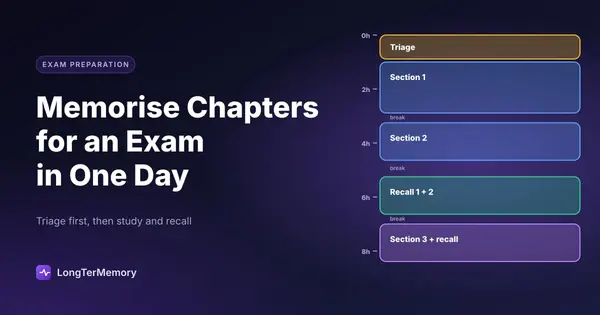
Here is a schedule that works:
| Time Block | Activity |
|---|---|
| Hour 1 | Triage and prioritize (see below) |
| Hours 2-3 | Deep study: highest-yield section 1 |
| 15 min break | Walk, eat, no screens |
| Hours 3.5-5 | Deep study: highest-yield section 2 |
| 30 min break | Meal, real break |
| Hours 5.5-7 | Active recall: test yourself on sections 1 and 2 |
| 15 min break | Short rest |
| Hours 7.5-9 | Deep study: section 3, then active recall on all |
| 1 hour before bed | Light review of weak points only |
| Sleep | Non-negotiable |
The structure matters. Without it, you will spend time inefficiently, lose track of what you have covered, and feel scattered rather than in control.
Prioritizing Testable Content Over Comprehensive Coverage
This is the single most valuable skill for one-day exam prep, and it is a skill most people never develop because they usually have more time and do not need it.
How to Triage Your Material in the First Hour
Spend the first hour of your day doing nothing but understanding the exam. Get clear on:
- What topics are covered, and roughly what percentage of the exam each topic represents
- What format the exam uses (multiple choice, essays, case studies, short answer)
- What past exams or practice questions look like, if you have access to them
- What the official learning objectives or exam blueprint says, if one is published
This information is the foundation of your triage. If the exam tells you that 40% of questions cover topic A and 10% cover topic D, you need to spend roughly four times as long on A as on D. Most people do not do this calculation. They treat all material as equally important and then run out of time before they have covered the most important parts.
The Three Categories of Material
Once you have done your triage, sort everything you need to study into three categories:
Category 1: High-yield fundamentals. These are the core concepts, definitions, and principles that will appear directly or indirectly in the majority of exam questions. This is where the bulk of your day goes. You need solid recall of these. Not perfect recall, solid recall.
Category 2: Medium-yield details. These are the specifics that reinforce the fundamentals. Important to know, but you do not need to spend as long on them as the fundamentals. After covering Category 1, come back here if you have time.
Category 3: Low-yield peripheral content. This is the edge case material, the deep dives, the niche subtopics. Under normal prep conditions, you would cover it. With one day left, be honest: the expected value of spending an hour on low-yield content is much lower than spending that hour reinforcing your high-yield knowledge.
Cut Category 3 ruthlessly. You can always attempt those questions using reasoning rather than pure memorization, and you have not sacrificed anything critical by doing so.
Use Past Exam Questions as Your Compass
If your exam or certification has published practice questions or past papers, these are the most reliable guide to what is actually tested. Within the first hour, scan through available practice questions and note which topics appear most often.
This is more reliable than syllabi because it reflects what the exam writers actually care about in practice. Syllabi list everything that could theoretically be covered. Past questions show you what is consistently prioritized.
How to Apply Triage to Textbook Chapters
If your exam is built around textbook chapters, the triage above translates directly into a chapter-level plan. Start by listing every chapter the exam covers and estimating its weight from the syllabus, past exams, or your instructor’s emphasis. Then mark each chapter as high-yield, medium-yield, or low-yield.
For high-yield chapters, aim for deep study plus active recall: read the key sections, close the book, and reconstruct the main ideas from memory. For medium-yield chapters, skim for definitions and summaries, then do a single recall pass. For low-yield chapters, read only headings, summaries, and any terms that appear in practice questions.
This is exactly how you memorise chapters for an exam in one day without pretending you can absorb every word. You front-load the chapters most likely to appear and use retrieval practice to make the important material stick.
What to Do During Deep Study Blocks
During your two-hour deep study blocks, you are not reading passively. You are engaging actively with the material in a way that creates retrievable memories, not just familiarity.
The 20-Minute Read-Then-Recall Cycle
The most efficient approach for each topic: read the material for about twenty minutes, then close everything and spend five to ten minutes trying to write down everything you can remember from what you just read.
Do not peek. Do not re-open your notes to check while you are writing. Let your brain struggle to retrieve the material. The struggle is exactly what creates stronger memory traces.
After your recall attempt, open your notes and check what you got right and what you missed. The things you missed are your study agenda for the next pass. Go back to those specific points, read them again, then try to recall again.
This cycle is significantly more effective than reading through material multiple times because each recall attempt is a retrieval practice event. Retrieval practice is one of the most robust findings in memory research: testing yourself on material produces two to three times better retention than re-reading the same material for the same amount of time.
Do Not Skip Examples and Practice Questions
When your study material includes worked examples or practice questions, do not treat these as supplementary. They are among the most valuable content you can encounter during exam prep.
Work through every example actively. Do not just read the solution, cover it and try to solve the problem yourself first. Even if you get it wrong, the attempt followed by seeing the correct solution encodes the method more deeply than reading the solution passively.
Make Summary Cards As You Go
As you move through each topic, create a brief summary: the two or three most important points from this section, stated in your own words. These summary cards serve two purposes. First, they force you to synthesize what you just learned, which deepens encoding. Second, they give you a condensed review resource for the last hour before sleep.
Keep the summaries short. This is not the time for comprehensive notes. One to three bullet points per topic is the right scope.
Active Recall: The Most Important Part of Your Day
The hours you spend on active recall are the hours that will actually determine your exam score. Studying deposits knowledge; active recall is what makes it accessible when you need it.
After covering your first two major topics, shift to active recall before adding more content. The research on this is consistent: distributing retrieval practice across learning is more effective than front-loading all input and reviewing at the end.
Practice Retrieval Methods for a One-Day Sprint
Blank page recall: Close all notes. Write down everything you know about Topic 1 from scratch. Then check your accuracy. This is brutal but effective.
Self-quizzing: Convert your summary cards into questions. Cover the answer and try to answer from memory. Work through all your summary cards from the day’s study at the end of each session.
Past question practice: If you have practice questions, do them under exam conditions (timed, closed notes) rather than using them as a guided walkthrough. The discomfort of attempting questions you are uncertain about is precisely what builds exam readiness.
Out-loud explanation: Explain a topic out loud as if you are teaching it to someone who knows nothing about the subject. The places where your explanation breaks down or becomes vague are exactly the places where your understanding has gaps.
Recovery and Rest: Building Consolidation Into a One-Day Plan
Sleep is not a luxury you can sacrifice for more study time. This is not motivational advice, it is neuroscience.
Memory consolidation, the process by which short-term memories are converted into durable long-term memories, happens primarily during sleep. Specifically, during the slow-wave sleep phases that occur in the earlier part of the night, your brain replays and strengthens the memories from the day. If you pull an all-nighter, you are denying your brain the consolidation process, and a significant portion of what you studied will not be accessible during the exam.
Multiple studies have directly compared sleep-deprived students against rested students on exam performance, and the results are not ambiguous. Even students who studied more total hours but slept fewer than six hours significantly underperformed students who studied less but slept a full seven to eight hours.
This means: stop studying no later than midnight if your exam is in the morning. Ideally stop at ten or eleven. Do your final light review of weak points an hour before stopping, then do something genuinely relaxing, and sleep.
The Night Before: What To Do With the Final Hour
Do not try to learn new material in the last hour. Use it for light review of the summary cards you made during the day, focusing on the ones you struggled with most. This is exposure, not learning. You are not trying to master anything new. You are reinforcing what you already covered so it is primed for retrieval.
Keep it calm. Do not spiral into trying to cover topics you did not reach during the day. What is in your head at this point is what you have. A calm, well-rested brain will outperform an exhausted, panicked one even if the rested brain studied slightly less.
If you have far less than a day, our guide on how to memorize fast in 1 hour shows how to triage and recall in a single focused hour.
If you only have tonight rather than a full day, see our guide on how to study for exams in one night for a shorter overnight plan.
The Morning of the Exam
Wake up with enough time to eat a real meal, review your summary cards lightly (not intensively), and arrive at the exam location without rushing. Rushing activates stress responses that impair working memory, which is exactly what you need to perform well on an exam.
During the exam itself, start with the questions you find easiest. Build your confidence and warm up your recall before tackling the harder questions. If you hit a question you genuinely cannot answer, flag it and move on. Come back at the end. Your brain often surfaces answers while you are working on other questions, and sitting stuck on one hard question is a poor use of time.
FAQ: Memorising Chapters for an Exam in One Day
How many chapters can you memorise for an exam in one day?
It depends on length and density, but a realistic target is to deeply learn the two or three highest-yield chapters and cover the rest at summary level. Trying to memorise every chapter for an exam in one day with equal care leaves you with shallow recall everywhere.
What should you skip when you only have one day?
Skip low-yield peripheral content: deep dives, niche subtopics, and anything that does not appear in past papers or the exam blueprint. Read headings, summaries, and key terms for those chapters, and spend your real study time on the fundamentals.
Is it better to re-read the chapters or test yourself?
Test yourself. Read for about twenty minutes, close the book, and write down everything you remember. Retrieval practice produces far better retention than re-reading the same pages.
Should you pull an all-nighter to memorise more chapters?
No. Memory consolidation happens during sleep, so sacrificing it to fit in more reading usually costs more than it gains. Stop studying by ten or eleven and sleep.
The Bottom Line
One day is not ideal. But used well, memorising chapters for an exam in one day is realistic if you triage first and test yourself constantly. it is far more powerful than most people realize. The difference is not how many hours you sit with your notes. It is how intelligently you use the hours you have.
If you want to make future one-day situations less common, consider using a platform like LongTerMemory to build ongoing spaced repetition habits between exams, so the material stays fresh and exam day feels like a review rather than a sprint. But for right now, you have everything you need. Go make today count.