The Story Method: Memory Techniques That Make Facts Stick
The story method is one of the most effective memory techniques: turn dry facts and lists into vivid stories your brain can't forget. Here's how.
Table of Contents
- Why Narrative Structure Is a Memory Superpower
- Building a Memory Story From Scratch
- Step 1: Identify What You Need to Encode
- Step 2: Personify and Concretize Your Information
- Step 3: Build the Narrative
- Applying the Story Method to Real Academic Subjects
- History: Causation Chains and Date Anchors
- Biology: Processes and Sequences
- Law: Cases, Holdings, and Rules
- Science: Mechanisms and Cause-Effect
- Making Stories More Memorable: Key Principles
- Combining Story Method With Retrieval Practice
- How the Story Method Compares to Other Memory Techniques
- When the Story Method Works Best
- Getting Started: Your First Memory Story
Here’s something that says a lot about how human memory works: you probably can’t remember what you had for lunch three Tuesdays ago, but you can likely recall a story your grandmother told you fifteen years ago in remarkable detail.
Same brain. Completely different outcomes.
The difference isn’t effort or repetition. It’s structure. Narrative structure, specifically. Your brain is exceptionally good at encoding and retrieving information when it’s organized as a story, with characters, causes, sequences, and consequences. It’s considerably worse at retaining isolated facts, definitions, and lists, which is exactly what most academic study material consists of.
The story method is one of the most effective memory techniques for bridging that gap. It takes the kind of information your brain struggles with (arbitrary facts, sequences, definitions, lists) and restructures it into the kind of information your brain is designed to hold onto (narrative).
Used correctly, it’s one of the most powerful memory tools available. Let’s break down how it works, why it works, and how to apply it to the subjects you’re actually studying.
Why Narrative Structure Is a Memory Superpower
The human brain didn’t evolve to remember lists of vocabulary definitions or the steps in the Krebs cycle. It evolved to survive in a social, causal, sequential world, tracking who did what, why things happened, and what came next. Narrative is the format that matches how your brain naturally represents and retrieves information.
When researchers study memory, they consistently find that narrative encoding produces dramatically stronger recall than either repetition or visual mnemonics alone. A 2000 study by Bower and Morrow found that people remembered up to 70% more information when it was organized as a story than when it was presented as a list of equivalent facts. The structure itself aids retrieval, because each element of the story acts as a cue for what comes next.
This works for several reinforcing reasons:
Causal chaining: Stories create causal links between events. If A causes B, and B causes C, remembering A tends to automatically prime the recall of B, which primes C. A list of three isolated facts offers no such built-in retrieval structure.
Emotional engagement: Stories engage more cognitive processing systems simultaneously. You’re tracking characters, anticipating outcomes, responding emotionally. That broader engagement creates more memory consolidation pathways than dry fact memorization.
Distinctiveness: A story with unusual, vivid, or absurd details is far more distinctive than a generic fact. Distinctive information is easier to retrieve because it has fewer competing memories that look similar.
Sequential anchoring: Stories have an inherent order, beginning to middle to end. Information with a natural sequence is easier to store and retrieve than information without one.
Building a Memory Story From Scratch
The basic process is simpler than it sounds once you do it a few times. Here’s how to construct one.
Step 1: Identify What You Need to Encode
The story method works best for specific types of information:
- Ordered sequences (historical events, biological processes, procedural steps)
- Lists of items (vocabulary sets, characteristics, components)
- Cause-and-effect chains
- Abstract concepts that need to be made concrete
It works less well for things you need to understand deeply and apply flexibly, like mathematical problem-solving or complex argument analysis. Think of the story method as a tool for encoding the raw material that you then work with, not a replacement for genuine understanding.
Step 2: Personify and Concretize Your Information
The first transformation is turning abstract content into concrete characters and objects. Numbers, processes, concepts, and terms all need physical representations you can place in a scene.
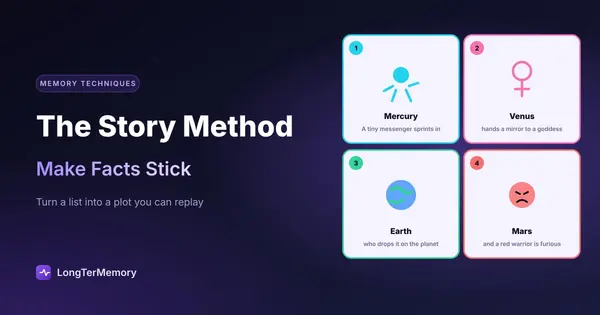
For example, if you’re memorizing the order of the planets (Mercury, Venus, Earth, Mars, Jupiter, Saturn, Uranus, Neptune), each planet needs to become a character or object that either sounds like its name or represents it symbolically.
Mercury might be a fast-talking messenger carrying letters (after the Roman messenger god). Venus could be a beautiful woman in a red dress. Earth is you, sitting in your living room. Mars is a soldier covered in rust. Jupiter is a massive, grumpy king. Saturn wears a hula hoop (its rings). Uranus is a blue figure stumbling sideways (its axial tilt). Neptune is a swimmer clutching a trident.
The specifics don’t matter as long as they’re vivid and personally meaningful to you. The more bizarre and visually distinctive, the better.
Step 3: Build the Narrative
Now link your characters and objects into a continuous story with causation and sequence.
Using our planets: The fast-talking Mercury messenger sprints past a beautiful woman in a red dress (Venus) and crashes into you sitting in your living room (Earth), sending you flying into a rusty soldier (Mars) who screams at the grumpy king (Jupiter), who sits on the hula-hoop figure (Saturn), who bumps into the sideways-stumbling blue figure (Uranus), who falls into the swimming Neptune with the trident.
That story is absurd, visual, causal, and sequential. It will likely outlast weeks of staring at a list of planet names. More importantly, when you recall it during an exam, the sequence is self-retrieving: one character appears, and the causal chain automatically pulls the next one into view.
Applying the Story Method to Real Academic Subjects
Let’s move from abstract method to concrete application across different disciplines.
History: Causation Chains and Date Anchors
History is almost ideal for the story method because it already has narrative structure. The challenge is that textbooks strip that structure out and replace it with facts, dates, and names.
Your job is to put the narrative back.
Rather than trying to remember isolated dates, build causal stories: Character A (a charismatic nationalist leader) has a grievance against Character B (the occupying empire) because of Event C (an unfair trade law), which leads to Event D (a uprising), which is suppressed but triggers Event E (international sympathy and support), eventually leading to Event F (independence).
When you learn history as a chain of motivated actions and reactions between characters with understandable goals and fears, both the sequence and the causation become memorable, because they mirror how real human events unfold.
For specific dates, you can anchor them by linking the year to a memorable image (many mnemonics exist for encoding numbers as images), and embedding that image into the story: “Character A was thirty-three years old when Event D happened in 1833.”
Biology: Processes and Sequences
The Krebs cycle, the steps of mitosis, the sequence of protein synthesis, the cascade of the complement system in immunology, these are all ordered processes that the story method handles extremely well.
Each molecule, organelle, or cell becomes a character. Each chemical transformation becomes an action taken by one character on another. The energy output (ATP, NADH, FADH2) becomes something the characters collect or produce.
For the Krebs cycle, you might picture Acetyl (a chemical-smelling character in a lab coat) walking into a circular room (the cycle), hooking arms with Oxaloacetate (a old man), spinning to produce Citrate (a sour-smelling cloud), then going through a series of transformations where ATP coins and NADH tokens drop out at each step, until Oxaloacetate is regenerated and ready to receive the next visitor.
The biology is still the biology, but it’s now organized as a narrative that your memory can grab onto.
Law: Cases, Holdings, and Rules
Law school memory challenges center on cases (who sued whom, what happened, what the court held) and the doctrines those cases establish. The story method is practically tailor-made for this.
For each case, your story is literally the facts: real characters, a real conflict, a real decision. The legal rule emerges naturally from the story’s resolution. When you need to retrieve the rule, you think back to the story of the case, which cues both the facts and the holding.
The additional trick for law is to connect cases together into doctrinal narratives: “First there was Case A, which established a strict rule. Then Case B came along with unusual facts that seemed unfair under the strict rule, so the court created an exception. Then Case C used that exception to extend the doctrine in a new direction…” This meta-story of doctrinal development is often exactly what an essay question is testing.
Science: Mechanisms and Cause-Effect
Chemistry, physics, and biology mechanisms all involve causes leading to effects through intermediate steps. Story structure maps directly onto this.
An oxidation-reduction reaction becomes a story of an electron thief (the oxidizing agent) stealing electrons from a reluctant donor (the reducing agent), with consequences that cascade through a reaction chain. The unusual property of water that makes it expand when frozen becomes a story of hydrogen bonds insisting on forming a crystalline lattice that holds molecules slightly further apart than in liquid form.
Understanding-based stories like these serve double duty: they aid memorization, and they also deepen your conceptual understanding of the mechanism, which improves your ability to apply it to novel problems.
Making Stories More Memorable: Key Principles
Not all stories encode equally well. These principles make the difference between a story that sticks and one that fades.
Make it bizarre: Normal events are forgettable. Unusual, absurd, or impossible events are memorable. A textbook fact about the digestive system is forgettable. The same fact expressed as a story where stomach acid is an angry dragon that dissolves everything with its breath is memorable. Your brain flags the unusual.
Make it personal: Include yourself in the story whenever possible. Your brain processes self-relevant information differently and tends to retain it better. This is called the self-reference effect in memory research.
Make it emotional: Fear, humor, disgust, wonder, these emotional colors strengthen the memory trace. Not because you need to feel the emotion intensely, but because emotional relevance signals to your brain that the information matters.
Make it sensory: Include specific sights, sounds, smells, and textures in your stories. Multi-sensory encoding creates more retrieval pathways.
Make it causal: Ensure that one event in the story causes the next, rather than having events that just happen to follow each other. Causation creates the retrieval chain that makes the sequence self-retrieving.
Combining Story Method With Retrieval Practice
The story method is an encoding tool. It doesn’t replace retrieval practice; it makes retrieval practice more effective.
After building a memory story, close your notes and try to narrate the story from beginning to end. Note where you get stuck. Return to those gaps specifically. Then wait a day, and try to narrate again. Then wait three days, and try again.
This combination of narrative encoding and spaced retrieval is significantly more effective than either approach alone. The story makes the initial encoding stronger. The spaced retrieval converts that strong encoding into long-term memory.
Tools like LongTerMemory can help you structure the retrieval practice side of this, scheduling review sessions at optimal intervals based on your recall performance. You provide the story and the initial encoding; the system manages when to test you on it.
How the Story Method Compares to Other Memory Techniques
The story method is one of several proven memory techniques, and each has a different strength. Knowing when to reach for which one is half the skill.
The memory palace technique (Method of Loci) stores information at locations along a mental route. It excels at large volumes of material and precise ordering, but it requires building and maintaining the palace itself. The story method is lighter weight: no locations to memorize, just a causal chain.
Acronyms and acrostics compress lists into a single word or sentence. They’re fast to create and ideal for short lists, but they only cue the first letter of each item, so they work best when you already partly know the material. Stories carry the full content, not just prompts for it.
Science-backed memorization routines like spaced repetition and retrieval practice strengthen memories after encoding, but they don’t change what the memory is made of. The story method complements them: it improves the raw material that those routines then consolidate into long-term memory.
In practice, the strongest memorizers combine these memory techniques rather than choosing just one. A memory palace can hold a story at each station. An acronym can cue the characters of a story. Start with the story method for sequences and processes, and layer in the others as your material demands it.
When the Story Method Works Best
| Best Use Cases | Less Ideal Use Cases |
|---|---|
| Ordered sequences and processes | Mathematical derivations requiring flexible application |
| Historical event chains | Developing genuine conceptual understanding |
| Anatomical structures and pathways | Essays requiring original analysis |
| Vocabulary with shared characteristics | Problem-solving skills that need practice, not memory |
| Legal cases and doctrines | Statistics requiring calculation fluency |
The story method isn’t for everything. It’s specifically for when you need to hold arbitrary or complex information in memory and retrieve it accurately, especially in sequence or in detail.
Getting Started: Your First Memory Story
If you’ve never consciously built a memory story before, here’s a challenge for your next study session.
Pick one list, sequence, or set of facts you’ve been struggling to remember. Give each item a character or object with a vivid visual representation. Write a brief story (it only needs a sentence per item) that chains them together with causation. Then close your notes and try to retell the story.
You’ll be surprised how much easier it is to retrieve information from that story structure than from the raw list. That surprise is useful, because it’s the kind of experience that changes how you approach studying going forward.
The human brain is a story machine. Of all the memory techniques you could add to your study routine, this one works most directly with how your brain already operates. Work with that, not against it, and the material that used to slide off your memory will start to stick.