How to Remember Long Answers in 5 Minutes
Distill long exam answers into skeleton outlines and rehearse them in 5 focused minutes using proven rapid memorization techniques.
Table of Contents
- Why Reading a Long Answer Repeatedly Doesn't Work
- Step 1: Distill the Answer to a Skeleton Outline
- Step 2: Rapid Rehearsal , The Speak-Check-Repeat Cycle
- Step 3: Use Structure Cues So Your Brain Fills in the Rest
- The Mistake That Kills 5-Minute Memorization
- How to Make It Stick Past the Exam
- Quick Reference: The 5-Minute Memorization Checklist
You’re sitting in front of your notes the night before the exam. There’s a 10-mark answer on economic cycles, a 15-mark one on photosynthesis, and a 12-mark one on the causes of World War I. Each one has five or six key points. You need to know all three cold. And you have, realistically, about 15 minutes before your brain starts glazing over.
Sound familiar? This situation , big answers, small window of time , is one of the most common panics in exam preparation. And here’s what most students do: they read the full answer over and over, hoping it’ll stick. It won’t. Not in 5 minutes.
What actually works in 5 minutes is a completely different approach. It doesn’t require reading anything twice. It requires building a skeleton, rehearsing it out loud, and trusting the structure to carry the content. Let’s break it down.
Why Reading a Long Answer Repeatedly Doesn’t Work
Before we get into what to do, it helps to understand why the obvious approach fails.
When you read a long answer passively , even a well-written one you understood in class , your brain processes it as familiar, not as memorized. There’s a technical term for this: the fluency illusion. The material feels like it’s there because recognition is easy. But recognition is not the same as recall. In an exam room, you don’t get to see the answer and check if it looks right. You have to produce it from scratch.
The second problem is that big answers have too much information to hold in working memory at once. Your brain can’t grab the whole thing as a single unit. But it can grab a framework. And that’s exactly what we’re going to build.
Step 1: Distill the Answer to a Skeleton Outline
This is the most important step, and it takes about 90 seconds.
Read through the full answer once , slowly, with intention. As you read, identify the core points: the 3–6 key ideas that the answer would be wrong without. Ignore examples, transition phrases, elaborations. Just find the bones.
Write them down as a numbered or bulleted list. Single words or short phrases, not full sentences. If your answer has sub-points, use indentation to show the hierarchy:
1. Definition / opening claim
2. Cause A
   - Mechanism
3. Cause B
4. Effect / consequence
5. Counterargument (if relevant)
6. Conclusion / synthesis
That list is your skeleton. It fits on a Post-it note. Your brain can hold it.
Why this works: Cognitive science shows that humans remember structure better than content. Once you’ve locked in the structure, your brain fills in the details automatically during retrieval , especially if you understood the material in the first place. You’re not memorizing the answer word for word; you’re memorizing the map, and letting memory navigate.
Step 2: Rapid Rehearsal , The Speak-Check-Repeat Cycle
Now comes the actual memorization. Put the full answer away. Look at only your skeleton.
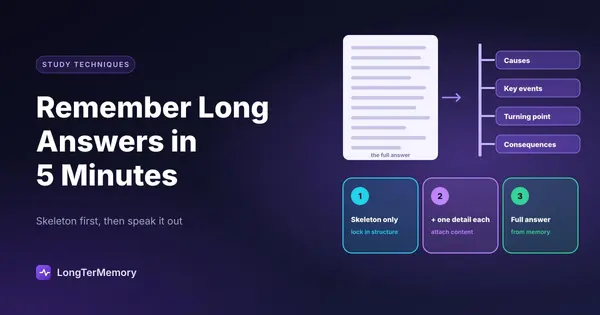
Round 1: Cover the skeleton. Try to say each point out loud, in order, from memory. Stumble on one? Glance at the skeleton, say it once, cover it again, and continue. This is not “cheating” , it’s the exact mechanism your brain needs to encode the sequence.
Round 2: Cover the skeleton again. This time, for each point you recall, try to add one supporting detail , a cause, a mechanism, an example. You’re building flesh onto the bones.
Round 3: Say the full answer out loud from start to finish without stopping. Don’t check the skeleton. Don’t pause to second-guess. If you blank, keep going , your brain often catches up a sentence later.
Three rounds, 90 seconds each. That’s your 5 minutes.
| Round | What you do | Goal |
|---|---|---|
| 1 | Skeleton recall only | Lock in structure |
| 2 | Add one detail per point | Attach content to structure |
| 3 | Full answer from memory | Simulate exam conditions |
This is a compressed version of active recall, and it’s dramatically more effective than passive re-reading for short memorization windows.
Step 3: Use Structure Cues So Your Brain Fills in the Rest
There’s one more technique that makes the 5-minute approach stick much longer than you’d expect: structure cues.
A structure cue is a word, phrase, or pattern at the beginning of each point that tells your brain what type of thing comes next. For example:
- “The first cause is…” , signals a sequence
- “This leads to…” , signals a consequence
- “However, critics argue…” , signals a counterargument
- “In summary…” , signals a conclusion
These aren’t filler words. They’re memory anchors. When you’re under exam pressure and your mind starts racing, structure cues act as railroad tracks: they keep your answer on course even when your confidence wobbles.
If your skeleton uses these cues, you’re not just memorizing what to say , you’re memorizing how to say it, which is far more retrievable under stress.
The Mistake That Kills 5-Minute Memorization
The most common error students make when trying to memorize fast is trying to memorize too much.
If you attempt to load every detail, every example, every nuance of a 400-word answer into your brain in 5 minutes, you’ll remember almost none of it. The working memory can’t process that volume that quickly.
The counterintuitive fix: deliberately leave things out. Decide in advance which 4 points are non-negotiable and which 2 are nice-to-haves. Memorize only the non-negotiables in your first pass. If time allows, add the rest. This selective approach results in a more coherent answer than a panicked attempt to cram everything.
An examiner reading an answer with 4 well-articulated points scores it higher than an answer with 6 half-remembered, disorganized ones.
How to Make It Stick Past the Exam
5-minute memorization is a short-term tactic. It works for same-day or next-day recall. If you need to retain this material for weeks or months , for a final, a professional exam, or a course that builds on itself , you need to combine it with spaced repetition.
The skeleton-based approach works beautifully here. Store your skeleton outlines as flashcard prompts: “What are the 5 key points for the economic cycles answer?” Review them the next day, then in three days, then a week later. Each review takes under 2 minutes. Over time, the answer moves from short-term recall into deep long-term memory.
Tools like LongTerMemory can turn your study materials , PDFs, notes, textbooks , directly into spaced repetition flashcards, automatically. Instead of building skeleton cards manually, you upload your notes and the system generates the Q&A pairs for you. It’s the 5-minute method scaled to an entire semester.
Quick Reference: The 5-Minute Memorization Checklist
Before your next exam, use this:
- Read the full answer once with full attention
- Extract the 4–6 non-negotiable core points
- Write skeleton (words/phrases only, hierarchical)
- Round 1: recall skeleton from memory (cover it)
- Round 2: add one detail per point
- Round 3: say full answer out loud, no stopping
- Add structure cues to the beginning of each point
That’s it. Five minutes, one structured approach, and you go into the exam with something your brain can actually use under pressure.
The real secret isn’t that you’re memorizing faster , it’s that you’re memorizing smarter. Structure beats volume. Active beats passive. And a skeleton you own beats an answer you’ve only read.