How to Recall Exam Answers Efficiently for Tests
Turn your study material into Q&A pairs, apply the hierarchy method, and use practice testing to make answers automatic under exam pressure.
Table of Contents
- Why Q&A Pairs Are the Most Efficient Unit of Study
- Step 1: Turn Your Answer Sets Into Q&A Pairs
- Step 2: Use the Hierarchy Method to Memorize Answers by Category
- Step 3: Active Practice Testing , Making Answers Automatic Under Pressure
- How Practice Testing Makes Answers Automatic Under Pressure
- A Fast Q&A Review System for the Night Before an Exam
- Scaling It Up: Let AI Build Your Q&A Pairs
- The Core Insight
Most people study their answers. The top scorers study their questions.
That distinction sounds subtle, but it changes everything about how well information sticks. When you study an answer , reading it over, highlighting it, summarizing it , you’re practicing recognition. You’d know the right answer if you saw it. But in an exam, you don’t see the answer first. You see the question. And that’s a completely different cognitive task.
The students who consistently perform well on tests have learned, often without realizing it, to memorize from the question side. They’ve trained their brain to associate the trigger (a question prompt) with the response (the correct answer). And that’s a skill you can build deliberately, quickly, and for any subject.
Here’s how.
Why Q&A Pairs Are the Most Efficient Unit of Study
Think about how memory actually works during an exam. You read a prompt , “Explain the mechanism of active transport” or “What year did the Berlin Wall fall?” , and your brain needs to retrieve the associated answer. This is a cue-target relationship: the question is the cue, the answer is the target.
When you study answers in isolation , reading your notes linearly, reviewing a summary , you’re strengthening the answer in memory but not strengthening its link to the question. So when the question appears on the test, the retrieval pathway isn’t there. You know the material somewhere, but you can’t get to it.
Studying in Q&A pairs forces you to build that retrieval pathway every time you practice. The question triggers the answer. The more times you successfully retrieve the answer from the question prompt, the stronger that pathway becomes. This is the essence of active recall, and it’s backed by over a century of memory research.
Step 1: Turn Your Answer Sets Into Q&A Pairs
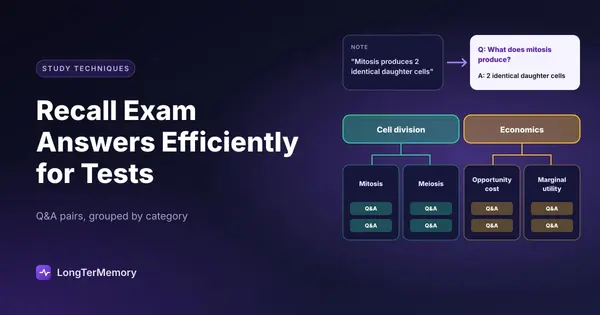
The first task is to transform your study material into a format your brain can actually use. This means rewriting your notes , or having a tool do it for you , as explicit question-and-answer pairs.
For each key concept, ask: What question would produce this answer?
Some examples:
| Original note | Q&A version |
|---|---|
| ”Mitosis produces 2 identical daughter cells” | Q: What does mitosis produce? A: 2 identical daughter cells |
| ”The Treaty of Versailles was signed in 1919” | Q: When was the Treaty of Versailles signed? A: 1919 |
| ”Opportunity cost = next best alternative forgone” | Q: What is opportunity cost? A: The next best alternative forgone |
This reframing takes effort upfront, but it pays off massively during review. You’ve already done half the memorization work by actively translating the content into question form , that act alone strengthens encoding.
Pro tip: Write the questions first, before looking at the answers. This creates a generation effect , the extra cognitive effort of producing the question makes both the question and the answer more memorable.
Step 2: Use the Hierarchy Method to Memorize Answers by Category
Not all questions are equal. Some answers are high-stakes (they appear on every version of the exam, or they underpin everything else). Some are medium-priority. Some are peripheral.
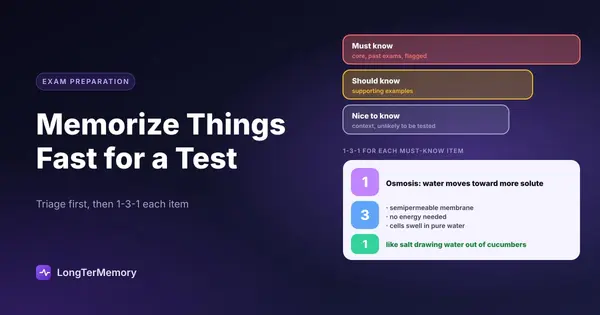
The hierarchy method is simple: organize your Q&A pairs into three tiers before you start reviewing.
Tier 1 , Must know: Core definitions, fundamental principles, anything the examiner will certainly ask. Memorize these first. Spend 60% of your review time here.
Tier 2 , Should know: Supporting concepts, secondary causes, important examples. Memorize after Tier 1 is solid. Spend 30% of your time here.
Tier 3 , Nice to know: Edge cases, additional detail, bonus knowledge. Memorize only if time allows. Spend 10% here, or skip entirely under time pressure.
This hierarchy prevents the most common exam failure: spreading attention evenly across all material and ending up with shallow knowledge across the board instead of solid mastery of the essentials.
Create your tiers before you start the review session. The act of categorizing is itself a review: you’re making judgments about importance, which encodes the material more deeply than passive reading ever could.
Step 3: Active Practice Testing , Making Answers Automatic Under Pressure
Once you have your Q&A pairs organized by tier, the actual memorization happens through practice testing. Not re-reading. Testing.
The method:
- Cover the answer side of your Q&A pair (or hide it on a flashcard)
- Read only the question
- Try to produce the answer from memory , say it out loud, write it down, or just mentally retrieve it
- Check the answer
- Mark it: confident (knew it), hesitant (partial recall), blank (didn’t know)
- Move on; come back to hesitant and blank items in the next pass
This is deceptively simple, but the key is that you must attempt to retrieve the answer before you look at it. Even a failed retrieval attempt , where you try and can’t quite get there , creates a stronger memory trace than simply reading the correct answer. The struggle is the learning.
Do three full passes through your Tier 1 questions before moving to Tier 2. By the third pass, most of your Tier 1 answers should feel automatic.
How Practice Testing Makes Answers Automatic Under Pressure
There’s a specific reason that practice testing builds pressure-resistant memory, not just regular memory.
When you retrieve an answer under test conditions , slight time pressure, a cold question prompt, no context clues , you’re training the exact neural pathway that exam day will demand. You’re not just memorizing the answer; you’re memorizing the process of retrieving it from a question stimulus.
This is why students who review by re-reading often blank out in exams even when they “knew” the material at home. Their memory is context-dependent: it worked in the reading environment but not in the retrieval environment. Practice testing bridges that gap by making retrieval practice the primary study method.
The research on this , known as the testing effect , is some of the most robust in cognitive psychology. A 2006 study by Roediger and Karpicke showed that students who studied by testing themselves retained 50% more information one week later than students who spent the same time re-reading. The effect compounds over multiple study sessions.
A Fast Q&A Review System for the Night Before an Exam
If you’re short on time, here’s a compressed system that still outperforms passive review:
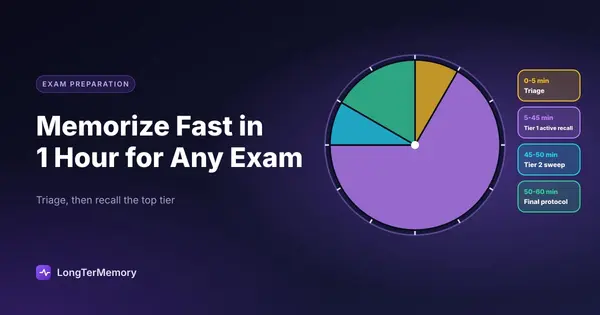
30–45 minute session:
- Minutes 0–5: Sort your Q&A pairs into tiers. Be ruthless.
- Minutes 5–20: Pass 1 through Tier 1 only. Mark confident / hesitant / blank.
- Minutes 20–30: Pass 2 through Tier 1 hesitant and blank items only.
- Minutes 30–40: Single pass through Tier 2.
- Minutes 40–45: Final rapid-fire pass through any remaining blanks.
You won’t cover everything. But you’ll know what you know, you’ll have shored up the most important gaps, and your retrieval pathways for the core content will be significantly stronger than if you’d spent the same 45 minutes reading.
Scaling It Up: Let AI Build Your Q&A Pairs
Building Q&A pairs manually from a textbook or lecture slides is effective but time-consuming. For large volumes of content , an entire semester, a professional certification, a standardized exam , the manual approach becomes a bottleneck.
LongTerMemory uses AI to automatically generate Q&A flashcard pairs from your uploaded materials. Upload a PDF, paste in your notes, or import a document, and the system extracts the key question-answer relationships for you. Combined with built-in spaced repetition scheduling, it handles both the creation and timing of your review sessions.
This means you can spend more of your limited study time on the actual practice testing , the part that builds real memory , and less on the admin of card creation.
The Core Insight
You can’t memorize answers for a test by studying answers. You memorize them by training your brain to retrieve them from questions.
Q&A pairs, hierarchical prioritization, and active practice testing aren’t tricks , they’re how memory actually works. The students who score consistently well aren’t necessarily smarter or studying longer. They’re studying in the direction of retrieval, which is the only direction that counts on test day.
Start every study session with a question. End every session knowing which questions you still can’t answer. That’s the whole game.