How to Memorize Test Questions and Answers
Build your own question bank, harness the generation effect, and review Q&A sets with spaced repetition to ace any exam with confidence.
Table of Contents
- Why the Question-Answer Link Is What Gets Tested
- Step 1: Build a Question Bank From Your Own Study Material
- Step 2: The Generation Effect , Writing Questions Improves Retention
- Step 3: Review Q&A Sets With Spaced Repetition
- How to Review Q&A Sets Most Efficiently
- A Complete System for Any Test
- The Bottom Line
There’s a subtle difference between being prepared for a test and being prepared to pass a test. Being prepared means you understand the material. Being prepared to pass means you can produce the right answers under time pressure, from a cold question prompt, without any cues.
Most students stop at the first level. They understand the material , it makes sense when they read it, they could explain it if asked directly. But they haven’t built the retrieval-on-demand system that exams actually require.
The bridge between understanding and exam performance is memorizing test questions and answers as linked units , and doing it in a way that transfers to the actual exam environment. Here’s the full approach.
Why the Question-Answer Link Is What Gets Tested
It helps to think clearly about what an exam is actually testing. It’s not testing whether information exists somewhere in your memory. It’s testing whether you can retrieve specific information in response to a specific prompt, under time pressure, in a formal environment.
That’s a very specific cognitive task. And it’s one you can train directly.
When you study a Q&A pair , seeing the question, producing the answer, checking, correcting , you’re doing exactly what the exam will ask. You’re building the neural association between the question stimulus and the answer response. Every successful retrieval strengthens that association.
When you study by reading your notes or re-reading a textbook chapter, you’re doing something quite different: you’re building familiarity with the content, but not building retrieval pathways from question prompts. That’s why students often feel well-prepared going in and then find that answers don’t come as fast or as cleanly as expected.
The solution is to make question-prompted retrieval the primary form of study, not a bonus at the end.
Step 1: Build a Question Bank From Your Own Study Material
The most effective question banks are the ones you build yourself , not because custom cards are inherently magical, but because the act of generating questions from your material is itself a powerful memory technique called the generation effect.
When you read a paragraph of notes and ask “what question would this answer?”, you’re engaging deeply with the material. You have to understand it well enough to identify what’s testable. You have to translate it into a retrieval cue. That cognitive work encodes the content far more deeply than passive reading.
Here’s how to build a question bank efficiently:
From lecture notes: After each lecture, spend 5 minutes turning your notes into Q&A pairs. Don’t wait until before the exam , the material is freshest now, and early encoding is stronger.
From textbook chapters: At the end of each section or chapter, write 3–5 questions covering the main ideas. Most textbooks have review questions at the back , use those as a starting point, but supplement with your own based on what the professor emphasized.
From past exam papers: Past papers are the highest-value source of questions. They reveal the exact format and difficulty of what you’ll face. Use them to reverse-engineer what question structures appear most often, then build your own variants around those patterns.
Format tip: For each Q&A pair, store both the question and the answer in a single place , a physical card, a digital flashcard app, or a spreadsheet. Keep them together so you can review them systematically rather than hunting through different notebooks.
Step 2: The Generation Effect , Writing Questions Improves Retention
This deserves its own section because it’s genuinely one of the most underused study techniques.
The generation effect refers to the well-documented finding that information you generate yourself , rather than passively receive , is retained significantly better. When you write a question from your notes, you’re not just recording information. You’re actively constructing it, and that construction process leaves a stronger memory trace.
There are a few ways to apply this deliberately:
Write questions before reviewing the answers. Cover your notes, read a heading or topic, and try to write a question from memory about what that section should cover. Then check your notes to write the answer. The gap between question and answer , even a few seconds , strengthens encoding.
Predict exam questions. Before reviewing a topic, ask yourself: “If I were the professor, what would I test here?” Write those predicted questions, then study the material specifically to answer them. Students who predict exam questions accurately , which becomes easier over time , perform significantly better than those who simply review all material equally.
Teach-back questions. After studying a topic, explain it out loud as if you’re teaching someone who knows nothing. Then write 2–3 questions that a student of your explanation might ask. Answer them. This forces clarity and identifies gaps you didn’t know you had.
Step 3: Review Q&A Sets With Spaced Repetition
Building a question bank is only half the work. The other half is reviewing it in a way that actually transfers material into long-term memory rather than just short-term recall.
The gold standard for Q&A review is spaced repetition , a scheduling technique based on the forgetting curve discovered by Hermann Ebbinghaus in the 1880s.
The principle is simple: review an item at the moment just before you’d forget it. This interval starts short (review again tomorrow) and gradually extends as the item becomes more solid in memory (review in three days, then a week, then two weeks). This approach is dramatically more efficient than reviewing everything every day, because it focuses your effort on the items that are actually at risk of being forgotten.
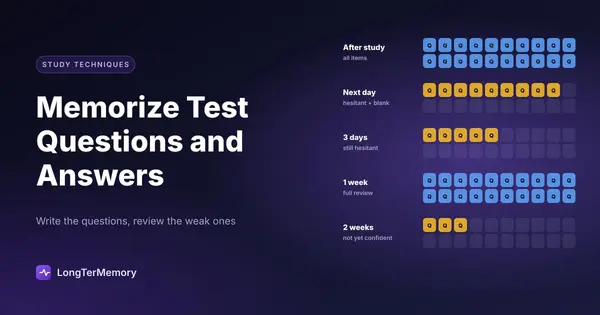
In practice, spaced repetition for Q&A review looks like this:
| Study session | What to review |
|---|---|
| After initial study | All new Q&A pairs |
| Next day | Items marked hesitant or blank from session 1 |
| 3 days later | Items marked hesitant from session 2 |
| 1 week later | All items (full review) |
| 2 weeks later | Items not yet fully confident |
Most modern flashcard tools , including LongTerMemory , automate this scheduling for you. You rate each card after retrieval (easy / medium / hard), and the system calculates the optimal next review date. This means you stop wasting time reviewing cards you already know cold and focus your attention on the ones you’re actually at risk of forgetting.
How to Review Q&A Sets Most Efficiently
A few specific techniques for making your review sessions as effective as possible:
Active retrieval only. Always attempt to retrieve the answer before looking at it, even if you’re not confident. The attempt , even a failed one , is part of the learning. Passive reading of cards is much less effective.
Say answers out loud. Verbal retrieval is more effortful than silent recall, which makes it more effective for encoding. It also mimics the written production you’ll need in the exam.
Use short, dense sessions. A 20-minute focused session with full attention is more effective than an hour of distracted half-attention. Your brain encodes more deeply when it’s genuinely engaged and the session is time-bounded.
Don’t skip failed items. When you blank on a card, your instinct might be to move past it quickly and come back to it “later.” Don’t. Look at the answer, understand why it is what it is, say it back, and put the card at the back of the deck for re-encounter in the same session.
Create answer variations. For important items, write 2–3 question variants that test the same knowledge from different angles. “What is opportunity cost?” and “Why does making one choice always involve a trade-off?” are testing the same concept but from different entry points. This prevents the brittle memorization where you can only answer the question in exactly the format you practiced.
A Complete System for Any Test
Here’s a full system that works for any exam, from a weekly quiz to a professional certification:
Week before exam:
- Build your question bank from all study materials
- Organize questions into tiers (must know / should know / nice to know)
- Run first pass: test yourself on all Tier 1 questions; mark confident / hesitant / blank
Days before exam: 4. Run focused review passes on hesitant and blank items 5. Add Tier 2 questions once Tier 1 is solid 6. Review any predicted exam questions you generated
Night before: 7. Final rapid-fire pass through all Tier 1 questions only 8. Sleep , this is when your brain consolidates the day’s learning (see why sleep matters for memory)
Morning of: 9. Quick 10-minute review of your most important 20 Q&A pairs 10. Stop studying 30 minutes before the exam , your brain needs to settle
This system works because every step is building the same thing: a strong, question-triggered retrieval pathway for the specific content that will appear on the test. By exam time, answering those questions won’t feel like a memory challenge. It’ll feel like a reflex.
The Bottom Line
Memorizing test questions and answers isn’t about cramming harder. It’s about training the right cognitive skill: retrieval from a question prompt, under pressure, on demand.
Build your own question bank. Use the generation effect to encode as you create. Review with spaced repetition so that nothing important gets forgotten. And test yourself actively, never passively.
The students who perform best on exams aren’t the ones who studied the most. They’re the ones who spent the most time in exam mode during their preparation.