How to Prepare for the NBCOT Occupational Therapy Exam
A complete guide to preparing for the NBCOT occupational therapy board exam, with study strategies, resources, and timeline planning.
Table of Contents
- Understanding the NBCOT Exam Format
- The Four NBCOT Practice Domains
- When to Start Studying
- Starting with the NBCOT Practice Exam
- Study Resources That Actually Work
- NBCOT Official Materials
- TherapyEd
- OT Miri (YouTube and Courses)
- Quizlet Decks and Community Resources
- LongTerMemory for Systematic Review
- What to Study: High-Yield Content Areas
- Frames of Reference and Theoretical Models
- Assessments and Evaluation Tools
- Pediatric OT Content
- Mental Health OT
- Competency and Practice Management (Domain 4)
- Practice Questions: The Core of Your Prep
- How to Use Practice Questions Effectively
- Study Schedule for the Final Four Weeks
- Handling Exam Anxiety
- Exam Day Logistics
- After the Exam
- Putting It Together
Graduating from occupational therapy school is a massive achievement. You’ve survived fieldwork, clinical rotations, and more theory than you thought it was possible to absorb. But between you and the OTR credential stands one more challenge: the NBCOT exam. And if you’re feeling anxious about it, that’s completely normal. It’s a genuinely difficult test covering an enormous breadth of clinical content.
The good news is that the NBCOT is a learnable exam. It’s not trying to trick you. It’s testing whether you can think like a clinician and apply OT principles to real-world scenarios. That’s a very specific skill, and it can absolutely be developed through the right kind of preparation.
This guide will walk you through everything you need to know to prepare effectively, from understanding the exam structure to planning your study timeline to using the right resources and strategies.
Understanding the NBCOT Exam Format
Before you can prepare effectively, you need to understand exactly what you’re preparing for.
The National Board for Certification in Occupational Therapy (NBCOT) OTR certification exam consists of 180 items completed in four hours. Treat every item as if it counts.
Since January 2024, items come in two types:
- Single-response multiple choice: three or four options, one correct answer
- Multi-select scenario sets: an opening scene describing a practice situation, then four related items, each with six options of which you select the three best
You receive credit for each correct option you select, and there are no deductions for incorrect ones. Single-response items make up the bulk of the exam, but the scenario sets can be the most challenging because they ask you to reason through a whole case.
The Four NBCOT Practice Domains
The exam is organized around the four domains of the official 2022 OTR Examination Content Outline:
| Domain | Weight |
|---|---|
| 1. Evaluation and Assessment | 23% |
| 2. Analysis, Interpretation, and Planning | 23% |
| 3. Select and Manage Interventions | 38% |
| 4. Competency and Practice Management | 16% |
Domain 3, Select and Manage Interventions, carries the most weight at 38%, so intervention planning and clinical reasoning deserve the largest share of your study time. Domain 4 is the smallest at 16%, but it still covers evidence-based practice, ethics, supervision, documentation, and the regulatory context of OT practice, so don’t skip it.
When to Start Studying
Most candidates have between two and four months between graduation and their exam date. Here’s a general framework:
12 weeks out: Content review begins. Work through your study materials systematically by domain.
8 weeks out: Shift to mixed practice questions alongside continued content review.
4 weeks out: Heavy practice testing emphasis. Take full-length practice exams under timed conditions.
Final week: Light review, focus on weak areas, manage anxiety.
If you have less than eight weeks, don’t panic. It’s still possible to prepare effectively, but you’ll need to be more strategic about what you study and lean even harder on practice questions as your primary study tool.
Starting with the NBCOT Practice Exam
Before you do anything else, take a baseline practice exam. NBCOT itself offers an official practice exam that closely mirrors the real thing in format and difficulty. This isn’t about passing or failing. It’s about getting a realistic picture of where you stand right now.
Your score on that baseline practice exam tells you two things:
- Which domains you’re already strong in (spend less time here)
- Which domains are weak (spend more time here, especially Domain 3 if it’s low, since it’s the largest)
Going into study without a baseline is like training for a marathon without knowing your current mile pace. You end up over-preparing areas you don’t need and under-preparing the ones that matter most.
Study Resources That Actually Work
The NBCOT prep industry is crowded with materials of widely varying quality. Here are the resources that candidates consistently report as most useful.
NBCOT Official Materials
The official NBCOT practice tests are the closest thing to the real exam: they’re built on the exam content outline and mirror its format and flow. Some are included in the NBCOT Exam StudyPack and some can be bought individually. If you only buy one resource, make it this.
NBCOT also publishes the 2022 OTR Examination Content Outline for free on its website. Read it carefully. It lists the tasks and knowledge statements in each domain, which makes it your definitive study outline.
TherapyEd
TherapyEd’s National OT Exam Review and Study Guide is probably the most widely used third-party resource for NBCOT prep. It organizes content by domain and clinical area, includes practice questions, and is regularly updated. Many candidates use it as their primary content review book.
If you’re a TherapyEd user, don’t just read it passively. Turn each section into questions you can test yourself on.
OT Miri (YouTube and Courses)
OT Miri has become one of the most popular NBCOT prep resources in recent years, particularly for visual and auditory learners. The YouTube content covers clinical concepts with clear explanations, and the paid course materials include practice questions and study guides organized by domain. Especially useful for making sense of pediatric and neurological content.
Quizlet Decks and Community Resources
There are extensive community-created Quizlet decks specifically for NBCOT preparation. The quality varies, but several well-known decks are widely used and reasonably accurate. Use these for vocabulary, frames of reference, and assessment tool review, but be cautious about using community content for anything nuanced. Verify key clinical reasoning points against authoritative sources.
LongTerMemory for Systematic Review
If you have uploaded PDF notes from your OT program, a tool like LongTerMemory can automatically generate question-answer pairs from your materials and schedule them for spaced repetition review. This is particularly useful for the high-volume content areas like assessments and frames of reference, where there are simply a lot of names, purposes, and populations to remember. Spaced repetition prevents the common experience of reviewing a concept one week and forgetting it before exam day.
What to Study: High-Yield Content Areas
The NBCOT spans the entire OT scope of practice, which is enormous. Given limited time, you need to prioritize strategically.
Frames of Reference and Theoretical Models
Frames of reference and theoretical models come up throughout the exam, both explicitly and embedded in scenario questions. You need to be able to:
- Identify which frame of reference best fits a given population and presenting problem
- Understand the core assumptions and intervention approach of each major framework
- Distinguish between similar frameworks (for example, Biomechanical vs. Rehabilitation frame)
The major ones to know deeply include: Biomechanical, Rehabilitative, Neurodevelopmental (NDT/Bobath), Sensory Integration (Ayres), Cognitive Behavioral, Model of Human Occupation (MOHO), Person-Environment-Occupation (PEO), and Occupational Adaptation.
Assessments and Evaluation Tools
Standardized assessments are heavily tested because selecting the right assessment tool for a given clinical situation is a core OT competency. For each major assessment, you should know:
- Population it’s designed for
- What it measures
- Whether it’s standardized and normed
- Time required to administer
- Whether it’s performance-based or interview-based
Key assessments to know include: COPM, AMPS, Allen Cognitive Level Screen, Barthel Index, FIM, MMSE, MoCA, Bruininks-Oseretsky, Beery VMI, Sensory Profile, and the BOTMP.
Pediatric OT Content
Pediatric content receives significant coverage on the NBCOT, including developmental milestones, pediatric conditions (cerebral palsy, autism spectrum disorder, Down syndrome, sensory processing disorder), school-based OT, and early intervention.
If pediatrics wasn’t your clinical strength, carve out extra time here. Developmental milestone sequences and the specific interventions used for various pediatric presentations tend to come up frequently.
Mental Health OT
Mental health is another area that some OT students feel underprepared in, particularly if their fieldwork placements were primarily physical rehabilitation. The NBCOT expects candidates to understand psychosocial frames of reference, group process, psychiatric diagnoses as they relate to OT function, and the role of the OT in mental health settings.
Review the major psychiatric diagnoses (schizophrenia, bipolar disorder, major depressive disorder, anxiety disorders) through the lens of how they affect occupational performance, not just their DSM criteria.
Competency and Practice Management (Domain 4)
Domain 4 is the smallest domain at 16%, but it’s easy to under-prepare because it feels like background knowledge. Topics include:
- AOTA Code of Ethics and how it applies to clinical scenarios
- Supervision requirements for OTA, OT students, and non-licensed personnel
- Documentation requirements (SOAP notes, goal writing, progress notes)
- Billing and reimbursement basics (Medicare, Medicaid, insurance)
- Informed consent and confidentiality
- Advocacy and professional roles
Many candidates assume they picked this up during fieldwork and then find these questions harder than expected. Give it a focused block of review rather than leaving it to chance.
Practice Questions: The Core of Your Prep
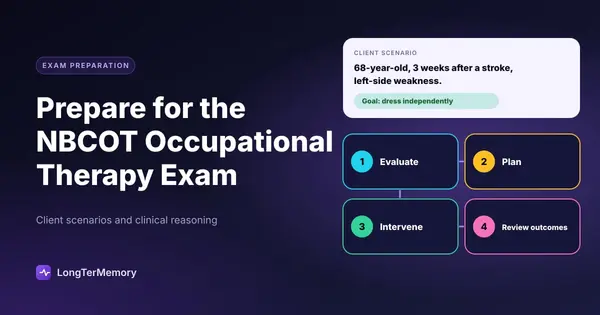
No matter how much content you review, you cannot pass the NBCOT without doing a large volume of practice questions. The exam tests clinical reasoning, not recall. Questions are scenario-based, meaning you’ll be given a client presentation and asked to determine the most appropriate evaluation, intervention, or professional response.
How to Use Practice Questions Effectively
Don’t just check your answers. After every question, whether you got it right or wrong, read the rationale. The rationale teaches you the clinical reasoning behind the answer, which is what you need to answer similar questions on the real exam.
Track your performance by domain. Most question banks allow you to filter questions by domain or content area. Run domain-specific question sets to identify exactly where you’re losing points. This is more useful than random mixed practice, at least until you’re a few weeks out.
Analyze your wrong answers. Separate your errors into categories:
- Content gap: You didn’t know the material
- Reasoning error: You knew the content but chose incorrectly
- Careless error: You misread the question or selected the wrong option
Content gaps need more study. Reasoning errors need more practice questions and rationale review. Careless errors need to be addressed through question-reading habits. These require different responses, so categorizing matters.
Take at least two full-length timed practice exams. Timing is a real factor in the NBCOT. Four hours sounds like plenty of time for 180 items, but the scenario-based format slows most candidates down. Practice under realistic conditions.
Study Schedule for the Final Four Weeks
| Week | Focus |
|---|---|
| Week 1 | Domain-by-domain content review, 80-100 practice questions per day |
| Week 2 | Full practice exam + detailed rationale review, continued weak-domain targeting |
| Week 3 | Second full practice exam, focus on assessments and frames of reference |
| Final week | Light review only, ethics and professional standards, sleep and physical self-care |
Don’t schedule new content in the final few days. Your brain needs consolidation time, and attempting to learn new material at the last minute tends to create anxiety without meaningfully improving your score.
Handling Exam Anxiety
NBCOT anxiety is extremely common, and it makes sense: this exam determines whether you can practice. A little anxiety is actually helpful for focus, but high anxiety is counterproductive.
Some strategies that candidates find genuinely useful:
Simulate the exam environment. Take your practice exams somewhere other than your couch. Sit at a desk, set a timer, and don’t check your phone. The more familiar the testing conditions feel, the less cognitive load the exam environment itself creates.
Focus on what you can control. You can control your study hours, your sleep, your nutrition, and your preparation quality. You can’t control exam day nerves or which specific questions appear. Put your energy toward the former.
Remember your clinical training. The NBCOT is testing whether you think like a competent OT. You’ve spent years learning to think exactly that way. Trust your clinical reasoning when multiple answers seem plausible.
Exam Day Logistics
- Bring two forms of identification: a valid, unexpired government-issued photo ID with your legal name and signature, plus a secondary ID
- Arrive 30 minutes early; NBCOT requires it for check-in
- The testing center will have a locker for your belongings
- Take breaks if needed, but the exam clock keeps running while you’re away, and you’ll go through check-in again to re-enter
Eat a proper meal beforehand. Not a heavy one, but not nothing. Hydrate normally. Wear comfortable layers since testing centers are often cold.
After the Exam
Scores are released according to the NBCOT Exam Scoring Calendar, and you’ll see your result in your MyNBCOT account, with an email when it’s posted. If you don’t pass on the first attempt, you can retake it. Many successful OTs have passed on the second or third attempt, and the feedback report includes domain-level performance information to guide your retake preparation.
One exam doesn’t define your career. It defines the next step.
Putting It Together
The NBCOT is a challenging but very passable exam for students who prepare strategically. Know the domain weights. Build your study plan around them. Use the official NBCOT materials. Do a large volume of scenario-based practice questions and review every rationale. Take full-length timed practice exams. Leave time for sleep and consolidation.
The clinical reasoning skills you’ve been building throughout your OT education are exactly what this exam tests. Your job now is to demonstrate that you have them, in a standardized format, under timed conditions. You can do that.