How to Prepare for the Physician Assistant National Certifying Exam (PANCE)
Practical PANCE prep strategies covering organ systems, high-yield resources, and spaced repetition to help physician assistants pass on the first attempt.
Table of Contents
- What the PANCE Tests Across Organ Systems and Medical Content Areas
- Organ Systems and Their Approximate Weightings
- Task Categories
- High-Yield Resources and Question Banks for PANCE Preparation
- The Essential Question Bank: PANCE Prep Pearls or Rosh Review
- The Review Book: Clinical Medicine Made Ridiculously Simple or PACKRAT Review
- The Video Resource: Hippo Education or PANCE Bootcamp
- Spaced Repetition and Active Recall Strategies for PANCE Readiness
- Why Spaced Repetition Is Especially Powerful for Medical Content
- How to Build a Spaced Repetition System for PANCE Prep
- Active Recall Over Passive Review
- Managing the Final Two Weeks
- A Note on Timing
- The Bottom Line
If you have made it through PA school, you already know you are built for hard things. You survived clinical rotations, shelf exams, OSCEs, and the constant feeling that you should be studying more than you currently are. And now, sitting on the other side of graduation, you are staring down the Physician Assistant National Certifying Exam, better known as the PANCE, which might honestly feel like the biggest hurdle of all.
Here is what I want you to hear before we get into the strategy: the PANCE has a first-time pass rate that consistently hovers around 96 to 98 percent for recent graduates. The exam is hard, but it is designed to be passable by someone who has genuinely trained to be a PA. You are not trying to become a specialist. You are proving that you have mastered broad clinical competency. That is a different kind of challenge, and it responds to a different kind of preparation.
This guide breaks down exactly what the PANCE tests, which resources are worth your time, and how to study in a way that builds lasting medical knowledge rather than just short-term familiarity.
What the PANCE Tests Across Organ Systems and Medical Content Areas
The PANCE is administered by the National Commission on Certification of Physician Assistants (NCCPA) and consists of 300 multiple-choice questions broken into five 60-question blocks, with a total testing time of around five hours. You have been building toward this day for years, but understanding the exact structure of what you are walking into is still step one.
The exam is organized around two frameworks at the same time: organ systems and task categories. Knowing both matters for your study strategy.
Organ Systems and Their Approximate Weightings
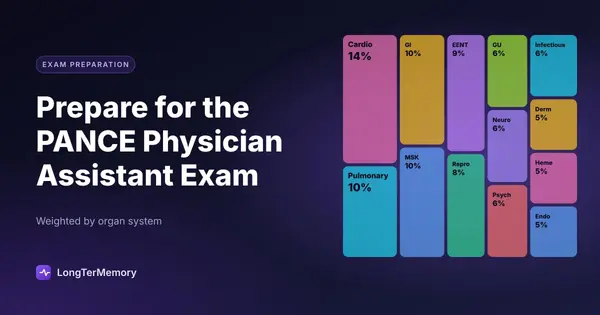
The PANCE covers twelve organ systems, and they are not weighted equally. Knowing which systems carry the most questions helps you prioritize. Here is a simplified breakdown:
| Organ System | Approximate % of Exam |
|---|---|
| Cardiovascular | 14% |
| Pulmonary | 10% |
| Gastrointestinal and Nutrition | 10% |
| Musculoskeletal | 10% |
| EENT | 9% |
| Reproductive | 8% |
| Genitourinary | 6% |
| Neurological | 6% |
| Psychiatry/Behavioral | 6% |
| Dermatology | 5% |
| Hematology | 5% |
| Endocrine | 5% |
| Infectious Disease | 6% |
Cardiovascular, pulmonary, GI, and musculoskeletal together account for nearly half your exam. Start there.
Task Categories
Beyond organ systems, every question on the PANCE also tests one of four core clinical tasks:
- History taking and performing physical examinations
- Using diagnostic and laboratory studies
- Formulating the most likely diagnosis
- Pharmaceutical therapeutics
- Health maintenance, patient education, and clinical interventions
This means the PANCE is not just a recall exam. It is asking you to think like a clinician. Questions are clinical vignettes, not isolated definitions. You will be asked to read a scenario and make a judgment call, which is why studying medical facts in isolation is not enough. You need to practice applying knowledge to cases.
High-Yield Resources and Question Banks for PANCE Preparation
The PA prep market is crowded. There are dozens of textbooks, apps, and courses claiming to be the definitive PANCE resource, and it is easy to spend so much time picking tools that you barely use any of them. The truth is that your prep stack does not need to be large. It needs to be strategic.
The Essential Question Bank: PANCE Prep Pearls or Rosh Review
Question banks are the single most important resource for PANCE prep. Doing practice questions is not just about finding the right answer. It is about learning to think through clinical reasoning under exam conditions. Every question you do incorrectly is a flashcard in disguise, pointing you directly at a gap you need to fill.
Two question banks stand out:
PANCE Prep Pearls is widely used across PA programs. It covers organ systems in detail and provides robust explanations for both correct and incorrect answers. If your program used it during rotations, you already have a head start.
Rosh Review is another top contender, particularly praised for its USMLE-style vignette format, which matches the actual PANCE question style very closely. The explanations are thorough and the question difficulty calibration is reliable.
Whatever you choose, commit to doing a set number of questions every single day, not just when you feel like it. Fifty questions per day for six to eight weeks is a realistic and effective target.
The Review Book: Clinical Medicine Made Ridiculously Simple or PACKRAT Review
For content review, many candidates swear by Lange Q&A Physician Assistant or the PACKRAT (Physician Assistant Clinical Knowledge Rating and Assessment Tool), which is a 225-question practice exam widely used during PA programs. The PACKRAT correlates well with PANCE performance, and if you took it during school, reviewing your results is a smart starting point.
PANCE Prep Pearls by Dwayne Williams also doubles as a content review resource, not just a question bank. Its tabular, high-density format makes it excellent for rapid content review in the final weeks of prep.
The Video Resource: Hippo Education or PANCE Bootcamp
If you are a visual or auditory learner, a video-based review course can fill gaps that reading alone does not address. Hippo Education PA-C Review produces high-quality, clinician-taught content. PANCE Bootcamp is another popular option with structured video lectures and integrated practice questions.
Use video content selectively. It is easy to feel productive watching lectures when you are not actually encoding information. Always follow up a video lesson with active recall, something we will come back to shortly.
Spaced Repetition and Active Recall Strategies for PANCE Readiness
Here is where most PA candidates leave performance on the table. They do questions. They review content. They watch lectures. But they do not have a systematic plan for making sure what they learned this week is still accessible in five weeks. That is where spaced repetition comes in, and for a content-heavy exam like the PANCE, it is genuinely a game changer.
Why Spaced Repetition Is Especially Powerful for Medical Content
Medical knowledge is dense and highly interconnected. The reason a drug causes a certain side effect relates to the receptor it targets, which relates to the physiology of the organ system, which relates to the pathophysiology of the disease you are treating. None of this knowledge lives in isolation, and forgetting one piece can cascade into confusion about adjacent concepts.
Spaced repetition works by scheduling review at precisely the moment your brain is about to forget something. Instead of re-reading a chapter of cardiology and feeling like you know it all over again, you get tested on the exact concepts that are slipping. It is a far more efficient use of your limited study hours.
Tools like LongTerMemory take this further by letting you upload your own study materials, including notes from PA school, and automatically generating Q&A pairs from them. Instead of spending hours building flashcard decks, you can convert your existing material into an active review system in minutes.
How to Build a Spaced Repetition System for PANCE Prep
The core principle is simple: review information at increasing intervals over time. In practice, it looks something like this:
Week 1: Study cardiovascular content. Create or import flashcards. Review them daily.
Week 2: Move to pulmonary while continuing spaced review of cardiovascular cards. You are not re-reading cardio. You are just answering flashcard questions when the system tells you to.
Week 3 and beyond: Add new organ systems while the spaced repetition algorithm handles the scheduling of everything you have already covered.
By exam day, you will have reviewed your most difficult concepts multiple times, without the feeling of aimless re-reading that kills confidence and burns time.
Active Recall Over Passive Review
Every study session should prioritize active retrieval over passive recognition. Reading a list of hypertension drugs is passive. Covering that list and trying to produce it from memory is active recall. The second approach produces dramatically stronger memories.
Practical ways to implement active recall in PANCE prep:
- Answer practice questions before reviewing content, not after. This is counterintuitive but very effective. The attempt to retrieve information before you know the answer makes subsequent learning stick faster.
- Explain concepts out loud as if you are teaching a first-year student. If you cannot explain the pathophysiology of aortic stenosis without looking at your notes, you do not know it yet.
- After every question block, close the answer explanation and try to recall what you learned from the incorrect answers. Then check.
- Use the blank page technique: after studying a disease entity, close everything and write down every clinical detail you can recall, presentation, diagnosis, treatment, and complications.
Managing the Final Two Weeks
In the two weeks before your PANCE, your job is not to learn new content. It is to consolidate what you already know. Shift your question bank focus to full-length simulated practice exams if available. Review your flagged questions systematically. Keep your spaced repetition reviews going, but do not add new cards.
Sleep is not optional during this period. Memory consolidation happens primarily during sleep, and cramming at the expense of rest is a net negative for clinical recall. Protect your sleep like it is part of your study plan, because it is.
On exam day, trust the preparation. The PANCE rewards candidates who have built genuine clinical reasoning, not just memorized lists. Go in knowing that your months of preparation have encoded far more than you consciously feel access to in the moment of sitting down.
A Note on Timing
Most PA programs recommend taking the PANCE within six months of graduation, while your clinical knowledge is still fresh. Delaying beyond that window significantly increases the content you need to refresh. If you are in that situation, audit which organ systems have gotten the rustiest and front-load your review time there.
If you have already failed the PANCE, first: you are not alone, and the data strongly shows that repeat candidates who study systematically have very high second-attempt pass rates. Use your score report to identify which organ systems and task categories were weakest, and build your next study cycle around those gaps specifically. A targeted retake strategy is far more effective than simply repeating everything you did before.
The Bottom Line
The PANCE is a broad, clinically-oriented exam that rewards systematic preparation more than heroic cramming. Focus your content review on the high-yield organ systems. Do practice questions every day. And use spaced repetition to make sure that the knowledge you build in week one is still accessible in week eight. You have done the hard work of PA school. Now you just have to show it.