How to Prepare for the PE Professional Engineer Exam
A complete guide to the PE exam: format, study strategies, reference manual tips, and discipline-specific resources to earn your professional license.
Table of Contents
- What the PE Exam Actually Tests
- Understanding the NCEES Reference Handbook
- Creating Your Study Plan
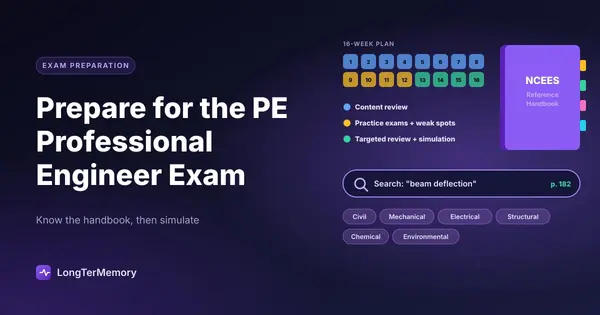
- Phase 1: Content Review (Weeks 1 to 8)
- Phase 2: Practice Exams and Weakness Identification (Weeks 9 to 12)
- Phase 3: Targeted Review and Simulation (Weeks 13 to 16)
- Discipline-Specific Resources
- Common Mistakes to Avoid
- The Mental Side of the PE Exam
- The Bottom Line
Passing the PE exam is one of the most significant milestones in an engineering career. It’s the exam that transforms you from an engineer-in-training into a licensed Professional Engineer, someone who can stamp drawings, take legal responsibility for engineering decisions, and open doors that stay closed without those two letters after your name.
And yet, a lot of engineers put it off for years. The exam feels enormous. The content spans a huge range of material. And because most people sit for it while working full time, the idea of studying while managing a real engineering job is genuinely daunting.
Here’s the thing: the PE exam is absolutely passable with a structured approach. It’s not about memorizing everything. It’s about knowing how to use your resources, understanding the format deeply, and practicing in a way that mirrors the actual test environment. This guide breaks all of that down.
What the PE Exam Actually Tests
Before you can study well, you need to understand exactly what you’re being tested on.
The PE exam is open-book, which changes the game significantly. You’re allowed to bring the NCEES PE Reference Handbook, which is the official reference document for your exam. What this means in practice is that the exam isn’t really testing whether you memorized a formula. It’s testing whether you understand engineering principles deeply enough to apply them, find what you need quickly, and solve complex problems under time pressure.
Most PE exams consist of 80 questions in a single session (for the CBT computer-based test format), with around 9 hours total including breaks. The specific structure varies by discipline, so check the NCEES website for your exact exam format.
The disciplines covered include:
- Civil (with PE exams in transportation, structural, geotechnical, water resources, and construction)
- Mechanical
- Electrical and Computer
- Chemical
- Environmental
- Industrial and Systems
- Structural
Each discipline has its own content outline and its own set of high-frequency topics. Knowing which domains carry the most weight in your discipline is your first job before you crack open any study material.
Understanding the NCEES Reference Handbook
This is the single most important document in your PE exam prep, and most candidates don’t spend nearly enough time with it before exam day.
The NCEES PE Reference Handbook is a dense, comprehensive reference document. It contains formulas, tables, unit conversion factors, charts, and technical data across every topic in your discipline. You can download it for free from the NCEES website and study with it throughout your prep.
Here’s why reference manual strategy matters so much: on exam day, time is everything. If you spend three minutes hunting for a formula every time you need it, you’ll run out of time before you run out of knowledge. The engineers who perform best on the PE exam are the ones who can navigate the reference handbook like it’s second nature.
How to build reference handbook fluency:
- Study exclusively using the digital NCEES handbook from day one, even during basic review
- Tab and bookmark frequently used sections in your personal printed copy (if you print one)
- Practice locating formulas under timed conditions during your mock exams
- Never memorize a formula cold; instead, memorize which section of the handbook contains it
Think of the handbook as your open-book cheat sheet with a time tax. The faster you can find things, the more time you have to actually solve problems.
Creating Your Study Plan
Most successful PE exam candidates study for 3 to 6 months, putting in roughly 100 to 300 total study hours depending on their background. If your daily engineering work is closely aligned with your exam discipline, you may need less time. If you’re rusty in key areas, plan for more.
Phase 1: Content Review (Weeks 1 to 8)
This is where you go back through the fundamentals of your discipline. You’re not trying to relearn everything from scratch. You’re rebuilding your working knowledge of the key topic areas and getting comfortable using the reference handbook alongside each concept.
Work through a structured review textbook for your specific PE discipline. The most popular options are the NCEES practice exams, the School of PE review guides, and PPI’s study materials. All of them organize content by exam domain and come with practice problems.
Don’t skip problem solving during content review. For every concept you review, work at least 2 to 3 practice problems immediately afterward. Passive reading of engineering concepts without working problems is one of the biggest mistakes PE candidates make.
Phase 2: Practice Exams and Weakness Identification (Weeks 9 to 12)
Once you’ve finished the content review, shift almost entirely to practice exams and problem sets. The NCEES practice exam is the closest thing to the actual exam in format and difficulty, and you should save at least one official NCEES practice exam to use as a full simulation during this phase.
After each practice session, analyze your wrong answers by topic area. You’re looking for patterns: which domains are consistently weak, which question types trip you up, and where your reference handbook navigation slows you down. Use that data to direct your final review.
Phase 3: Targeted Review and Simulation (Weeks 13 to 16)
In the final stretch, you’re not doing broad review anymore. You’re drilling your weak spots, working problems under timed exam conditions, and building the mental endurance for a long, concentrated exam session.
Run at least 2 full timed simulations before exam day. Set up your real exam environment: use only the NCEES handbook, sit at a desk, time each section, and don’t take extra breaks. The PE exam is a marathon. Your brain needs practice working at high focus for extended periods.
Discipline-Specific Resources
Your specific PE exam discipline matters a lot for resource selection. Here’s a breakdown of the most trusted resources by discipline:
| Discipline | Top Resources |
|---|---|
| Civil | NCEES practice exam, PPI Civil PE, School of PE |
| Mechanical | NCEES practice exam, MERM (Mechanical Engineering Reference Manual) |
| Electrical | NCEES practice exam, School of PE, Testmasters |
| Structural | NCEES practice exam, ASCE design standards, PPI Structural |
| Chemical | NCEES practice exam, PPI Chemical PE, Perry’s Chemical Engineers’ Handbook |
| Environmental | NCEES practice exam, PPI Environmental PE |
Regardless of your discipline, always make the official NCEES practice exam the anchor of your preparation. It’s the most accurate reflection of what the real exam looks like.
Common Mistakes to Avoid
Knowing what trips people up is as valuable as knowing what to do right.
Studying without the reference handbook. If you drill problems by memory and then sit an open-book exam, you’ll spend test day searching for things you never practiced finding. Every study session should involve the handbook.
Over-reviewing familiar material. It feels good to practice in your area of strength. But the exam doesn’t care that you’re great at fluid mechanics if you blank on structural analysis. Use practice exam performance data to guide where you spend time, not comfort level.
Underestimating the time commitment. One hour of studying per week isn’t going to move the needle. The engineers who pass treat the PE like a part-time job during their preparation period. That usually means 10 to 15 hours per week minimum.
Taking the exam before you’re ready. The PE exam costs money and effort to sit. There’s no value in rushing. If your practice exam scores aren’t consistently in passing range, push back your exam date and keep preparing.
The Mental Side of the PE Exam
The PE exam is a long, demanding test, and mental stamina matters. Candidates sometimes hit a wall in the final hours when fatigue starts to degrade their performance.
Build your endurance during preparation. Run practice sessions that are longer than feels comfortable. Learn to check your pace without obsessing over it. And develop a strategy for skipping and flagging, since moving through questions confidently and returning to harder ones later is a genuine skill that takes practice.
On exam day, trust your preparation. The engineers who prepared systematically, practiced with the handbook, and built real exam endurance are the ones who earn those PE letters.
If you’re managing large amounts of study material and want a more efficient review system, tools like LongTerMemory can help you convert technical content and practice problem explanations into spaced repetition flashcards, so the concepts you’re weakest on get reinforced automatically over time.
The Bottom Line
The PE exam is demanding, but it’s not unfair. It tests whether you can apply solid engineering knowledge in a time-pressured, reference-assisted environment, which is actually a reasonable approximation of real engineering practice. The engineers who prepare well tend to find the exam harder than they expected but manageable.
Start early. Get comfortable with the reference handbook. Work practice problems relentlessly. Run full exam simulations. And go in with the confidence that comes from knowing you prepared the right way.
Your PE license is a career-long credential. It’s worth the months of preparation it takes to earn it right.