How to Turn Procrastination Into Study Momentum
Stop waiting to feel ready. Learn the behavioral chain, Zeigarnik effect, and environmental triggers that convert procrastination into real study momentum.
Table of Contents
- The Behavioral Chain That Converts Procrastination Into Action
- The Two-Minute Entry Rule
- Breaking the Guilt-Avoidance Loop
- Using the Zeigarnik Effect to Maintain Momentum Once You've Started
- The Deliberate Interruption Technique
- Keeping Micro-Commitments Open
- Why Completion Feels So Good (and Why It Can Work Against You)
- Environmental Triggers That Interrupt Procrastination Cycles
- The Study Context
- Digital Environment Design
- The Starting Ritual That Bypasses Resistance
- A Practical Framework for the Next Time Procrastination Hits
- The Long Game: Building a Study Identity
- The Bottom Line
You know the feeling. It’s 2pm. You told yourself you’d start studying at noon. Two hours have evaporated watching videos, scrolling through your phone, reorganizing your desk, making coffee, and maybe reorganizing your desk again. And the whole time, there’s been this low-level hum of guilt sitting right behind everything you’re doing, because you know you should be studying.
Procrastination isn’t a character flaw. It’s not laziness, and it’s almost certainly not about the subject being too hard. It’s a very normal, very human response to tasks that feel aversive in some way, whether that’s because they feel overwhelming, because you fear failing at them, or because starting them requires walking away from something immediately rewarding, like your phone.
Understanding why you procrastinate is useful. But what actually changes things is understanding the mechanics of how to convert that stuck, resistant energy into actual study momentum. That’s what we’re going to cover here.
The Behavioral Chain That Converts Procrastination Into Action
One of the most powerful insights from behavioral psychology is that motivation follows action, it doesn’t precede it. Most people wait to feel motivated before they start. That approach almost never works, because the brain isn’t going to generate motivation for a task you haven’t started yet. The brain generates motivation from progress.
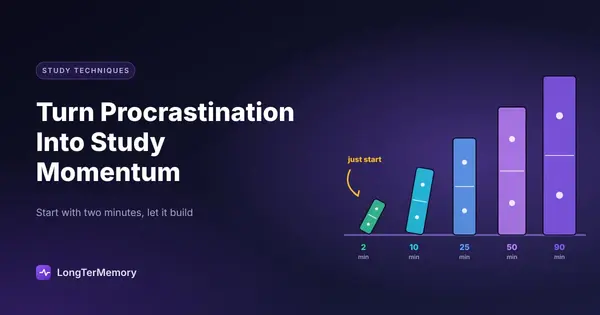
This is called the action-motivation cycle, and it flips the script entirely. Instead of waiting until you feel like studying, you take a tiny action, which creates a tiny bit of progress, which creates a small sense of accomplishment, which generates enough motivation to take the next action.
The practical implication: your opening move should be embarrassingly small.
Not “I’ll study for three hours.” Not even “I’ll read this chapter.” Try something like: “I’ll open my notes and read the first paragraph.” That’s it. That’s the entire goal for the first two minutes.
Why does this work? Because the hardest part of any study session isn’t the studying. It’s the transition from not-studying to studying. Once you’ve crossed that threshold, even with the smallest possible action, the momentum tends to build naturally.
The Two-Minute Entry Rule
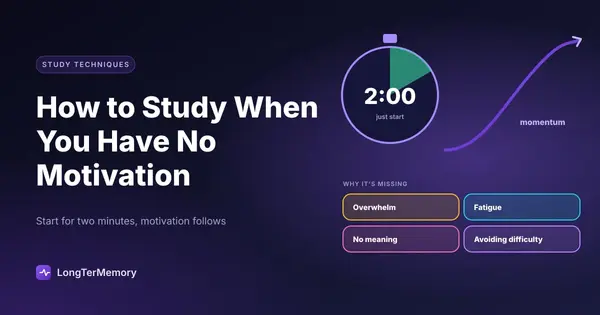
One practical version of this: commit to studying for exactly two minutes. Set a timer. Promise yourself that when it goes off, you’re completely free to stop.
Here’s what actually happens in roughly 90% of cases: you don’t stop. Because two minutes in, you’re engaged. The material has your attention. The cost of stopping now feels higher than the cost of continuing.
This works because of something called activation energy, borrowed from chemistry. Every task has an activation energy, a threshold of effort required just to begin. Procrastination is mostly about that activation energy being higher than your current motivation can clear. The two-minute rule artificially lowers the activation energy to almost nothing.
Breaking the Guilt-Avoidance Loop
Here’s a pattern that makes procrastination worse: you avoid studying because it feels aversive. The avoidance creates guilt. The guilt makes the task feel even more aversive, because now it carries emotional weight on top of the actual content. So you avoid it more. The loop tightens.
Interrupting this loop requires doing something that feels counterintuitive: being less harsh on yourself when you notice you’ve been avoiding. Not because avoidance is fine, but because the self-criticism is actively making it harder to start.
Research on self-compassion and academic performance consistently finds that students who treat themselves kindly after procrastination episodes return to studying faster than those who engage in harsh self-criticism. The guilt-avoidance loop collapses when you stop using guilt as a motivator.
A simple reframe: instead of “I’ve wasted two hours, I’m terrible,” try “I’ve been away from studying for two hours. That’s done now. What’s the smallest step I can take in the next two minutes?”
Using the Zeigarnik Effect to Maintain Momentum Once You’ve Started
Once you’ve crossed the activation energy threshold and started studying, the challenge shifts. Now the question is: how do you stay in motion?
This is where the Zeigarnik effect becomes one of the most useful tools in your kit.
The Zeigarnik effect was discovered by Soviet psychologist Bluma Zeigarnik in the 1920s. She noticed that waiters in a restaurant had remarkable recall of unpaid orders, and almost zero recall of paid ones. The act of completing a task seemed to wipe it from working memory, while incomplete tasks stayed mentally active.
The implication for studying is this: your brain maintains attention on unfinished things. An incomplete task generates a kind of mental pull, a low-level cognitive hook that keeps you oriented toward it.
You can use this deliberately.
The Deliberate Interruption Technique
Instead of studying until you’ve naturally finished a topic, try stopping deliberately mid-thought. Stop in the middle of a concept, in the middle of a practice problem, in the middle of a section you’re genuinely curious about.
When you come back to study later, or the next day, that incomplete task is already active in your working memory. There’s no cold-start problem. You’re not staring at blank notes wondering where to begin. You know exactly where you were and what you were in the middle of. You just pick it up.
Writers have used this trick for centuries. Hemingway reportedly stopped writing mid-sentence whenever he had to stop for the day, so he’d always know exactly where to pick up. The same principle applies to studying.
Keeping Micro-Commitments Open
Another application of the Zeigarnik effect: make small, specific promises to yourself about your next session while you’re still in the current one. Something like: “Next session I’m going to tackle those three pharmacology mechanisms I didn’t cover today.”
That specific, incomplete mental item stays active. It makes starting the next session easier because your brain is already partially engaged with it. It’s not a looming abstract thing, it’s a concrete next step that you’ve already identified.
This is much more powerful than a general note that says “study pharmacology.” The more specific and unfinished the commitment, the stronger the pull.
Why Completion Feels So Good (and Why It Can Work Against You)
Here’s an important flip side of the Zeigarnik effect: once you feel a sense of completion, the mental tension releases. This is satisfying in the short term, but it can reduce motivation to return.
This is why some students study intensively in one long session and then feel like they’re “done” for days afterward. They completed something, the Zeigarnik tension dissolved, and there’s no longer an unfinished hook pulling them back.
The fix: never end a session on a note of full completion. Always leave something small and specific open for next time.
Environmental Triggers That Interrupt Procrastination Cycles
The third piece of converting procrastination into momentum is your environment. Most people underestimate how much their physical and digital environment drives their behavior, including the decision to procrastinate or study.
Your environment sends cues. A phone on your desk sends a cue: check this. A browser with social media tabs open sends a cue: scroll this. A cluttered desk sends a cue: deal with this first. None of these cues require conscious thought, they happen automatically, and they compete with the cue you actually want: study this.
Designing your environment to send fewer competing cues and a stronger study cue is one of the highest-leverage things you can do.
The Study Context
The most powerful environmental trigger is location. If you study at the same desk, in the same chair, in the same spot consistently, that location becomes associated with studying. Walking into that space starts to prime your brain for study mode automatically, in the same way walking into a gym primes your body for exercise.
This is called context conditioning, and it’s why studying in bed is such a bad idea. You’ve spent years conditioning your brain to associate bed with sleep and rest. Trying to override that conditioning is an uphill battle you’ll usually lose.
If you don’t have a dedicated study space, create as much ritual around your study sessions as possible. Same location in a library or cafe. Same physical setup. Maybe the same specific playlist or ambient sound. The ritual itself becomes the trigger.
| Weak Study Environment | Strong Study Environment |
|---|---|
| Phone on desk face-up | Phone in another room or app-blocked |
| Browser with all tabs open | Study materials only, distractions closed |
| Studying in bed | Dedicated desk or study space |
| Starting when you “feel ready” | Starting with a 2-minute commitment |
| Ending when you’ve finished a topic | Ending mid-thought (Zeigarnik intact) |
Digital Environment Design
Your phone and browser are optimized by hundreds of engineers to maximize your engagement. Competing with that using willpower alone is a losing strategy. Design your digital environment instead.
Practical steps that actually work:
- Put your phone in a different room, or use apps like Forest or Freedom that block distracting apps during study blocks
- Use a browser extension that blocks social media during study hours
- Close all browser tabs except the ones you need for studying
- Use a separate browser profile for studying that has no bookmarks to distracting sites
None of these require willpower in the moment. You make the decision once when setting up, and then the environment does the work for you. That’s the whole point.
The Starting Ritual That Bypasses Resistance
A starting ritual is a short, fixed sequence of actions you do before every study session. It works as an environmental trigger: rather than relying on a physical space to prime you, it uses a sequence of behaviors.
The ritual should be short, three to five minutes maximum. It should be consistent, the same sequence every time. And it should end with you in your study materials.
Something like: put phone on silent and out of reach, make tea, open notebook, write today’s date and what you’re studying, read the first line of your notes.
The tea, the notebook, the date, these become contextual cues associated with studying. Over time, starting the ritual starts to feel like starting to study, which dramatically reduces the friction of getting going.
A Practical Framework for the Next Time Procrastination Hits
When you notice you’re procrastinating, here’s a concrete sequence to run through:
Step 1: Don’t negotiate with your brain. Don’t ask yourself if you feel like studying. Don’t check in with your motivation. Just initiate the starting ritual.
Step 2: Commit to two minutes only. Lower the activation energy to almost nothing. You are not committing to a full session. You’re committing to opening your notes and reading the first line.
Step 3: Stop mid-thought when you do eventually take a break. Use the Zeigarnik effect deliberately. Leave something open. Write a specific note to yourself about exactly where to pick up.
Step 4: Check your environment before you start. Phone dealt with. Distracting tabs closed. Correct space. If your environment isn’t set up for studying, fix that before trying to study in it.
These four steps address the three major levers: lowering activation energy, using momentum to sustain engagement, and removing competing cues.
The Long Game: Building a Study Identity
The behavioral chain, the Zeigarnik effect, and environmental design are powerful tools for individual sessions. But over time, the most durable shift is a change in self-concept.
People who consistently study aren’t people who are always motivated or who never procrastinate. They’re people who identify as learners, and who return to studying after procrastination quickly, without drama, without waiting for motivation to appear.
Building that identity is mostly a matter of showing up repeatedly, even when the sessions are short and you don’t feel like it. Each small session reinforces the identity. Each time you run the two-minute rule, you add a data point: “I’m someone who starts when I commit to starting.”
LongTerMemory can be a useful part of this system. When your review cards are automatically generated from your study materials and waiting for you, you remove one more decision from the equation. You don’t have to figure out what to study. You just open the app and work through what’s due. That kind of automated structure removes exactly the kind of friction that procrastination exploits.
The Bottom Line
Procrastination isn’t a wall you need to knock down. It’s a friction problem that can be engineered around.
Lower the activation energy with two-minute commitments. Build momentum using the Zeigarnik effect by stopping mid-thought. Remove environmental cues that compete with studying. And over time, build the identity of someone who shows up even when motivation is low.
The sessions where you start while procrastinating, where you fight the resistance and do it anyway, are often the sessions that matter most. Not because the content is different, but because every one of them reinforces the habit of starting. And starting is, genuinely, most of the battle.