How to Remember What You Read for Exams
Struggling to retain textbook chapters? Learn proven active reading and recall strategies to remember what you read and ace your next exam.
Table of Contents
- Why your brain deletes most of what you read
- Active reading vs. passive reading: what actually encodes information
- The SQ3R method in plain English
- Annotation tactics that do not waste time
- Post-reading recall sessions that cement exam content
- The 5-minute blank-page summary
- Teach it to an imaginary student
- Self-quizzing with flashcards
- How to build a review system from your reading notes
- The spaced repetition schedule that works
- From notes to flashcards in under 10 minutes
- Let LongTerMemory do the heavy lifting
- A weekly workflow to remember everything for exam day
- Conclusion
You spend two hours grinding through a dense textbook chapter. You highlight a few sentences, maybe underline a definition, and close the book feeling productive. Two days later you stare at a practice question and realize you cannot recall a single key concept. If that sounds familiar, you are not broken and you are not alone. Most students confuse reading with learning, but the truth is that remembering what you read for exams requires a completely different set of skills than simply moving your eyes across a page.
In this guide, I will show you exactly how to shift from passive consumption to active encoding. You will learn why active reading builds stronger memory traces than rereading, how short post-reading recall sessions can double your retention, and how to build a simple review system that turns your notes into exam-ready knowledge. Whether you are prepping for finals, professional certifications, or licensing boards, these strategies are backed by cognitive science and tested by top performers. If you are staring down a huge reading list with almost no time, our guide on how to read 100 pages in a day adapts these same principles for a single high-pressure session.
Why your brain deletes most of what you read
Your brain is not a hard drive. It is a prediction machine that prioritizes information it thinks you will use. When you read passively, your brain tags the material as low priority and dumps it within hours. Research by Hermann Ebbinghaus shows that without active reinforcement, we forget roughly 70% of new information within 24 hours and up to 90% within a week. That is why cramming the night before rarely sticks.
The fix is not to read slower or highlight more. The fix is to change the way your brain processes text while you read and to follow up with deliberate retrieval. Let us break down exactly how to do that.
Active reading vs. passive reading: what actually encodes information
Active reading forces your brain to process, question, and connect new information in real time, which creates stronger neural pathways than passive skimming. Passive reading is like watching a movie trailer: you get a vague sense of the plot, but you cannot retell the story. Active reading is like directing the movie: you decide what matters, fill in gaps, and link scenes together.
Here is the difference in practice:
| Passive Reading | Active Reading |
|---|---|
| Eyes move across text while mind wanders | You ask questions before each section |
| Highlighting everything that sounds important | You summarize ideas in your own words |
| Finishing a chapter without pausing | You predict what comes next and verify |
| Rereading the same page three times | You connect new facts to what you already know |
A landmark review by Dunlosky et al. published in Psychological Science in the Public Interest ranked active learning techniques as far more effective than passive strategies like rereading or highlighting alone. Specifically, practice testing and distributed practice received the highest utility ratings.
If you want to go deeper on this topic, check out our breakdown of active versus passive learning.
The SQ3R method in plain English
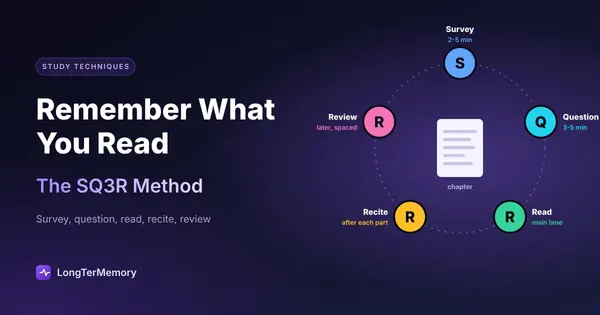
One of the oldest and most reliable active reading frameworks is SQ3R, which stands for Survey, Question, Read, Recite, Review. It sounds academic, but it is surprisingly simple.
- Survey: Skim headings, bold terms, and summaries for 2-3 minutes before diving in.
- Question: Turn headings into questions. If the heading is “The Krebs Cycle,” ask yourself, “What is the Krebs Cycle and why does it matter?”
- Read: Hunt for answers instead of drifting through paragraphs.
- Recite: After each section, close the book and answer your question out loud.
- Review: At the end of the chapter, skim your notes and verify you can recall the main ideas.
Studies show that students using structured methods like SQ3R score up to 30% higher on comprehension tests compared to those using unstructured reading. You can adapt this for dense textbooks by reading our guide on the SQ3R method for dense textbooks.
Annotation tactics that do not waste time
Highlighters are dangerous. They create an illusion of competence. Instead, use marginal notes and symbols.
- ? = I do not understand this yet.
- ! = This is likely to appear on the exam.
- -> = Connect this to a concept on page X or in another chapter.
- Summary box: At the bottom of every 5 pages, write a 1-sentence summary in the margin.
These annotations force you to judge importance and make connections, two behaviors that signal to your brain that this material is worth keeping.
Post-reading recall sessions that cement exam content
Recalling information from memory immediately after reading strengthens retention far more than rereading the same page. This phenomenon is known as the testing effect or retrieval practice. In a classic study by Roediger and Karpicke, students who practiced retrieval retained approximately 50% more information after one week than students who simply reread their notes.
The best part? You do not need a quiz bank to benefit. You just need a blank sheet of paper and five minutes.
The 5-minute blank-page summary
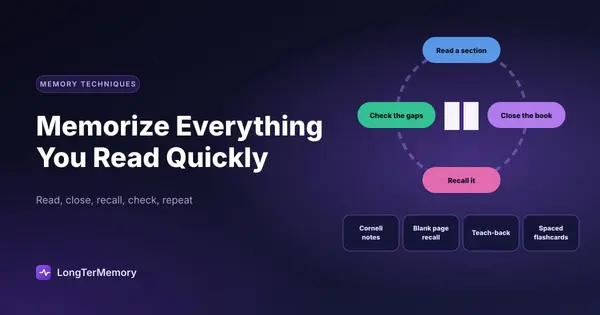
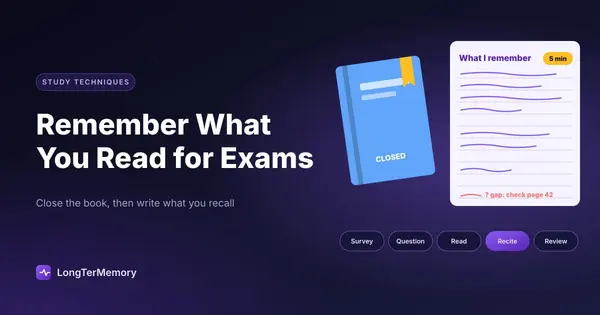
As soon as you finish a chapter or section, close the book and grab a blank page. Write down everything you can remember without looking. Do not worry about perfect organization. The struggle to remember is exactly what strengthens the memory trace.
After those five minutes, reopen the book and check your summary against the text. Mark what you missed in red. Those red gaps are your highest-priority review targets because they represent the exact concepts your brain is most likely to forget.
Teach it to an imaginary student
If writing feels stiff, pretend you are explaining the material to a confused classmate. Speak out loud for two to three minutes. Use simple language and analogies. If you stumble over a definition or cannot explain a cause-and-effect relationship, you have found a hole in your understanding.
This technique, often called the Feynman Technique, leverages elaborative rehearsal, which research links to deeper encoding than rote repetition. Teaching forces you to reorganize information into your own mental models, making it far easier to retrieve under exam pressure.
For more tactics like this, read our full guide on active recall techniques.
Self-quizzing with flashcards
Turning your reading into questions is one of the fastest ways to prepare for objective exams. Instead of highlighting a definition, write a flashcard question: “What are the three stages of memory encoding?” The act of generating the question itself is a form of active processing.
Here is a quick comparison of recall methods:
| Method | Time Needed | Best For | Retention Boost |
|---|---|---|---|
| Blank-page summary | 5 minutes | Conceptual chapters | High |
| Teach aloud | 3 minutes | Processes and systems | High |
| Self-quizzing | 2 minutes per card | Definitions and facts | Very High |
| Rereading | 15 minutes | Nothing, honestly | Low |
Notice that rereading takes the most time and delivers the least benefit. If you want proof, see why science says rereading does not work.
How to build a review system from your reading notes
A structured review system turns scattered notes into durable knowledge by scheduling spaced repetition and organizing material for quick review. Without a system, even the best notes disappear into a folder you will never open again. With a system, every hour you spend reading continues to pay off for weeks.
The spaced repetition schedule that works
Spaced repetition is the practice of reviewing material at increasing intervals. Instead of reviewing a topic every day, you review it after one day, then three days, then seven days, then two weeks. This pattern aligns with how your brain naturally forgets and strengthens memories just before they decay.
Here is a simple schedule you can start today:
| Review Round | When to Review | What to Do |
|---|---|---|
| 1st | 1 day after reading | Blank-page summary or flashcard drill |
| 2nd | 3 days after 1st review | Teach the concept aloud |
| 3rd | 7 days after 2nd review | Answer 5 practice questions |
| 4th | 14 days after 3rd review | Mixed review with other topics |
Research published in Nature shows that spaced repetition can improve long-term retention by up to 200% compared to massed practice, also known as cramming. If you are curious about the mechanics, we compared spaced repetition versus traditional studying in detail.
From notes to flashcards in under 10 minutes
Many students avoid flashcards because creating them feels like a second job. It does not have to be that way. Follow this rapid conversion process after each reading session:
- Extract: Pull out 5-10 key facts, definitions, or relationships from your notes.
- Questionize: Turn each fact into a question. For example, “Mitochondria are the powerhouse of the cell” becomes “What is the primary function of mitochondria?”
- Categorize: Tag cards by exam topic or chapter so you can study them in mixed sets later.
- Schedule: Assign each card to your spaced repetition calendar.
If you are doing this manually, aim for one 10-minute flashcard session for every 45 minutes of reading. That ratio keeps your review load manageable while maximizing retention.
Let LongTerMemory do the heavy lifting
Here is the reality: building a review system by hand takes discipline and time that most students do not have. You have to write flashcards, decide when to review them, and track your progress across dozens of topics. That is where LongTerMemory changes the game.
LongTerMemory is built on the same spaced repetition science we just covered, but it automates the busywork. You can ingest PDFs and web content directly into the platform. Instead of spending an hour manually copying definitions into flashcards, LongTerMemory extracts key concepts and generates review-ready questions for you. It then automatically schedules your reviews using optimized spaced repetition intervals, so you never have to guess when to study a topic again.
Students who switch from manual flashcard creation to LongTerMemory typically save 3-5 hours per week on study prep, time they reinvest into practice exams or deeper reading. If you are serious about remembering what you read for your next exam, start your free trial of LongTerMemory today and let the system handle the scheduling while you focus on learning.
A weekly workflow to remember everything for exam day
Putting these pieces together does not require a perfect daily routine. It just requires a consistent weekly rhythm. Here is a simple workflow you can adapt to any exam schedule:
- Monday to Thursday: Read one chapter or topic using active reading techniques. Complete a 5-minute blank-page summary immediately after each session.
- Friday: Convert your weekly notes into flashcards or questions. Schedule your first review for Saturday.
- Saturday: Complete your first spaced repetition review. Mark any cards you miss for extra attention.
- Sunday: Mixed review day. Pull cards from previous weeks and interleave topics. This combats the illusion of competence you get from studying one subject for too long.
This cycle ensures that no reading session is wasted. Every chapter gets encoded, recalled, and reviewed before your brain has a chance to dump it.
Conclusion
Forgetting what you read is not a character flaw. It is the natural result of reading without a system. The students who ace their exams are not necessarily smarter or faster readers. They are simply better at active reading, retrieval practice, and spaced repetition.
Start small. Pick one chapter this week and apply the blank-page summary technique. Convert your notes into five flashcards. Schedule one review session three days later. These tiny actions compound into exam-day confidence.
For a structured chapter-by-chapter approach, see our complete guide on how to memorize a textbook.
And if you want to accelerate the entire process, give LongTerMemory a try. With automatic flashcard generation from your PDFs and web articles, plus built-in spaced repetition scheduling, you can spend less time managing your study system and more time actually mastering the material. Sign up for your free trial here and turn every page you read into knowledge you can actually use.