How to Use Retrieval Practice for Foreign Language Listening
Most listening practice is passive. Learn how dictation, shadowing, and retrieval-based drills build real foreign language listening comprehension.
Table of Contents
- Why Passive Listening Doesn't Build Real Comprehension
- The Recognition Versus Retrieval Gap
- Speed Is Part of the Skill, Not Just an Obstacle
- Dictation and Shadowing as Retrieval-Based Listening Tools
- Dictation: Forcing Exact Retrieval
- Shadowing: Training Real-Time Production and Comprehension Together
- Building a Listening Recall Practice Routine Alongside Vocabulary SRS
- Turn Listening Mistakes Into Review Material
- A Weekly Structure That Actually Builds the Skill
- Common Mistakes That Slow This Down
- The Bottom Line
Vocabulary flashcards get all the attention in language learning, and for good reason, they work well and they are easy to build a habit around. But there is a skill that quietly wrecks a lot of otherwise solid learners at the exact moment it matters most: listening comprehension. You can pass a written vocabulary test, ace a grammar quiz, and still completely freeze the moment a native speaker starts talking at normal speed.
The reason is not that your vocabulary is insufficient. It is that most listening “practice” is actually passive exposure dressed up as practice, and passive exposure builds recognition, not the fast, automatic retrieval that real-time listening actually demands.
Why Passive Listening Doesn’t Build Real Comprehension
Think about how most people “practice listening.” They put on a podcast in their target language while cooking, or watch a show with subtitles on, and let the audio wash over them. This is not useless, exposure to natural speech patterns and rhythm has some value, but it is a fundamentally different cognitive activity from what you need for actual comprehension under real conditions.
The Recognition Versus Retrieval Gap
When you listen passively with subtitles on, you are mostly doing recognition: seeing the written word and matching it to the sound you just heard. That feels like understanding because the meaning is right there on screen. But recognition and retrieval are different skills, in the same way that recognizing a flashcard answer once you’ve seen it is completely different from producing that answer cold.
Real listening comprehension, the kind you need in a conversation, an oral exam, or watching content without subtitles, requires retrieving meaning from sound alone, in real time, without any visual crutch. If you have only ever practiced the recognition version, the retrieval version will feel shockingly harder than your practice led you to expect. This is the exact same fluency illusion that trips up students who re-read notes instead of testing themselves, just applied to your ears instead of your eyes.
Speed Is Part of the Skill, Not Just an Obstacle
There is also a timing problem specific to listening. Reading comprehension lets you set your own pace, you can pause, re-read a sentence, take as long as you need. Listening comprehension does not offer that luxury in real conversation. Native speech moves at a fixed pace whether you are ready for the next word or not, which means part of what you are training is not just “do I know this vocabulary” but “can I retrieve it fast enough to keep up.” That speed component needs its own dedicated practice, exposure alone does not train it efficiently.
Dictation and Shadowing as Retrieval-Based Listening Tools
Two classic techniques solve the passive-listening problem directly, because both force active retrieval rather than passive recognition.
Dictation: Forcing Exact Retrieval
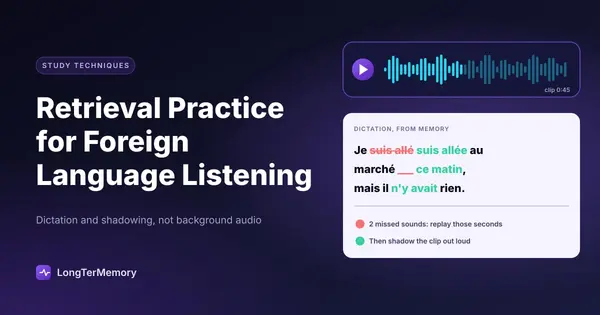
Dictation means listening to a short audio clip and writing down exactly what you hear, then checking your version against the transcript. This is a brutally effective retrieval exercise because there is nowhere to hide. You cannot fake understanding a phrase you could not actually transcribe. Every gap between what you wrote and what was actually said is a precise, specific diagnostic of where your listening comprehension breaks down, whether that’s a specific sound you’re not distinguishing, a grammatical structure you’re not parsing fast enough, or vocabulary you technically “know” but can’t retrieve at listening speed.
A simple dictation routine:
| Step | What to do |
|---|---|
| 1 | Choose a clip 30 to 60 seconds long, slightly below your comfort level |
| 2 | Listen once through without writing, just to get the gist |
| 3 | Listen again in short segments, pausing to write exactly what you hear |
| 4 | Compare your transcript to the real one, mark every discrepancy |
| 5 | Re-listen to the specific segments you got wrong, now that you know what they say |
That last step matters more than people expect. Re-listening after you already know the correct transcript trains your ear to recognize that exact sound pattern next time, which is a different and more durable form of learning than simply reading the answer.
Shadowing: Training Real-Time Production and Comprehension Together
Shadowing means listening to audio and speaking along with it, almost simultaneously, mimicking the speaker’s pace, rhythm, and pronunciation as closely as you can manage. It sounds strange the first time you try it, and it is genuinely difficult at first, but it trains something dictation doesn’t: your ability to process incoming speech and produce language at the same time, which is exactly what a real conversation demands.
Shadowing works best with material that is slightly challenging but not overwhelming, somewhere around 80 to 90 percent comprehensible is a reasonable target. If you are shadowing content you can barely follow at all, you are mostly just mimicking sounds without building genuine comprehension alongside it.
Building a Listening Recall Practice Routine Alongside Vocabulary SRS
The most effective language learners do not treat listening as a separate, occasional activity. They integrate it into the same spaced, retrieval-based system they use for vocabulary, because the underlying learning principle, testing yourself and reviewing right before you’d forget, applies just as well to sounds and phrases as it does to word-meaning pairs.
Turn Listening Mistakes Into Review Material
Every time a dictation or shadowing session reveals a gap, whether it’s a specific word you misheard, an idiom you didn’t catch, or a grammatical pattern that flew past you, that gap is exactly the kind of material worth converting into a review item, not just noting once and moving on. A short audio clip paired with its correct transcript makes a genuinely effective flashcard, one that trains sound-to-meaning retrieval directly instead of relying on the text-to-meaning retrieval that standard vocabulary cards train. Building these audio-based gaps into a spaced repetition system alongside your regular vocabulary means the exact sounds and phrases that tripped you up get resurfaced for review right when you’re about to forget them, rather than sitting in a notebook you never open again. A system like LongTerMemory, which can ingest your notes and study material and turn them into an automatically scheduled review deck, makes this loop far less manual than maintaining a separate spreadsheet of listening mistakes by hand.
A Weekly Structure That Actually Builds the Skill
A realistic weekly listening routine, layered on top of whatever vocabulary study you’re already doing, might look like this:
- Two dictation sessions per week, using short clips slightly above your comfortable level, focused on precision and diagnosing specific gaps
- Two to three shadowing sessions per week, using slightly easier material, focused on pace, rhythm, and simultaneous production
- Daily light exposure (podcasts, shows, music) for volume and familiarity with natural rhythm, understanding this alone won’t build retrieval skill but still has real value
- Ongoing spaced review of the specific words, phrases, and structures that your dictation sessions revealed as weak points
The combination matters more than any single piece. Passive exposure builds familiarity and keeps you engaged with the language day to day. Dictation and shadowing build the actual retrieval skill that passive exposure cannot provide on its own. Spaced review makes sure what you learn from your mistakes actually sticks instead of evaporating after one good session.
Common Mistakes That Slow This Down
Practicing exclusively with subtitles on. Subtitles are a useful bridge early on, but if you never remove them, you are training reading comprehension with a soundtrack, not listening comprehension. Build in regular subtitle-free sessions, even if they’re uncomfortable at first.
Choosing material that’s too hard. If you cannot follow the general gist of a clip at all, dictation and shadowing both become frustrating exercises in mimicking noise rather than building comprehension. Drop down a level, comprehension-building material should stretch you, not defeat you.
Treating listening as passive time. Podcast-while-cooking has its place, but if it’s the only listening practice in your routine, you are missing the retrieval component entirely, no matter how many hours of audio you rack up.
The Bottom Line
Listening comprehension is not a byproduct of enough passive exposure. It is a retrieval skill, just like vocabulary recall, and it needs to be trained the same way: through active, effortful practice that forces you to produce meaning from sound rather than simply recognize it. Dictation gives you precise, brutally honest feedback on exactly where your comprehension breaks down. Shadowing trains the real-time speed that actual conversation demands. And feeding what you learn from both back into a spaced review system makes sure the gaps you close stay closed.
Do this consistently, and the gap between “I know this vocabulary” and “I can actually understand someone saying it to me” starts to close, which is the entire point of learning a language in the first place.