How Spaced Repetition Compares to Traditional Studying
Explore the research on spaced repetition vs traditional studying, learn when each method works best, and discover hybrid strategies for maximum retention.
Table of Contents
- What the Research Says About Spaced Repetition Outcomes
- The Evidence Base
- Why It Works
- When Traditional Methods Outperform SRS, and When They Do Not
- What Traditional Studying Does Better
- What Spaced Repetition Does Better
- Hybrid Approaches That Combine the Best of Both Strategies
- The Two-Phase Model
- The Interleaved Weekly Routine
- Concept Cards vs. Fact Cards
- Automating the Hybrid System
- The Bottom Line
If you have spent any time in study communities online, you have probably heard people talk about spaced repetition as if it is a magic bullet for memory. You have also probably seen the skeptics who say it is overhyped, that good old-fashioned notes and re-reading work just fine, and that flashcards are too rigid for real understanding. So who is right?
The truth is more nuanced than either side usually admits. Spaced repetition is one of the most powerful memory techniques ever discovered, but it is not a complete replacement for every other study method. Traditional studying has real strengths that spaced repetition does not replicate. The students who perform best are usually the ones who understand when to use each approach, and how to combine them.
This article breaks down what the research actually says, when traditional methods win, when spaced repetition wins, and how to build a hybrid system that gets the best of both worlds.
What the Research Says About Spaced Repetition Outcomes
Spaced repetition is based on one of the oldest and most robust findings in the science of memory: the spacing effect. First documented by Hermann Ebbinghaus in the 1880s, the spacing effect states that information is retained better when it is reviewed multiple times over spaced intervals, rather than the same number of times crammed into a single session.
The Evidence Base
The spacing effect has been replicated hundreds of times across different ages, subjects, and materials. In a classic 2008 study by Karpicke and Roediger, students who used retrieval practice with spaced review retained about 80% of the material after one week. Students who used traditional re-reading retained about 33%. That is not a small difference. It is a two-and-a-half-fold improvement from the same total study time.
More recent research has confirmed that spaced repetition is particularly effective for:
- Declarative knowledge: Facts, definitions, vocabulary, formulas, dates, and terminology.
- Long-term retention: Material that needs to be remembered for months or years, such as medical knowledge, legal statutes, or language vocabulary.
- Cumulative subjects: Fields where each chapter builds on the previous one, like mathematics, chemistry, and foreign languages.
Why It Works
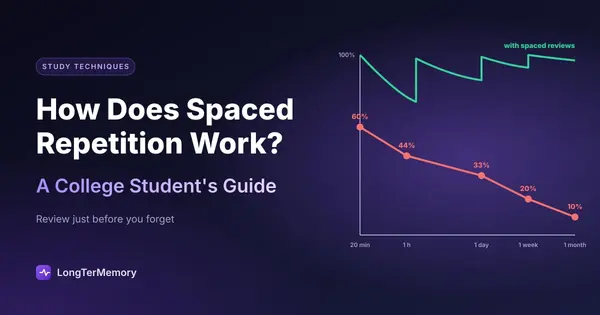
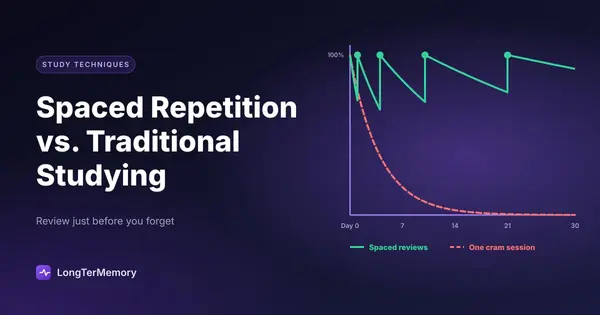
Spaced repetition works because it exploits how your brain actually forms long-term memories. Every time you successfully retrieve a piece of information from memory, the memory trace is strengthened. If you retrieve it just before you are about to forget it, the strengthening is maximized. Spaced repetition algorithms estimate your forgetting curve and schedule reviews at the exact moment when the memory is weakest but still retrievable. This creates a series of optimal strengthening events.
Traditional cramming, by contrast, creates memories that are strong in the short term but fragile in the long term. The repeated exposure during a single session strengthens the memory trace, but it does so less efficiently than spaced exposure, and the decay after the session is rapid.
When Traditional Methods Outperform SRS, and When They Do Not
Despite the impressive evidence for spaced repetition, it is not the right tool for every learning situation. Understanding its limitations is key to using it well.
What Traditional Studying Does Better
Traditional study methods, including reading, note-taking, summarizing, discussion, and problem-solving, excel in areas where spaced repetition is weak:
- Conceptual understanding: Spaced repetition flashcards are excellent for discrete facts, but they are not designed to teach you how concepts relate to each other. Understanding why a biological process happens, how a historical trend developed, or what the philosophical implications of an argument are requires synthesis, not just retrieval. Traditional methods like essay writing, diagramming, and discussion build that synthesis.
- Skill acquisition: Learning to solve calculus problems, write code, or conduct a chemistry lab requires procedural practice. You cannot flashcard your way to being able to integrate by parts. You have to do problems. Traditional practice, with worked examples and progressive difficulty, is the right tool here.
- Initial learning: Spaced repetition is a review tool, not a first-exposure tool. You need to understand something before you can effectively review it with flashcards. Reading the textbook, attending lecture, watching a video, these are the traditional methods that create the initial memory trace.
- Motivation and engagement: Some students find flashcard review monotonous. Traditional methods like study groups, teaching others, and project-based learning can be more engaging and socially rewarding. Engagement matters because it drives consistency, and consistency drives results.
What Spaced Repetition Does Better
Spaced repetition dominates in specific domains where retention of large volumes of discrete information is the primary challenge:
- Language vocabulary: Learning thousands of words in a foreign language is almost impossible without spaced repetition. The sheer volume of information overwhelms traditional review methods.
- Medical and legal knowledge: Doctors and lawyers need to retain enormous bodies of factual knowledge across years of practice. Spaced repetition is the standard tool in these fields for a reason.
- Certification exams: Most professional certification exams test a wide range of specific facts, standards, and procedures. Spaced repetition ensures that material learned six months before the exam is still accessible on test day.
- Preventing forgetting: If you have ever learned something, felt confident, and then discovered three months later that you could not remember any of it, you have experienced why spaced repetition exists. It is specifically designed to combat the natural decay of memory over time.
Hybrid Approaches That Combine the Best of Both Strategies
The best study systems do not choose between spaced repetition and traditional methods. They combine them strategically. Here is how to build a hybrid approach for different types of material.
The Two-Phase Model
For factual subjects like biology, history, or law, use a two-phase model:
Phase 1: Initial Learning (Traditional Methods) Read the textbook or attend the lecture. Take notes, ask questions, and make sure you understand the concepts. Create diagrams or concept maps to see how ideas connect. Do a few practice problems if the subject is quantitative. This phase builds comprehension.
Phase 2: Retention (Spaced Repetition) Once you understand the material, extract the testable facts, definitions, and concepts. Turn them into flashcards. Use a spaced repetition system to review them at optimal intervals. This phase prevents forgetting.
The key insight is that comprehension and retention are different cognitive processes. Traditional methods build comprehension. Spaced repetition builds retention. You need both.
The Interleaved Weekly Routine
For ongoing courses, structure your week to include both approaches:
- Monday and Wednesday: Traditional study sessions. Read new material, attend lectures, do problem sets, write summaries.
- Tuesday, Thursday, and Saturday: Spaced repetition review. Run through your flashcard decks for all active subjects.
- Friday: Mixed practice. Do practice tests, essays, or problems that require you to apply knowledge in new ways.
- Sunday: Light review and planning. Check your spaced repetition stats, identify weak areas, and plan the week ahead.
This routine ensures that you are always building new knowledge and always consolidating old knowledge. Neither phase is neglected.
Concept Cards vs. Fact Cards
One hybrid technique is to design two types of flashcards within your spaced repetition system:
- Fact cards: Simple question-and-answer cards for discrete information. “What is the capital of France?” “What is the formula for kinetic energy?”
- Concept cards: Cards that require explanation, connection, or application. “Explain how photosynthesis and cellular respiration are complementary processes.” “Apply the concept of supply and demand to explain why ticket prices rise for popular concerts.”
Fact cards handle the retention side. Concept cards push spaced repetition into the territory of deeper understanding. By mixing both types in your review deck, you get the memory benefits of spaced intervals and the comprehension benefits of traditional study methods.
If you are new to the method, our guide on how does spaced repetition work explains the forgetting curve, the spacing effect, and how to schedule reviews.
Automating the Hybrid System
The main barrier to using spaced repetition is the time it takes to create flashcards. If you have to manually type hundreds of cards from your notes, the system breaks down. This is where automation becomes essential.
LongTerMemory is built around the hybrid philosophy. You upload your PDF notes, textbook chapters, or web articles, and the platform automatically extracts key concepts and generates both fact cards and concept cards. The AI handles the flashcard creation, and the spaced repetition algorithm handles the scheduling. You get the retention power of SRS without the manual overhead.
At the same time, LongTerMemory encourages you to continue using traditional methods for initial learning. Read the material first. Understand it. Then use the platform to lock it into long-term memory. The combination is what produces durable, usable knowledge. Try LongTerMemory free and build a study system that combines the best of both worlds.
The Bottom Line
Spaced repetition is not a replacement for thinking. It is a tool for remembering what you have already thought about. Traditional studying is not obsolete. It is the foundation that makes spaced repetition useful. The question is not which method is better. The question is how to use each method for what it does best.
Build understanding with traditional methods. Lock that understanding into memory with spaced repetition. Combine them intelligently, and you have a study system that is more powerful than either approach alone.