How to Stop Overthinking and Start Studying
Break out of study paralysis: why overthinking your study plan is avoidance in disguise, and how a good-enough plan plus action beats anxiety every time.
You know the material is waiting. You have known all evening. But first you need to figure out the right approach: should you start with chapter four or review chapter three? Is it better to make flashcards or do practice questions? Maybe you should look up the best note-taking method first, there was that video about it. Actually, maybe the whole schedule needs redoing, because this week is unusual, and what is the point of starting wrong?
Two hours later you have seventeen browser tabs about study techniques, a color-coded plan you already distrust, and zero minutes of actual studying behind you. If that scene stings a little, good, this post is for you.
I study memory and anxiety for a living, and I want to make an argument that sounds harsh but is genuinely liberating: that planning session was not preparation. It was avoidance wearing preparation’s clothes. And the way out is not a better plan. It is a smaller one, executed immediately.
Why Overthinking Your Study Plan Is a Form of Avoidance
Let’s start with what is actually happening in your head during study paralysis, because understanding the mechanism is half of defeating it.
Studying for something that matters generates anxiety. That is normal and unavoidable: the material is hard, the stakes feel high, and starting means confronting the gap between what you know and what you need to know. Confronting that gap is genuinely uncomfortable. Your brain, which is exquisitely tuned to reduce discomfort right now, starts scanning for an exit.
Here is the clever part. Scrolling social media as an exit produces guilt, so your brain offers a better deal: an escape that feels like work. Researching techniques. Refining the schedule. Reorganizing notes. Choosing the perfect app. These activities have the emotional texture of productivity, effortful, study-adjacent, guilt-free, while delivering the same payoff as scrolling: you do not have to face the material yet.
Psychologists sometimes group this behavior with what is called structured procrastination, and the research on procrastination generally supports a key reframe: procrastination is not a time-management problem, it is an emotion-regulation problem. You are not planning because you lack a plan. You are planning because planning feels safe and starting feels threatening.
There is a second engine underneath it: perfectionism. The overthinking loop is usually powered by an unspoken belief that there exists a correct way to study, that choosing wrongly will waste precious time, and that more deliberation reduces the risk of choosing wrongly. Every part of that belief is false. The differences between decent study methods are small compared to the difference between studying and not studying. An hour of mediocre active review beats a perfect plan executed at zero volume, and it is not close.
And here is the cruelest feature of the loop: overthinking increases the anxiety it is trying to manage. Every planning session that ends without studying adds evidence to the quiet fear that you cannot do this. The gap does not shrink while you deliberate; the deadline does. So next time you sit down, the stakes feel higher, the anxiety is louder, and the pull toward “just figuring out the approach first” is stronger. It is a loop, and it tightens.
The Good-Enough Plan That Gets You Studying Today
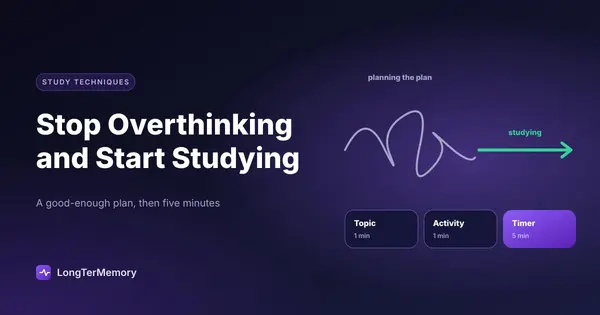
The antidote to overplanning is not no plan. It is a plan so small and so obviously adequate that your brain cannot generate objections faster than you can start. I call it the good-enough plan, and you can build it in three minutes. Literally three, set a timer, because the timer is part of the method.
Minute one: pick the topic. Not the optimal topic. Just one topic that will be on the exam and that you do not know well. If several qualify, pick whichever you saw most recently. The selection barely matters, and that is the point: any real topic studied is worth more than the perfect topic deliberated.
Minute two: pick the activity from a fixed menu. No researching methods. Your menu has three items, all of them backed by decades of memory research:
- Closed-book recall: write down everything you remember about the topic, then open the notes and see what you missed
- Practice questions on the topic, if you have any source of them
- Flashcard review, if a deck exists
That is the whole menu. Every item is a form of retrieval practice, which outperforms re-reading by roughly a factor of two in study after study. You cannot pick wrong from this menu.
Minute three: define done. A session needs a finish line or the overthinking returns mid-session (“is this working? should I switch?”). Make it concrete and small: 25 minutes on a timer, or 20 practice questions, or one full recall-and-check cycle. When you hit it, you are done and you have officially studied today.
Here is the good-enough plan as a single table you can copy:
| Decision | Rule | Time allowed |
|---|---|---|
| What topic | Any exam topic you are weak on | 1 minute |
| What activity | Recall dump, practice questions, or flashcards | 1 minute |
| How much | 25 minutes or a fixed question count | 1 minute |
One more structural tip, because decision fatigue is the fuel of overthinking: make the decisions the night before, not at the desk. A sticky note that says “Tomorrow: enzyme kinetics, 25 min recall” removes the entire decision layer from tomorrow’s session. You sit down and execute. And if you want the decision layer removed permanently, use a system that decides for you: a spaced repetition tool like LongTerMemory turns your uploaded notes and PDFs into questions automatically and tells you exactly what is due for review each day. Opening the app is the plan. For an overthinker, that is not a small feature, it is the feature: there is nothing left to deliberate about.
Action Reduces Anxiety Better Than Planning Ever Will
Now the part I most want you to internalize, because it flips the logic your anxiety is selling you.
Your brain’s pitch is: “Reduce the anxiety first, by getting clarity, then start.” It feels reasonable. It is backwards. Decades of clinical psychology, particularly the research behind behavioral activation and exposure-based approaches to anxiety, point the same direction: anxiety usually decreases after action, not before it. Waiting to feel ready is waiting for a train that arrives only once you stop needing it.
Three mechanisms drive this, and they are worth knowing:
First, starting shrinks the threat. Anxiety inflates tasks in imagination; contact with the actual task deflates them. Vague dread (“biochemistry”) becomes a bounded problem (“I remember glycolysis but not the regulation steps”). Bounded problems feel workable, and workable is the opposite of paralyzed. This is also why the first five minutes of a feared task are so disproportionately unpleasant, and why the discomfort curve drops steeply after them. Your anxious forecast is worst-case; the data from actually studying is merely average-case.
Second, action generates the evidence that self-talk cannot. You cannot think your way into feeling capable, your brain rightly discounts unearned reassurance. But a completed 25-minute session is a fact. Stack five of those facts across a week and the fear “I can’t do this” starts losing arguments with your own recent history. Confidence is downstream of evidence, and evidence is downstream of action. There is no shortcut through more planning.
Third, an unstarted task costs you all day. Unfinished, looming tasks keep intruding on your attention, and that background hum of “I still haven’t started” drains the same mental energy you need for studying. A morning session, even a small one, buys you a quieter mind for the entire rest of the day. Overthinkers chronically underrate this: the 25 minutes does not just produce learning, it switches off the alarm that was ruining the other 14 hours.
The Five-Minute Contract
If the paralysis is heavy today, use the smallest tool in the box. Make this deal with yourself: five minutes, then permission to stop. Open the notes, start the recall dump or the first flashcards, and if after five minutes you genuinely want to quit, quit, with a clear conscience, because you held up the contract.
What happens in practice, most of the time, is that you keep going. Starting was the expensive part; continuing is nearly free. The contract works precisely because it is honest, on the bad days you really do stop at five, and five minutes of retrieval practice is still infinitely more than the zero minutes that overthinking was offering. On genuinely depleted days, a kept five-minute promise also protects something subtle and important: your identity as someone who studies daily. Identities are built from kept promises, not from plan quality.
What This Looks Like as a Daily Loop
Pulling it together, here is the anti-overthinking routine in its entirety:
- Tonight: write tomorrow’s sticky note, topic, activity, finish line. Three minutes, timer on.
- Tomorrow: sit down and execute the note without renegotiating it. If resistance is high, invoke the five-minute contract.
- After the session: note one weak spot you discovered. That becomes a candidate for tomorrow’s sticky note. (Notice what this replaces: the discovery of weak spots through studying now does the job that anxious planning was pretending to do.)
- Weekly, once, briefly: a 15-minute review of what is due when, so the daily notes stay pointed at real deadlines. This is the only planning slot on the calendar. Planning outside this slot is recognized for what it is, avoidance, and answered with the five-minute contract.
No optimization research. No method-shopping. No schedule rebuilds on a Tuesday night. The system is deliberately boring, because boring is what execution looks like from the inside.
One last thing, from someone who has spent a career watching how memory actually forms: your brain does not record how elegant your study plan was. It records what you retrieved, how often, and how spaced. The learner with the crooked handwritten plan who did 25 minutes of recall every day will beat the learner with the beautiful spreadsheet every single time.
The perfect plan does not exist. The good-enough plan is on a sticky note, and today it says: one topic, one activity, 25 minutes. Start the timer.