How to Study Spanish Grammar and Vocabulary Efficiently
Master Spanish faster with spaced repetition, smart grammar drilling, and immersion balance. A practical guide for exam prep and real fluency.
Table of Contents
- Why Most Spanish Learners Plateau Early
- Spaced Repetition for Spanish Vocabulary: The Optimal System
- Grammar Drilling vs. Immersion: The Right Balance for Exam Preparation
- The Grammar Topics That Matter Most
- Oral and Written Spanish Exam Preparation Strategies
- How to Build Sentences Instead of Translating Them
- Using Technology Without Becoming Dependent on It
- Common Mistakes That Slow Spanish Learners Down
- The Long Game: Consistency Beats Intensity
If you’ve ever felt like Spanish has two completely different personalities, you’re not wrong. On one side there’s vocabulary, a giant pile of words you need to recognize and produce. On the other side there’s grammar, a web of conjugations, tenses, agreements, and exceptions that somehow always has another rule hiding behind it. Most learners attack these two areas separately, or worse, they ignore grammar until vocabulary feels comfortable, which is usually never.
The truth is that Spanish grammar and vocabulary are not separate subjects. They reinforce each other. The faster you can make them work together, the faster you will reach real fluency. This guide shows you how to study Spanish grammar and vocabulary efficiently, whether you are preparing for a DELE exam, a school test, or just want to speak with confidence.
Why Most Spanish Learners Plateau Early
Most people start Spanish with enthusiasm. They download an app, learn some phrases, and feel great for a few weeks. Then they hit the plateau. New words stop sticking. Grammar rules start blending together. The app keeps awarding gems, but actual conversation still feels out of reach.
The main reason this happens is that popular tools often prioritize engagement over memory science. They teach you to recognize words in multiple-choice questions, which feels like progress but does not build real recall. They introduce grammar in tiny bites without enough context or repetition. You end up with a collection of fragments instead of a usable mental model of the language.
Efficient Spanish study means moving beyond recognition and toward active production. You want to be able to produce the right word, in the right form, at the right moment, without translating through English first.
Spaced Repetition for Spanish Vocabulary: The Optimal System
Spaced repetition is the single most effective way to build a large Spanish vocabulary in the minimum amount of time. The idea is simple: review words right before you are about to forget them. This strengthens memory without wasting time on words you already know.
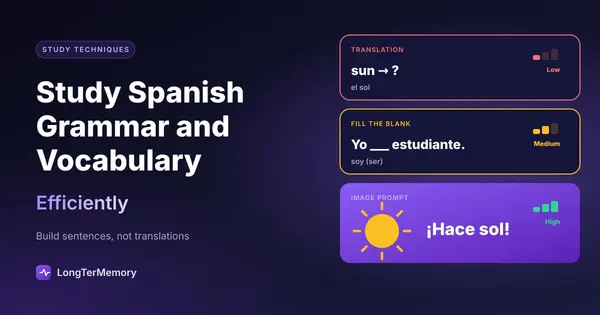
For Spanish vocabulary, spaced repetition works best when your cards go beyond simple translation. A card that asks “What is the Spanish word for house?” is weak. A card that asks you to complete a sentence like “Vivo en una ___ cerca del parque” is much stronger because it tests meaning, gender, and context at the same time.
Here is a simple comparison of card types:
| Card Type | What It Tests | Effectiveness |
|---|---|---|
| English to Spanish translation | Word recall only | Low |
| Spanish sentence with blank | Meaning plus grammar | Medium |
| Image with Spanish prompt | Direct concept mapping | High |
| Full sentence production from English | Active production | Very high |
The best approach is to build a deck with context sentences. Each new word appears in a short sentence that shows how it behaves. You will naturally absorb gender, prepositions, and common collocations without memorizing rules in isolation.
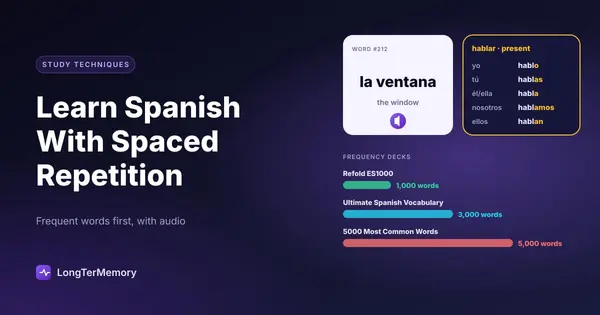
If you are just starting, focus on the 1,000 most common Spanish words first. Research consistently shows that the top 1,000 words cover around 85% of everyday conversation. After that, you can expand based on your specific goals, travel vocabulary, business Spanish, or exam preparation.
Grammar Drilling vs. Immersion: The Right Balance for Exam Preparation
There is a long-running debate in language learning. Some people say grammar drills are boring and useless. Others say immersion without structure is inefficient. The reality, as usual, is somewhere in the middle.
Grammar drilling gives you the skeleton of the language. It helps you understand why sentences are built the way they are. Without grammar, immersion is mostly noise. You might understand the mood of a conversation, but you will not learn how to form accurate sentences yourself.
Immersion gives you the living tissue. It shows you how real people use grammar in context, how word choices shift with tone, and how native speakers break rules for effect. Without immersion, grammar becomes a dry set of rules that you can explain but cannot use.
For efficient Spanish study, use a 70/30 balance in the early stages:
| Stage | Grammar Focus | Immersion Focus |
|---|---|---|
| Beginner (0-6 months) | 70% structured grammar, 30% listening/reading | Learn core patterns through short dialogs |
| Intermediate (6-18 months) | 50% grammar review, 50% immersion | Read graded readers, watch shows with subtitles |
| Advanced (18+ months) | 30% targeted grammar, 70% immersion | Consume native content, write and speak regularly |
The key is that grammar should always serve communication. Drill a tense until you can use it in a sentence, then immediately apply it in reading, writing, or speaking practice.
The Grammar Topics That Matter Most
Not all grammar points are equally important. If you want efficient progress, prioritize the topics that unlock the most real-world Spanish.
Start with the present tense of regular verbs and the two most important irregular verbs: ser and estar. These two verbs alone account for a huge amount of daily speech, and using them correctly makes you sound dramatically more fluent.
Next, master the preterite vs. imperfect past tenses. This distinction is essential for storytelling and conversation. English speakers often struggle because English uses context to mark this difference, while Spanish uses verb forms. Spending extra time here pays off enormously.
Then add the subjunctive mood. Many learners postpone this because it feels advanced, but the subjunctive appears constantly in everyday Spanish. You do not need to master every edge case, but you should recognize the common triggers like espero que, quiero que, and es necesario que.
Finally, focus on object pronouns and reflexive verbs. These are small words that carry a lot of meaning, and getting them wrong is one of the fastest ways to sound unnatural.
Oral and Written Spanish Exam Preparation Strategies
If you are studying for a Spanish exam, your preparation needs to match the exam format. A written grammar test rewards different skills than an oral interview, and efficient study means targeting exactly what the exam measures.
For written exams, practice under timed conditions. Many students know the grammar but run out of time because they have not practiced retrieving it quickly. Do past papers if they are available. Mark your errors and create flashcards specifically for the mistakes you repeat.
For oral exams, focus on automaticity. Examiners are not impressed by perfect grammar that comes out after thirty seconds of thought. They want fluid, coherent speech. Record yourself answering common questions. Listen back. Notice where you hesitate, and drill those specific structures until they flow.
Here is a simple weekly structure that balances all four skills:
| Day | Focus | Activity |
|---|---|---|
| Monday | Vocabulary | Spaced repetition + 10 new context sentences |
| Tuesday | Grammar | Targeted drills on one tense or structure |
| Wednesday | Reading | Graded reader or news article with active note-taking |
| Thursday | Listening | Podcast or show episode with transcript review |
| Friday | Writing | Short essay or journal entry using recent grammar |
| Saturday | Speaking | Conversation practice or self-recording |
| Sunday | Review | Light spaced repetition and error log review |
How to Build Sentences Instead of Translating Them
One of the biggest traps for English speakers is translating sentences word for word from English into Spanish. This almost always produces awkward results because the two languages organize information differently.
Efficient Spanish study trains you to think in Spanish structures. Instead of memorizing “I am hungry = tengo hambre,” learn that Spanish expresses hunger as something you have. Instead of asking “how do you say…?” ask “how does Spanish express this idea?”
A great exercise is to take a short English sentence and generate three different Spanish versions. For example, “I finished my homework” could become:
- Terminé mi tarea.
- Ya acabé con la tarea.
- Me terminé la tarea.
This forces you to think about register, regional variation, and natural phrasing rather than just one correct answer.
Using Technology Without Becoming Dependent on It
Apps and AI tools can accelerate your Spanish study enormously, but they can also become a crutch. The most efficient learners use technology to handle repetitive work and then step away to practice real production.
For example, an AI tool can generate example sentences for a new vocabulary word. That saves time. But you still need to write your own sentences, say them out loud, and use them in a real conversation. The tool creates the opportunity; your brain has to do the actual learning.
LongTerMemory works well here because it can turn your Spanish notes, textbook chapters, or grammar explanations into reviewable Q&A cards automatically. Instead of spending half your study time formatting flashcards, you can spend that time reviewing and producing Spanish. The AI generates cards from your materials, and the spaced repetition engine schedules them at the right intervals.
Common Mistakes That Slow Spanish Learners Down
Even with a good system, certain habits will sabotage your progress.
The first is collecting too many resources. Five apps, three textbooks, and twenty YouTube channels create decision fatigue. Pick one main grammar resource, one spaced repetition app, and one immersion source. Stick with them until you outgrow them.
The second mistake is neglecting pronunciation early on. Spanish pronunciation is relatively consistent, but bad habits fossilize quickly. Spend fifteen minutes a week on pronunciation drills, especially on the rolled R, the distinction between B and V, and stress patterns.
The third mistake is avoiding output. Many learners consume Spanish passively for months without speaking or writing. Output is where you discover the gaps in your knowledge. Start producing simple sentences from week one, even if they are full of errors.
The Long Game: Consistency Beats Intensity
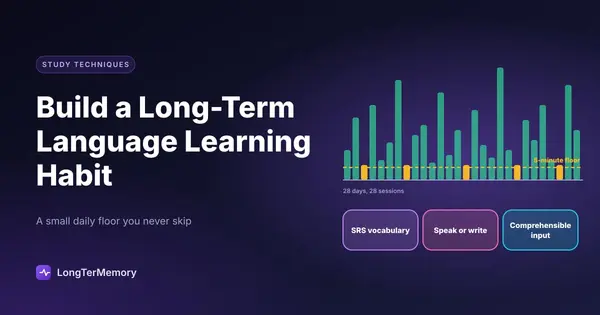
Spanish fluency is not built in a weekend. It is built through small, consistent sessions that compound over time. Twenty focused minutes a day will outperform three-hour cram sessions every time.
Make Spanish a daily habit, even on busy days. Review your spaced repetition deck. Listen to one song and read the lyrics. Write one sentence using a new grammar point. These tiny actions keep the language alive in your brain and prevent the backward slide that happens after breaks.
If you want to make the process even smoother, use a tool like LongTerMemory to generate cards automatically from your Spanish study materials. The less time you spend on deck management, the more time you spend actually learning. Try it for free and see how much faster vocabulary and grammar start to stick when the review schedule is handled for you.
Efficient Spanish study is not about doing more. It is about doing the right things in the right balance. Build your vocabulary with spaced repetition. Master core grammar through deliberate practice. Immerse yourself in real content. And never let a day go by without some active production. Do that consistently, and Spanish will stop feeling like a subject and start feeling like a skill you actually own.