How to Prepare for the TOEFL iBT Exam
A TOEFL iBT study plan for the 2026 format: sections, task types and the new 1-6 score scale, strategies for each skill, and how to use practice tests well.
Table of Contents
- Understanding the TOEFL iBT Format and Scoring
- The four sections
- What "adaptive" means for you
- How scoring works now
- Test at a center or at home?
- Step 1: Take a Diagnostic Test and Set Your Target
- Section-Specific Strategies for Reading, Listening, Speaking, and Writing
- Reading
- Listening
- Writing
- Speaking
- Section strategy summary
- Practice Resources and Mock Test Strategy for TOEFL Readiness
- Resources compared
- How to use full practice tests
- A 6-week TOEFL study plan
- Build Vocabulary That Lasts Until Test Day
- Common TOEFL Preparation Mistakes
- Frequently Asked Questions
- How long does it take to prepare for the TOEFL iBT?
- What changed in the TOEFL iBT in 2026?
- What is a good TOEFL score?
- Can I take the TOEFL iBT at home?
- What is the best way to study for TOEFL vocabulary?
- Turn Your Study Material Into Daily Reviews
- The Bottom Line
To prepare for the TOEFL iBT, first learn the current format (since January 2026 it’s a shorter, partly adaptive test of about 1.5 hours, scored on a 1 to 6 band scale alongside the familiar 0 to 120), then take a diagnostic practice test, and spend 4 to 12 weeks on daily academic vocabulary, section-specific task practice, and timed full tests. Most of your score gain will come from targeted practice on your weakest section and from making your speaking and writing responses automatic.
If you last looked at the TOEFL a few years ago, a lot has changed. The test is shorter, the task types are new, and the score report looks different. Some prep books and YouTube videos still describe the old version, which is a quick way to practice for an exam you won’t take.
This guide covers the format as it works now, strategies for every section, and a practice plan that gets you from “I’m not sure where I stand” to “I’m ready to book.”
Understanding the TOEFL iBT Format and Scoring
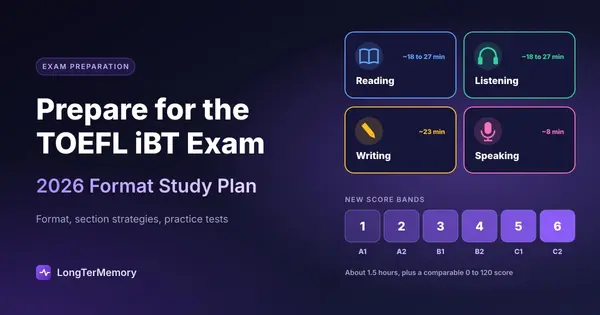
The TOEFL iBT tests four skills (Reading, Listening, Writing, Speaking) in about 1.5 hours, and since January 21, 2026 it uses new, shorter task types, multistage adaptive Reading and Listening sections, and a 1 to 6 band score aligned with the CEFR. ETS also reports a comparable score on the 0 to 120 scale during a transition period, so schools that still use the old scale can read your results.
Exact timings and task counts can change, so double-check the official ETS TOEFL website before your test date.
The four sections
| Section | Approximate time | Task types |
|---|---|---|
| Reading | About 18 to 27 min (adaptive) | Complete the Words, Read in Daily Life, Read an Academic Passage |
| Listening | About 18 to 27 min (adaptive) | Listen and Choose a Response, Conversation, Announcement, Academic Talk |
| Writing | About 23 min | Build a Sentence, Write an Email, Writing for an Academic Discussion |
| Speaking | About 8 min | Listen and Repeat, Take an Interview |
What “adaptive” means for you
In multistage adaptive sections, your performance on the first part decides whether the second part is easier or harder. Practically:
- Accuracy at the start matters. Don’t rush the first module.
- Harder questions in the second part are a good sign, not a reason to panic.
- You can’t predict your score from how hard it feels.
How scoring works now
| Scale | What it shows |
|---|---|
| 1 to 6 bands (in half-band steps) | The main score for each section and overall, aligned with CEFR levels (roughly A1 to C2) |
| 0 to 120 | A comparable score reported during the transition period |
| CEFR level | Shown on the score report |
Check which scale your target university, employer, or visa authority uses, and what minimum they require for each section, not just overall. Many programs set section minimums, especially for Speaking and Writing. Scores are valid for 2 years.
Test at a center or at home?
The TOEFL iBT is available at test centers and as a Home Edition with an online proctor. The content is the same. Home testing has strict room and equipment requirements, so run the official system check days in advance, not on the morning of the exam.
Step 1: Take a Diagnostic Test and Set Your Target
Before studying anything, take a full official practice test under timed conditions, then compare each section score with your target. The gap tells you how long you need and where to spend your time.
| Gap to your target | Typical prep time (1 to 2 h/day) |
|---|---|
| Already at or near your target | 2 to 4 weeks (format practice) |
| Half a band to one band | 6 to 8 weeks |
| More than one band | 3 months or more, with general English work first |
Write your section targets down. “Overall 5” isn’t a plan. “Reading 5, Listening 5, Writing 4.5, Speaking 4.5 (minimum 4 on each)” is.
Section-Specific Strategies for Reading, Listening, Speaking, and Writing
Each section rewards different skills, so practice each with its own routine rather than general English study alone. Here’s what works for each one.
Reading
The new Reading section mixes academic passages with everyday texts (emails, notices, schedules) and a word-completion task that tests vocabulary and grammar together.
- Complete the Words: this rewards strong spelling and knowledge of word forms. Practice reading academic paragraphs and filling in missing letters from context.
- Read in Daily Life: skim for purpose first (Who wrote this? Why?), then scan for details.
- Academic passages: read the first and last sentence of each paragraph to map the structure, then answer questions by returning to the text.
- Vocabulary is the engine. Learn academic words in context (example sentences, not just definitions). Our guide on learning academic vocabulary in a new subject shows a method that sticks.
Listening
- Take short notes, not transcripts: key words, arrows, abbreviations.
- Listen for signal phrases: “the main point is,” “however,” “on the other hand,” “what this means is.” Questions often target what comes right after them.
- Choose a Response tasks test natural conversation. Practice by listening to everyday English (podcasts, campus-style conversations) and predicting what someone would reply.
- Daily habit: 20 to 30 minutes of academic audio (lectures, educational podcasts), with a 2-sentence spoken summary afterward.
Writing
- Build a Sentence: you arrange words into a correct sentence. It tests grammar and word order, so review question formation, reported speech, and relative clauses.
- Write an Email: be clear and complete. Cover every point in the prompt, use a polite opening and closing, and match the tone (formal to a professor, friendly to a classmate).
- Academic Discussion: state your position in the first sentence, give one strong reason with a specific example, and respond to at least one other participant’s idea.
Here’s a reusable template for the academic discussion task:
| Part | What to write | Length |
|---|---|---|
| Position | ”I believe that… because…“ | 1 sentence |
| Reason + example | A specific, concrete example | 2 to 3 sentences |
| Engage another view | ”While [name] makes a good point about…, I think…“ | 1 to 2 sentences |
| Wrap-up | Restate in different words | 1 sentence |
Aim for roughly 100 words or more of clear, accurate English. Quality and relevance count more than length, but very short answers rarely score well.
Speaking
The new Speaking section is short, about 8 minutes, and focuses on two tasks:
- Listen and Repeat: you hear sentences and repeat them exactly. This tests pronunciation, rhythm, and listening accuracy. Practice with shadowing: play a short audio clip, pause, and repeat it word for word, then compare.
- Take an Interview: you answer questions on a familiar topic. Use a simple structure: answer directly, give a reason, add a personal example.
Record yourself every day. Listening back is uncomfortable, but it’s the fastest way to hear filler words, long pauses, and pronunciation habits you don’t notice while speaking.
Section strategy summary
| Section | Biggest score lever | Daily practice |
|---|---|---|
| Reading | Academic vocabulary + skimming | 1 passage + 15 new words |
| Listening | Note-taking + signal phrases | 20 min audio + spoken summary |
| Writing | Templates + grammar accuracy | 1 email or discussion response |
| Speaking | Fluency + pronunciation | 10 min shadowing + 2 recorded answers |
Practice Resources and Mock Test Strategy for TOEFL Readiness
Use official ETS materials as your main practice source, because they match the current format exactly, and take at least two or three full timed practice tests before your exam. Third-party materials are useful for extra drills, but only if they’ve been updated for the 2026 format.
Resources compared
| Resource | Best for | Watch out for |
|---|---|---|
| Official ETS free practice test | Diagnostic and final check | Limited number of tests |
| TOEFL TestReady (ETS) | Official practice and feedback | Some features are paid |
| Official ETS prep books and courses | Structured study | Make sure the edition covers the 2026 format |
| Third-party apps and books | Extra drills and vocabulary | Many still describe the pre-2026 test |
| Academic podcasts and lectures | Listening stamina | Not test-formatted |
| Spaced repetition flashcards | Vocabulary and grammar retention | Only as good as the words you add |
How to use full practice tests
- Test 1 (diagnostic): at the very start.
- Test 2: around the midpoint, to measure progress and adjust your plan.
- Test 3 (and 4 if you have time): in the final 1 to 2 weeks, under real conditions: same time of day, same setup (especially for Home Edition), no pauses.
After each test, spend as much time reviewing as testing. For every mistake, note the reason: vocabulary, misunderstood question, time, or grammar. Then turn it into practice: new words go into your flashcards, grammar errors go into a short review list.
A 6-week TOEFL study plan
For a learner about one band below their target, studying 1 to 1.5 hours a day:
| Week | Focus |
|---|---|
| 1 | Diagnostic test, format study, start daily vocabulary |
| 2 | Reading and Listening task types, note-taking practice |
| 3 | Writing templates, Build a Sentence grammar review |
| 4 | Speaking: daily shadowing and recorded interview answers, practice test 2 |
| 5 | Weakest section focus, timed section drills |
| 6 | Full practice test 3, light review, rest before test day |
Build Vocabulary That Lasts Until Test Day
Academic vocabulary drives your score in every section, and spaced repetition is the most efficient way to keep hundreds of new words available. Learning 15 words a day for 6 weeks is about 600 words, but only if you’re still remembering the ones from week one in week six.
A few rules that make vocabulary study effective:
- Learn words in sentences, not isolated translations.
- Include collocations: “conduct research,” “draw a conclusion,” “significant impact.”
- Review on a spaced schedule instead of rereading lists.
- Use the words: in your writing responses and speaking practice, the same week you learn them.
The research on this is solid: spaced retrieval beats massed study for vocabulary retention. We cover the method in detail in spaced repetition for language learning.
Common TOEFL Preparation Mistakes
The most common mistake today is preparing for the old TOEFL format. Others to watch for:
- Studying general English only, without practicing the actual task types
- Skipping speaking practice because it feels awkward
- Taking practice tests without reviewing the mistakes
- Ignoring section minimums required by your school
- Memorizing whole essays (raters notice, and they rarely fit the prompt)
- Not testing your Home Edition setup in advance
Frequently Asked Questions
How long does it take to prepare for the TOEFL iBT?
It depends on the gap between your current level and your target. Students close to their target often need 2 to 4 weeks of format practice. Those about one band below usually need 6 to 8 weeks of daily study, and larger gaps take 3 months or more.
What changed in the TOEFL iBT in 2026?
Since January 21, 2026, the TOEFL iBT is shorter (about 1.5 hours), uses new task types, has multistage adaptive Reading and Listening sections, and reports scores on a 1 to 6 band scale aligned with the CEFR, plus a comparable 0 to 120 score during the transition period.
What is a good TOEFL score?
It depends on your goal. Check your target university or program’s requirement, including which scale it uses and any minimum per section. Competitive programs often require higher Speaking and Writing scores than less selective ones.
Can I take the TOEFL iBT at home?
Yes. The TOEFL iBT Home Edition has the same content and scoring as the test center version, with an online proctor. You need a quiet private room and equipment that passes ETS’s system check.
What is the best way to study for TOEFL vocabulary?
Learn academic words in context, including common collocations, and review them with spaced repetition. Then use new words actively in your writing and speaking practice the same week.
Turn Your Study Material Into Daily Reviews
A TOEFL score is built on hundreds of words, phrases, and grammar patterns you need to recall instantly, under time pressure. Writing all those flashcards by hand takes hours you’d rather spend practicing.
LongTerMemory generates question and answer cards automatically from your study materials: upload academic articles, practice test transcripts, or your vocabulary notes as PDFs or web pages, and it creates the cards and schedules them with spaced repetition. You review a few minutes a day, and words from week one are still there on test day. The free trial is a good fit for a 6-week TOEFL plan.
The Bottom Line
TOEFL iBT preparation starts with knowing the current test: about 1.5 hours, new task types, adaptive Reading and Listening, and a 1 to 6 band score. Take a diagnostic, set section targets, and practice each skill with its own routine: vocabulary and skimming for Reading, note-taking for Listening, templates for Writing, shadowing and recording for Speaking.
Use official materials, take two or three full timed practice tests, review every mistake, and keep your vocabulary alive with spaced repetition. That’s the shortest path from where you are to the score you need.