How to Recover Mid-Exam After Misreading a Question
Just realized you misread an exam question? Here's what to do in the next 60 seconds: decide if it's worth fixing, calm down fast, and protect your score.
Table of Contents
- The 60-Second Recovery Plan
- How to Catch and Recover From Misread Questions Before Submitting
- Fix It Now, Fix It Later or Let It Go
- The Five-Second Math
- Is It Safe to Change Your Answer?
- Rescuing an Essay on the Wrong Topic
- The Emotional Regulation Required to Move On
- Calm Your Body in Under a Minute
- Give Your Mind a Script
- Why Replaying the Mistake Costs You Marks
- Should You Recheck Everything You've Done So Far?
- The Words That Trip People Up
- Building Exam Resilience So One Bad Question Doesn't Derail the Whole Test
- Rehearse Things Going Wrong
- Train a Reading Method
- Build Some Time Into Your Pace
- Track Your Misreads
- Know the Material Well Enough to Have Spare Attention
- FAQ
- Should I go back and change an answer after misreading it?
- What if I can't go back to the question?
- How do I stop panicking after a mistake?
- Why do I keep misreading questions even though I know the material?
- Should I tell the examiner I've made a mistake?
- The Bottom Line
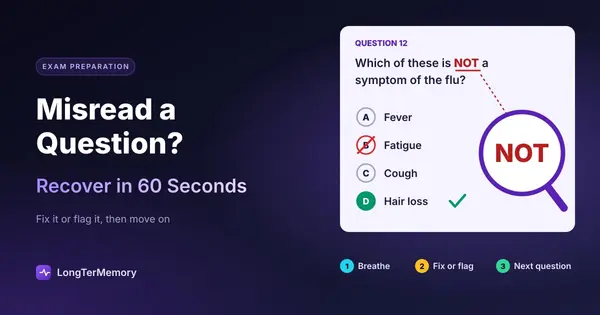
Your stomach drops. You’re on question 34 when you see the word NOT in question 12, and you answered it as if the word wasn’t there. Your heart speeds up. Now you’re wondering what else you missed.
First, the most important thing: that one question is almost never the real danger. The next ten minutes are. One misread question usually costs you a point or two. A panicked brain can cost you a lot more over the rest of the test.
Here’s how to handle it: what to do in the next 60 seconds, how to tell whether going back is worth it, how to steady yourself, and how to train so you’re less likely to do it again. The training part builds on our exam preparation guide.
The 60-Second Recovery Plan
When you realize you’ve misread a question, follow these four steps in order. Keep this list somewhere in your memory, because you won’t want to be inventing a plan in the moment.
- Pause and breathe (10 seconds). Take your hands off the keyboard or put your pen down. Breathe in, then let out a long, slow breath, two or three times.
- Check the rules (5 seconds). Can you go back to this question? If not, it’s gone, so skip straight to step 4.
- Make the decision (10 seconds). Is it worth fixing now, later or not at all? The table below tells you how to decide.
- Get back to the question in front of you. Read it slowly and carefully, as if it’s the first of the test.
The rest of this article explains the reasoning, but those four steps are the whole system.
How to Catch and Recover From Misread Questions Before Submitting
If you can still change your answer, the fix depends on how much it will cost you in time and how many marks are at stake.
Fix It Now, Fix It Later or Let It Go
| Situation | Best move |
|---|---|
| Multiple choice, you already know the right answer | Fix it now. It takes seconds |
| Multiple choice, you’d need to rework it | Flag it and come back at the end |
| Short written answer, small fix | Add a clear correction if you have the time |
| Long essay, wrong prompt, plenty of time left | Calculate the marks first, then decide (see below) |
| Long essay, wrong prompt, little time left | Add a short section answering the real question and link what you’ve already written |
| Adaptive or no-return test, such as NCLEX | Let it go. Your only job is the next question |
The Five-Second Math
When you’re stressed, one mistake feels enormous. A quick calculation brings it back to its real size.
- On a 100-question exam, one question is 1% of your score.
- On a test with a 130-question scored section, it’s under 1%.
- On a paper of 80 marks, a 4-mark question is 5%, which might justify a minute or two, but not ten.
Compare that with the time you have left. A simple rule: spend time on a fix in proportion to what it’s worth. Twenty minutes rescuing a 4-mark question could cost you far more on the questions you haven’t reached.
Is It Safe to Change Your Answer?
Yes, when you have a real reason. Misreading the question is about the best reason there is. The popular advice to “always trust your first instinct” doesn’t hold up well.
In a 2005 study, Justin Kruger, Derek Wirtz and Dale Miller looked at the eraser marks on midterm exams from more than 1,500 students. Changes from wrong to right outnumbered changes from right to wrong by about 2 to 1. Their explanation for the myth is regret: when you change an answer and get it wrong, you remember it painfully, so switching seems riskier than it really is.
There’s an important condition, though. Those students chose which answers to change, and they usually had some reason for it. The advice isn’t to change answers because you feel nervous. Change them when you’ve found something specific, like a misread word, a clue in another question or a calculation error.
Rescuing an Essay on the Wrong Topic
This is the scary version, and it’s rarely as hopeless as it feels. Try this:
- Reread the actual prompt and underline the verbs and limits, such as “compare”, “since 1945” or “two reasons”.
- Look for what you can salvage. Often, some of your material is still relevant.
- Add a clear bridge. For example: “These factors matter to the question because…” Then answer the real question directly in a new paragraph.
- Never cross out good work without a replacement. Many markers won’t grade what’s crossed out. Wait until the new answer is finished, and leave what you’ve written if it could earn something.
A short, direct answer to the right question will often earn more than a long, polished answer to the wrong one.
The Emotional Regulation Required to Move On
To recover, you need to calm your body first, then give your mind a useful instruction. Trying to “think positive” while your heart is racing rarely works by itself.
The physical alarm you feel isn’t a character flaw. Stress floods your system and competes for the working memory you need for the test. That’s why mistakes tend to arrive in clusters: the first error causes the panic, and the panic causes the next two. For more on why that happens, see how stress affects your memory.
Calm Your Body in Under a Minute
The simplest tool is a long exhale. Breathe in through your nose, then breathe out for longer than you breathed in. Researchers at Stanford (Balban and colleagues, 2023) found that just five minutes a day of breathing with extended exhales improved mood and reduced resting breathing rate. You won’t have five minutes in the exam, but two or three long breaths can take the edge off. It also gives you something to do in place of spiraling.
Other quick resets you can do at your desk:
- Press your feet into the floor and notice the pressure.
- Drop your shoulders and unclench your jaw.
- Look away from the screen at a distant spot for three seconds.
- Have a sip of water, if it’s allowed.
Give Your Mind a Script
Your inner voice is going to say something. Decide in advance what it says.
| The spiral | The script |
|---|---|
| ”I’ve failed this." | "That’s one question. I’m still in this." |
| "What else did I miss?" | "I’ll check at the end, if I’ve got time. Now, the next question." |
| "I’m so stupid." | "I found the mistake. That means I’m reading carefully now." |
| "I’m shaking, this is bad." | "This is adrenaline. It’s giving me energy to focus.” |
That last line has research behind it. In a 2010 study by Jeremy Jamieson and colleagues, students preparing for the GRE were told that arousal can improve performance. They scored higher on the math section than students who received no such message. Treating that racing heart as fuel doesn’t remove it, but it can stop it from getting in the way.
Why Replaying the Mistake Costs You Marks
Your attention is limited. Every bit of it that’s replaying question 12 is unavailable for question 35. This is what makes a small mistake expensive, and it’s the thing you can actually control.
If the thought keeps coming back, try a quick physical “parking” routine. If scratch paper is allowed, write “Q12” and put a box around it. Tell yourself you’ll deal with it at the end. That small act tells your mind the problem has been stored, so you don’t have to keep holding it in your head.
If your problem is less a mistake and more a sudden blank, we also have a dedicated guide on cognitive techniques for exam anxiety.
Should You Recheck Everything You’ve Done So Far?
Usually not straight away. Your urge to check everything comes from fear, and answering it immediately can eat your remaining time. Finish the test first, then use whatever’s left to review.
When you do get to the end, check in this order:
- Questions you flagged, starting with the ones you marked as misread.
- Questions containing words that flip the meaning, such as NOT, EXCEPT or LEAST.
- Questions with units or specific conditions, since those often go wrong.
- Anything else, as far as your time allows.
One misread question doesn’t mean you’ve misread them all. It’s far more likely that it was a single slip, and now that you’ve spotted it, you’re reading more alertly than before.
The Words That Trip People Up
Most misreads fall into a handful of predictable patterns. Once you know them, you’ll start seeing them coming.
| Trap | Example | What to do |
|---|---|---|
| Reversal words | NOT, EXCEPT, LEAST, FALSE | Circle or highlight them. Reword the question in your head |
| Superlatives | BEST, FIRST, MOST likely | Several options may be true. Find the one that fits best |
| Absolute words | Always, never, only, all | Check whether the statement really has no exceptions |
| Units and formats | Answer in meters, nearest tenth | Underline them and check at the end of the calculation |
| Time or scope limits | Since 1945, in adults, initially | Mark them, because they decide which facts count |
| Multiple parts | Explain and give two examples | Number the tasks and tick off each one |
| Familiar scenarios | A question that looks like a practice problem | Slow down, as one small detail may have changed |
That last one catches strong students especially. Your brain recognizes the pattern, fills in the rest, and answers the question it expected rather than the one on the page.
Building Exam Resilience So One Bad Question Doesn’t Derail the Whole Test
Resilience gets built before the exam, by practicing under realistic conditions and rehearsing what you’ll do when something goes wrong. You don’t want the first time you recover from a mistake to be on the day it counts.
Rehearse Things Going Wrong
Athletes practice recovering from errors, and you can do the same.
- Sit full-length, timed tests. You’ll make mistakes under pressure, which is the point.
- Practice your 60-second plan. When you make a mistake in a practice test, run the routine instead of carrying on with no plan.
- Make it harder. Occasionally skip a question at random, then act as if you got it wrong, and practice moving on.
- Review how you felt. Did you lose focus after one difficult question? Look at whether your accuracy dropped on the few that came after it.
Train a Reading Method
A consistent method makes reading accurately automatic. Here’s a good one for multiple choice:
- Read the question stem slowly, marking the key words.
- Put the question into your own words: “They want the one that’s not a symptom.”
- Try to answer before you look at the options.
- Read every option, even if the first one looks right.
- Reread the stem just before you confirm.
That final step takes about three seconds and catches a surprising number of errors. Practice it until you don’t have to think about it. Our guides to scoring higher on multiple-choice exams and becoming a better test taker go into more detail.
Build Some Time Into Your Pace
Rushing causes a lot of misreads, and a slightly faster pace on easy questions gives you a cushion. If you know you tend to run out of time, work on timing strategies for timed exams. Aim to leave about 10% of your time for review. On a 60-minute exam, that’s six minutes.
Track Your Misreads
Keep a simple log every time you make a misreading error in practice. Note the question type, the trap and what was going on at the time. After a few tests, you’ll almost certainly see a pattern: perhaps it’s always reversal words, or it’s always after the halfway mark when you’re getting tired.
Now you can fix something specific. For example, you might decide that when you’re past the midpoint, you’ll reread each stem one extra time. Our guide to learning from your practice test mistakes shows how to set up this kind of error log.
Know the Material Well Enough to Have Spare Attention
Careful reading uses working memory. When a topic is shaky, most of your attention goes into trying to remember the content, leaving less for noticing the word EXCEPT. The more automatic your knowledge is, the more attention you have left over for reading well.
That’s one reason to prepare with active recall rather than rereading. The research is strong: Rowland’s 2014 meta-analysis of the testing effect found a moderate overall benefit from retrieval (g = 0.50) compared with restudying. Retrieving under pressure in practice also makes the real thing feel more familiar.
Spaced practice helps here too, which is where LongTerMemory comes in. It turns your notes and PDFs into question-and-answer pairs, then schedules reviews automatically, so the content gets more automatic week by week without hours of card writing. Try it free with the material you’re studying now. On exam day, you’ll have more attention to spare for the wording of each question.
FAQ
Should I go back and change an answer after misreading it?
Yes, if the test allows it and you’ve found a specific error. Research on answer changing suggests that changes are more often helpful than harmful when there’s a good reason. Don’t change an answer just because you feel anxious about it.
What if I can’t go back to the question?
Let it go, and put your full attention on the next one. On adaptive or no-return tests, you can’t do anything about it, and replaying it only hurts your next answers. One question is rarely decisive, especially on a long exam.
How do I stop panicking after a mistake?
Pause, take two or three slow breaths with a long exhale, and use a line you’ve prepared in advance, like “That’s one question. Next.” Then read the next question slowly. Practice this during mock exams, so it’s automatic on the day.
Why do I keep misreading questions even though I know the material?
The usual causes are rushing, fatigue, anxiety and overconfidence on familiar-looking questions. Your brain predicts what the question says instead of reading it. Marking key words and rereading the stem before you confirm will catch most of these errors.
Should I tell the examiner I’ve made a mistake?
Generally there’s no need, since you can correct your own paper or answer within the rules. Ask a proctor only if there’s a procedural problem, such as a wrong answer sheet section, or a possible error in the exam itself. Follow your exam’s rules on corrections.
The Bottom Line
Misreading a question feels like a catastrophe for about a minute, and then it’s really just one question. Pause, breathe, decide quickly whether a fix is worth the time, and put your attention back on the question in front of you. Then, before the next exam, practice that exact routine until it’s a habit. You can’t guarantee you’ll never misread a question, but you can make sure it costs you only one.