What to Do After Failing a Professional Certification Exam
Failed your certification exam? Here's what to do in the first 48 hours, how to read your score report, and how to study differently for your retake.
Table of Contents
- The First 48 Hours
- Right After the Exam
- Then Step Away
- Avoid These Decisions in the First Two Days
- Understanding Your Score Report to Guide Retake Preparation
- What Different Programs Report
- A Three-Step Analysis
- The Hidden Problem: You Thought You Were Ready
- When to Retake: Check the Rules, Then Choose Your Date
- How Long Should You Wait?
- How to Study Smarter for the Second Attempt
- Start With a Diagnostic, Not Chapter One
- Make Retrieval Your Main Activity
- Study Your Wrong Answers Deeply
- Change at Least One Resource, But Only One
- Simulate the Real Thing
- A Sample 6-Week Retake Plan
- How to Rebuild Your Confidence
- Make the Second Round More Efficient
- FAQ
- How soon can I retake a certification exam?
- Is it normal to fail a professional certification exam?
- Do employers see how many attempts I took?
- Should I use the same study materials again?
- How will I know I'm ready for the retake?
- The Bottom Line
The screen says you didn’t pass. You spent months on this, you may have told your boss, and perhaps your employer paid for it. Now you’re in the parking lot of a test center wondering what you’re supposed to do next.
Failing a certification exam is a setback, not a verdict. These exams are designed to be hard, plenty of people who hold the credential today needed more than one attempt, and you now have something you didn’t have before: precise data on where you fell short.
Here’s what to do, in order: the first 48 hours, how to read your score report, when to rebook, and how to change your preparation so the second attempt goes differently.
The First 48 Hours
For the first two days, your job is to save information and let your head clear. Don’t book the retake, and don’t start studying again.
Right After the Exam
- Save your score report. Download it or photograph it now. Some programs make it available only for a limited time or only through a specific portal.
- Write down what you remember. Within a few hours, note the topics that felt hardest, the question formats that surprised you and how your time went. Write about topics only, and don’t reproduce actual questions. Most programs prohibit sharing exam content, and breaking that agreement could put your certification at risk.
- Note how you felt physically. Did you sleep? Were you anxious? Did you run out of time? Those details fade quickly, and they might explain a lot.
Then Step Away
- Take a real break. A day or two with no study material helps. Rest, exercise and see some people.
- Allow yourself to be disappointed. It hurts because you cared. Pretending otherwise usually makes it last longer.
- Tell only those who need to know. If your employer’s involved, a short message works: “I didn’t pass this attempt. I’ve got my score report and I’m planning a retake.” That’s enough. You don’t owe anybody a detailed explanation.
Avoid These Decisions in the First Two Days
| Tempting move | Why to wait |
|---|---|
| Booking the earliest possible retake | You don’t yet know what went wrong |
| Buying three new prep courses | More resources won’t fix the wrong method |
| Quitting the certification altogether | Big decisions made in disappointment tend to be poor ones |
| Posting exam details online | Could violate the candidate agreement |
Understanding Your Score Report to Guide Retake Preparation
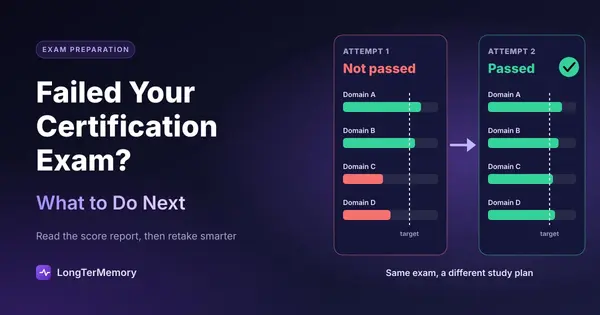
Your score report is a map of your retake plan: it shows how far you were from the passing line and which areas pulled you down. Read it carefully before you make any plans.
What Different Programs Report
Reports differ a lot between certifications, so look for what yours provides.
| Program type | What you’ll typically see | How to use it |
|---|---|---|
| Scaled score plus objectives (CompTIA, for example) | A score and a list of objectives associated with missed questions | Turn the list into your study checklist |
| Performance bands (PMI, for example) | Ratings such as Above Target, Target, Below Target or Needs Improvement by domain | Start with the lowest-rated, highest-weight domains |
| Percentages by section (many other programs) | A percentage correct or a bar for each domain | Multiply by the domain’s exam weight |
| Pass or fail only | Little or no breakdown | Rely on a diagnostic practice test instead |
A Three-Step Analysis
Step 1: Measure the gap. Were you close or far away? This one number changes your plan.
| Your result | What it usually means | Likely next step |
|---|---|---|
| Very close to passing | Your knowledge base is probably fine, and precision or test execution may be the issue | Targeted fixes and more timed practice |
| Moderately below | Clear weak domains | A focused plan on those domains, plus mixed practice |
| Far below | Serious gaps, or the exam was very different from your preparation | Rebuild your foundations, then reassess your materials and timeline |
Exact cutoffs vary by exam, so use these as a guide. Also, a scaled score isn’t always the same as a percentage, so don’t assume you can convert yours.
Step 2: Weigh your weak areas. A domain you scored poorly in matters more if it’s a big part of the exam. Rank domains using this quick calculation:
Priority = exam weight x how far below target you scored
Here’s an example. If you’re weak in a domain worth 30% and also weak in one worth 10%, begin with the 30% domain, even if the smaller domain’s score looks worse. A small gain on a heavily weighted domain can matter more than a big gain on a lightly weighted one.
Step 3: Find out why you lost the marks. The report shows you where you went wrong. To find out why, go back to practice tests and sort your errors:
| Error type | Clue | Fix |
|---|---|---|
| Knowledge gap | You’d never seen this, or couldn’t recall it | Study it, then test yourself on it |
| Recognition but not recall | It looked familiar, but you couldn’t apply it | Replace rereading with retrieval practice |
| Scenario application | You knew the facts but couldn’t use them | Do more scenario questions and explain your reasoning |
| Timing | You rushed or left questions unanswered | Timed sets, pacing checkpoints |
| Misreading or anxiety | You knew it afterward | Reading routine, simulated exam conditions |
That last category is worth checking honestly. If you often knew the answer as soon as you left the room, your issue may not be content at all. These guides on exam anxiety and time management in timed exams can help.
The Hidden Problem: You Thought You Were Ready
Many failed candidates share one surprise: “I felt prepared.” Often, the preparation built familiarity rather than usable knowledge. Watching videos and rereading notes can make material feel known, then the exam asks you to apply it to a scenario you haven’t seen before.
Be honest with yourself about how you spent your time. What percentage of your study was passive, like watching or reading? And what percentage was answering questions from memory? If your answer is mostly passive, you’ve found the most valuable thing you can change.
When to Retake: Check the Rules, Then Choose Your Date
Book your retake once your diagnostic scores are consistently above the passing level, and check your program’s rules before you pick a date. Policies vary enormously, and some of them could affect your plan.
Here’s a sample of how widely retake rules differ:
| Program | Waiting rule (check for updates) |
|---|---|
| CompTIA | No required wait between the first and second attempts |
| Microsoft | 24 hours after a first failure, then 14 days between later attempts, up to 5 attempts in total |
| EC-Council | No wait before a second attempt, then 14 days before a third |
| PMI PMP | Up to 3 attempts within your one-year eligibility period |
| NASAA Series 65 (windows opened from January 2027) | 30 days after a first or second failure |
| BCEN nursing certifications | 90 days |
These rules can change, and they’re sometimes different depending on the exam, so read the current policy on the official site. Also look up the retake fee, whether your voucher or employer covers it, and whether your eligibility expires.
How Long Should You Wait?
A minimum waiting period isn’t a recommendation. Your gap should depend on how far you were from passing.
| Situation | Reasonable study period |
|---|---|
| Very close, exam still fresh | 2 to 4 weeks |
| Moderate gaps | 4 to 8 weeks |
| Far below, or major gaps | 8 to 12+ weeks |
Be careful about waiting too long, though. If you leave it for six months, you may have forgotten what you worked so hard on. Pick a date and put it on your calendar: an open-ended plan to “retake it at some point” often never happens.
How to Study Smarter for the Second Attempt
The second attempt should look different from the first. Doing the same thing again, only harder, usually produces a similar result. Keep what worked, and change what didn’t.
Start With a Diagnostic, Not Chapter One
Take a full-length practice test from a good source before you restudy anything. Use different questions from the ones you’ve seen, if you can, because a repeated question bank can inflate your score. This shows how much you’ve retained and gives you a baseline to measure progress against.
Make Retrieval Your Main Activity
Practice testing and retrieval are among the best-supported methods in learning science. In a 2017 meta-analysis by Adesope and colleagues, practice tests outperformed comparison conditions with a moderate effect size (g = 0.61). Rowland’s 2014 meta-analysis found a similar benefit over restudying (g = 0.50).
Here’s a simple way to shift the balance of your study time:
| Activity | Typical first attempt | Better second attempt |
|---|---|---|
| Reading and videos | 70% | 20%, and only on weak areas |
| Practice questions and review | 20% | 50% |
| Flashcards or other retrieval | 10% | 30% |
These proportions are illustrative, so adjust them to your exam. The important part is the direction. Find out more in our guide to active recall.
Study Your Wrong Answers Deeply
Don’t just look up the right answer and move on. For every question you miss, write down:
- Why the right answer is right.
- Why your answer was wrong.
- What clue in the question should have tipped you off.
- What rule or idea you’d use on a similar question.
Then turn that rule into a flashcard. Our guide to learning from your practice test mistakes has a full system for this.
Change at Least One Resource, But Only One
If your main resource didn’t match the exam’s style, replace it. If it was fine, keep it. Don’t collect resources as a way of feeling productive. Often, one strong question bank plus the official exam guide is enough. A second explanation can be useful for a topic that isn’t clicking. Our list of free certification study materials may help if your budget’s tight after paying a retake fee.
Simulate the Real Thing
Do at least two or three full-length tests under exam conditions: same time of day, same duration, no phone, and only the breaks you’d actually get. Scoring well in short bursts doesn’t prove you can stay sharp in hour three. Practice your pacing checkpoints as well, so you know where you should be at the halfway mark.
A Sample 6-Week Retake Plan
| Week | Focus | Target |
|---|---|---|
| 1 | Score report analysis, diagnostic test, fix the plan | Baseline score and ranked weak domains |
| 2 and 3 | Top two weak domains, mostly practice questions | Domain sets at or above your target |
| 4 | Remaining weak areas, plus mixed question sets | First timed full-length test |
| 5 | Error review, timed sets, second full-length test | Consistently above the passing level |
| 6 | Light review, final test early in the week, rest | Calm, rested and no new material |
How to Rebuild Your Confidence
Real confidence comes from evidence of progress, not from pep talks. That’s why you should track what’s changing.
- Keep a score log. Record each practice test and each domain. Seeing a weak domain move from 55% to 75% is more convincing than any motivational quote.
- Separate the result from your identity. “I failed this exam on Tuesday” and “I’m a failure” are very different statements, and only one of them is true.
- Remember what you’ve kept. You’ve already done the work of learning most of the content, and you’ve experienced the real exam. You know how its questions feel, how long it takes and how nervous you get. Very few first-timers have that.
- Talk to someone who’s been there. Certification communities are full of people who passed on a later attempt, and their advice is often very practical. Our guide to online certification study communities can point you to some.
- Reconnect with your reason. Why did you want this? If it’s still valid, that’s your reason to go on. If it’s changed, that’s worth knowing too, and our guide on which certification to choose first may help you rethink things.
Having said that, watch for signs that you’re running on empty. If you’re dreading every session, sleeping badly and getting nowhere, take a look at the signs of study burnout and take a short break before you continue.
Make the Second Round More Efficient
A retake usually comes with less time and less patience, so you don’t want to spend it rewriting flashcards. LongTerMemory turns your official guide, course notes or other PDFs into question-and-answer pairs and schedules your reviews automatically with spaced repetition. It’s a quick way to swap passive rereading for retrieval. You can start with your weakest domain from the score report, and the free trial lets you see whether it works for you before you commit to it.
FAQ
How soon can I retake a certification exam?
It depends on the program. Some have no wait before a second attempt, while others require anything from 24 hours to 90 days. Check the current official policy, then choose your date based on your readiness rather than the minimum allowed.
Is it normal to fail a professional certification exam?
Yes. Many professional exams are demanding by design, and not all programs publish pass rates, but failing and retaking is common. Employers generally care about the credential you end up with, not how many attempts it took.
Do employers see how many attempts I took?
Usually not. Most credential verifications show only that you hold the certification, along with its dates. If you’re not sure, check your program’s verification policy. Should your employer ask directly, a short and honest answer is the best approach.
Should I use the same study materials again?
Use them if they matched the exam and your score report points to issues with method or timing. Replace them if the exam felt very different from what you’d studied. In most cases, changing how you study matters more than changing what you study from.
How will I know I’m ready for the retake?
A good sign is scoring consistently above the passing level on several full-length tests that use questions you haven’t seen, under timed conditions, with no weak domain far below the others. One high score isn’t enough, so look for a stable pattern.
The Bottom Line
A failed exam gives you something valuable: real information. Save your report, take a couple of days off, then work out how far you were from passing and why. Choose your date, shift your study time from passive review to active practice, and test yourself under real conditions until your scores are stable. Plenty of certified professionals have been exactly where you are today. The next attempt doesn’t need more effort so much as a better plan.