
How to Prepare for the Series 65 Exam: Topics, Plan and Passing Score
What the Series 65 tests, who needs it, the 92 of 130 passing score, how to prioritize its four sections, and a 6-week plan with a practice question strategy.
Table of Contents
- Series 65 at a Glance
- What the Series 65 Tests and Who Needs It
- Who Typically Takes It
- Choosing Between the 65 and the 66, and Possible Waivers
- Topic Breakdown and Study Priorities
- Economic Factors and Business Information (15%)
- Investment Vehicle Characteristics (25%)
- Client Investment Recommendations and Strategies (30%)
- Laws, Regulations and Guidelines (30%)
- How Long Should You Study?
- A Sample 6-Week Plan at About 15 Hours a Week
- Practice Question Strategy
- Move Through Three Phases
- Review Every Question
- Learn the Question Formats
- Manage Your Time
- Memorize Using Spaced Retrieval
- Exam Day and What If You Don't Pass
- FAQ
- Is this exam hard?
- Do I need a firm to sponsor me?
- How long is a passing score valid?
- Can I pass without a finance background?
- Which section should I study first?
- The Bottom Line
The Series 65 has a reputation for being tricky, and it’s earned. In three hours, you’ll need to move from bond math to securities law to the ethics of advising a client, and the questions are written to catch people who only half remember the rules.
The good news is that the exam is highly predictable. NASAA publishes the outline, the four sections have fixed weights, and the passing line is known. You don’t need a background in finance. You do need a plan that gives the right amount of time to each section and plenty of practice questions.
Here’s what’s on the test, who actually needs it, how to prioritize each topic, and how to use practice questions so that your score moves.
Series 65 at a Glance
The Series 65 is the Uniform Investment Adviser Law Examination, a NASAA exam administered by FINRA. These are the facts to know, based on the official FINRA exam page at the time of writing:
| Detail | Series 65 |
|---|---|
| Full name | Uniform Investment Adviser Law Examination |
| Created by | NASAA (North American Securities Administrators Association) |
| Administered by | FINRA |
| Questions | 130 scored, plus 10 unscored pretest questions |
| Time | 180 minutes |
| Passing score | 92 of the 130 scored questions (about 71%) |
| Fee | $187 |
| Prerequisites | None |
You may still see 94 of 130 (72%) mentioned in older study material. FINRA and NASAA now list 92, so if a guide quotes the old number, check how current the rest of it is too. Confirm all the details on the official pages before you book, because fees and rules change.
What the Series 65 Tests and Who Needs It
The exam tests whether you can give investment advice competently and legally, and most candidates take it to register as an investment adviser representative (IAR). It’s a state-level qualification that’s designed to protect clients.
Who Typically Takes It
- Aspiring financial advisers who charge fees for advice
- People launching their own registered investment adviser (RIA) firm
- Financial planners moving to fee-based advice
- Career changers entering wealth management
You don’t need a sponsoring firm to take it, which sets it apart from exams like the Series 7. Passing the exam doesn’t make you registered, though. Registration is a separate process that goes through your state, so check its requirements.
Choosing Between the 65 and the 66, and Possible Waivers
Before you begin studying, make sure this is the right exam for you, because you might not need it.
| Your situation | What it might mean |
|---|---|
| You want to give fee-based advice and don’t plan to sell securities on commission | Series 65 is the usual route |
| You already hold, or plan to take, the Series 7 and want to do both | The Series 66 may suit you better, as it’s a shorter exam with a Series 7 corequisite |
| You hold a qualifying designation, like CFP, CFA, ChFC, PFS or CIC | You may qualify for a waiver of the exam |
Waivers depend on your state, and they only remove the exam, not your registration or continuing education obligations. Ask your state regulator to confirm what applies to you.
If you’re also planning a broader career in securities, you might want to take a look at our guide to the FINRA SIE exam as well.
Topic Breakdown and Study Priorities
The exam has four sections, and two of them make up 60% of the test. Client strategies and law are where this exam is mostly won or lost, so they deserve the largest share of your time.
| Section | Weight | Scored questions | Priority |
|---|---|---|---|
| Economic Factors and Business Information | 15% | 20 | Medium |
| Investment Vehicle Characteristics | 25% | 32 | High |
| Client Investment Recommendations and Strategies | 30% | 39 | Highest |
| Laws, Regulations and Guidelines, including Prohibition on Unethical Business Practices | 30% | 39 | Highest |
You can miss up to 38 of the 130 scored questions and still pass. That’s a helpful number: you don’t need to be perfect, so you shouldn’t let one difficult topic hijack your whole plan. A fairly even performance across the sections is what gets you there.
Economic Factors and Business Information (15%)
This section covers the economic and financial basics that sit behind investment decisions. For candidates without a finance background, it’s a chance to learn the language of the rest of the exam.
Topics to focus on:
- Business cycles, plus leading, coincident and lagging indicators
- Monetary and fiscal policy, interest rates and inflation
- Reading financial statements, along with key ratios
- Time value of money, including present and future value
- Basic statistics, like mean, median, standard deviation and correlation
- Types of risk, including systematic and unsystematic risk
Study tip: Learn the formulas until you can use them, not just recognize them. Then practice applying them to word problems.
Investment Vehicle Characteristics (25%)
This is a big “know the product” section, covering what each investment is, how it pays, how it’s taxed and what risks it carries.
| Product family | What to know |
|---|---|
| Equities | Common and preferred stock, rights, warrants, ADRs |
| Fixed income | Treasury, corporate and municipal bonds, yields, duration, credit ratings |
| Pooled investments | Mutual funds, ETFs, unit investment trusts, REITs, share classes |
| Derivatives | Options basics, including calls, puts and hedging strategies |
| Insurance products | Fixed and variable annuities, life insurance |
| Alternative investments | Hedge funds, private placements, limited partnerships |
Study tip: Comparison tables work very well here. Put products side by side by income, risk, liquidity, taxation and who they suit, then use these concept tables for structured review or turn each cell into a flashcard. Many exam questions ask you to tell two similar products apart.
Client Investment Recommendations and Strategies (30%)
This is where you apply what you’ve learned to real clients. It’s about choosing the right recommendation given a client’s goals, risk tolerance and situation.
Topics to focus on:
- Client profiles, covering objectives, risk tolerance, time horizon and constraints
- Portfolio theory, asset allocation, diversification and rebalancing
- Portfolio performance measures, including Sharpe ratio, alpha and beta
- Taxation of investment income and retirement accounts
- Retirement plans, including IRAs, 401(k)s and ERISA basics
- Trusts, estates and business entities
- Trading basics and order types
Study tip: Practice with scenarios. Every time you read about a product or strategy, ask yourself who it’s right for and who it’s wrong for. “A retired 70-year-old who needs income” and “a 30-year-old in a high tax bracket” often lead to very different answers.
Laws, Regulations and Guidelines (30%)
This is often the most feared section, because it demands precise knowledge of who’s regulated, who’s exempt and what’s forbidden. Many of the questions turn on one or two words.
Topics to focus on:
- The Uniform Securities Act and the Investment Advisers Act of 1940
- Definitions, including the differences between a broker-dealer, agent, investment adviser and IAR
- Federal covered advisers vs state-registered advisers
- Registration requirements, exemptions and exclusions
- Fiduciary duty, disclosure and suitability
- Prohibited practices, such as unsuitable recommendations, misrepresentation and guaranteeing against loss
- Rules on custody, advisory contracts, fees and client communications
- Enforcement powers and penalties
Study tip: This section rewards exact wording and memorization, so it’s a good fit for flashcards. Watch out for words like “always”, “only” and “unless”. Make cards that ask about the exceptions, because that’s where the questions tend to hide. Our guide on how to memorize test questions and answers has more on building them.
How Long Should You Study?
Plan on roughly 80 to 120 hours for most candidates, spread over 4 to 10 weeks. Treat that as a common planning range from prep providers, not an official figure. If you already work in finance, you might need less. If you’re a career changer, you may need more, particularly for the math and products.
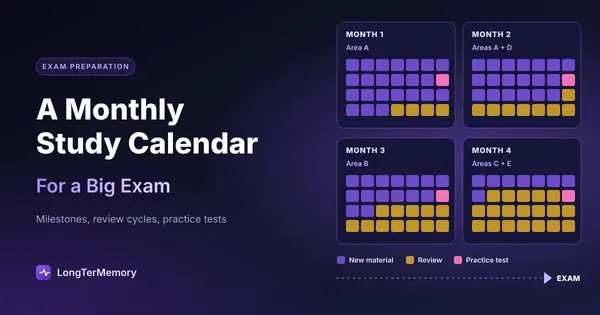
A Sample 6-Week Plan at About 15 Hours a Week
| Week | Focus | Practice goal |
|---|---|---|
| 1 | Short diagnostic, then economics and business basics | 100 questions on this section |
| 2 | Investment vehicles, part one: equities, bonds, funds | 150 questions |
| 3 | Investment vehicles, part two, then client profiles and portfolio theory | 150 questions |
| 4 | Client strategies, taxes and retirement plans | 200 questions |
| 5 | Laws and ethics, with daily flashcards | 200 questions, including a first full-length test |
| 6 | Weak areas and full-length exams | 2 or 3 full-length tests, and error review |
If your calendar has more room, spread this out, and don’t simply study more hours in each sitting. Scattering the same number of hours across more days usually helps memory. If you’re fitting it around work, our guide to studying while working will help, and for the wider view, take a look at strategies for professional certifications.
Practice Question Strategy
Practice questions should make up at least half of your study time, because the exam tests how you apply knowledge and read carefully, not just what you’ve memorized. Here’s how to get the most out of them.
Move Through Three Phases
| Phase | When | What to do | Rough target |
|---|---|---|---|
| Learning | Throughout content study | Short topic sets, 20 to 40 questions, right after each topic | Understand each explanation |
| Mixed | Once you’ve covered most of the content | Mixed sets of 50 or more questions from all sections | 70% or above |
| Simulation | Last 1 to 2 weeks | Full 140-question timed tests | Consistently 75 to 80% or above |
The targets for scores above the passing line are a safety margin that’s commonly recommended by prep providers. They help because real exams feel harder than the ones you take on your sofa.
Review Every Question
Your review is where you really learn. Spend about as much time reviewing a test as you spent taking it. For every wrong answer, and also for any question you guessed right, write down:
- Why the correct answer is right.
- Why your choice was wrong.
- Which word or detail you should’ve noticed.
Turn the lesson into a flashcard. You can use our system for learning from practice test mistakes to organize this.
Learn the Question Formats
The Series 65 likes a few recognizable patterns. Practice each one specifically.
| Format | How it works | How to handle it |
|---|---|---|
| Roman numeral | You pick which combination of statements is correct | Eliminate options with one statement you know is false |
| EXCEPT or NOT | You look for the statement that doesn’t fit | Mark the word, and test each option as true or false |
| Best recommendation | Several answers seem reasonable | Start with the client’s goal, then check the time horizon and risk |
| Calculations | Yields, ratios and returns | Write the formula first, then plug in values |
| Legal definitions | Is this person an agent? Is this exempt? | Ask who, what and which regulator, in that order |
For more help with test technique, see our guide to multiple-choice exam strategy.
Manage Your Time
You have 180 minutes for 140 questions, including the 10 unscored ones, which you can’t identify. That works out to about 77 seconds per question, or about 73 if you want to keep 10 minutes for review. Check yourself at these points:
| Time used | Questions you should have finished |
|---|---|
| 45 minutes | About 37 |
| 90 minutes | About 74 |
| 135 minutes | About 111 |
| 170 minutes | All 140, with 10 minutes to review |
Don’t fight with one hard question for several minutes. Flag it, make your best guess and move on. When you run into a question that looks totally unfamiliar, remember it might be an unscored pretest item, so don’t let it rattle you.
Memorize Using Spaced Retrieval
For rules, definitions, formulas and product features, use short daily sessions of spaced repetition and answer from memory. These are the facts that tend to fade if you read them once in week two and don’t return to them until week six.
Good Series 65 flashcards look like this:
- Weak: “Investment Advisers Act of 1940: tell me everything.”
- Better: “Under the Uniform Securities Act, can an adviser guarantee a client against losses?”
- Weak: “What’s the Sharpe ratio?”
- Better: “A portfolio has a higher Sharpe ratio than another. What does that tell you about risk-adjusted return?”
One specific question per card makes it easier to answer and easier to tell when you’ve really got it.
Making these from a 500-page study guide takes a long time, and that’s where LongTerMemory can help. Upload your guide or notes as PDFs and it creates question-and-answer pairs automatically, then schedules your reviews using spaced repetition. You keep your hours for practice tests and the difficult material. Start with the law section, since that’s where exact wording matters most, and use the free trial to see if it’s a good fit.
Exam Day and What If You Don’t Pass
Treat exam day as routine: sleep well, arrive early, take the required identification, and follow your pacing checkpoints. Don’t try to learn anything new on the last evening. A light review of formulas and definitions is plenty.
If you don’t pass, the rules give you another chance. According to FINRA, for exam windows opened on or after January 4, 2027, you’ll wait 30 days after a first or second failed attempt and 60 days after a third. Windows opened before that date follow the older rule, which requires a 180-day wait after a third attempt within two years. Use your section results to focus your retake on the areas that cost you the most points, and look at how the credential fits your longer-term certification roadmap.
FAQ
Is this exam hard?
Yes, it’s generally considered challenging, mainly because of its range and the precise wording of the legal questions. You need 92 of 130 scored questions to pass, or about 71%. Candidates who put in steady preparation with plenty of practice questions are in a strong position.
Do I need a firm to sponsor me?
No. Unlike the Series 7, the Series 65 doesn’t need firm sponsorship, and FINRA lists no prerequisites. You can enroll on your own. Keep in mind that passing doesn’t register you, as registration is handled separately through your state.
How long is a passing score valid?
Generally, passing results lapse if you aren’t registered within two years, but the details can vary by state and situation. Check with your state regulator if you plan to wait a while before registering after you pass.
Can I pass without a finance background?
Yes. Many career changers pass it. Allow extra time for the economics, math and investment products, and don’t skip the fundamentals. A diagnostic test in the first week will show you where you need to spend your time.
Which section should I study first?
Start with economics and investment vehicles if you’re new to finance, since the later material builds on them. Keep the law section going throughout with short flashcard sessions rather than leaving it to the end, as it’s 30% of the exam.
The Bottom Line
The Series 65 is a wide exam with a clear structure. Confirm it’s the right exam, give most of your time to client strategies and law, and spend at least half of your study hours on practice questions. Use spaced retrieval for the rules and formulas, then finish with full-length timed tests. When you can consistently score well above the 92-question line under real conditions, you’re ready.