How to Track Your Study Progress and Stay Motivated
Discover which study metrics actually matter, how to build a simple study log you'll stick with, and use progress data to fuel long-term motivation.
Table of Contents
- Why Most Students Don't Track, and Why That's a Mistake
- What to Track (and What Not to Bother With)
- How to Build a Study Log You'll Actually Maintain
- Option 1: Paper Log
- Option 2: Spreadsheet
- Option 3: Study Tracking Apps
- Using Progress Data to Make Better Decisions
- How Progress Tracking Sustains Motivation Over Long Study Periods
- A Simple System to Start Today
- When Tracking Becomes Counterproductive
- The Bottom Line
Here’s a common experience: you’ve been studying for weeks. You’re putting in the hours. But you don’t really know if what you’re doing is working. The exam is getting closer, and you’re not sure if you’ve covered enough, retained enough, or practiced enough. You feel like you’re working hard, but you can’t tell if you’re making progress.
This uncertainty is one of the most demoralizing things about a long study period, and it’s completely solvable. The solution is systematic tracking, not obsessive record-keeping, but a simple, consistent system that tells you where you are, what’s working, and what to do next.
When you track your study progress well, two things happen. First, you make better decisions about where to spend your time. Second, you get a motivation engine that doesn’t rely on willpower. You can see progress, and seeing progress keeps you going.
Why Most Students Don’t Track, and Why That’s a Mistake
Most students run their study life by feel. They study until they feel ready, review topics that feel unfamiliar, and put in time until the anxiety drops to a tolerable level. The problem is that feelings are terrible proxies for learning.
The fluency illusion, the feeling of familiarity with material you’ve reviewed a few times but don’t actually know well, makes material feel more learned than it is. Students who study by feel consistently overestimate how much they know and underestimate how much they’ve forgotten.
Tracking cuts through the illusion. When you record your quiz scores, your topic coverage, and your review frequency, you’re working with data rather than feelings. Data doesn’t lie. A practice test score of 62% tells you something concrete that no amount of “I feel like I kind of know this” can substitute for.
What to Track (and What Not to Bother With)
Not all tracking is useful tracking. The wrong metrics can give you a false sense of productivity without actually improving your performance.
Track these:
Practice test scores by domain. This is the most valuable data you can collect. After every practice exam or quiz, record your overall score and, if possible, your accuracy by topic area. A running log of these scores over time shows you whether you’re improving, plateauing, or declining, and which subjects need more attention.
Topics covered. Keep a checklist of the major content areas in your exam or course. Mark each one as you complete initial review, first practice, and final review. This prevents the common trap of spending all your time on a few familiar topics while neglecting others entirely.
Review dates. If you’re using spaced repetition, you want to know when you last reviewed each major topic. Spacing your reviews optimally means knowing which topics are overdue for revision and which ones you’ve covered recently enough that they don’t need attention yet.
Session quality rating. After each study session, spend 30 seconds giving it a 1-to-5 rating for focus and effectiveness. Over time, you’ll notice patterns. Maybe you’re consistently less effective when you study at night, or on days you skipped exercise, or when you studied for more than two hours without a break. This data helps you optimize your study conditions, not just your content.
Don’t bother tracking:
Total hours studied. Hours are a measure of input, not output. Tracking hours can make you feel productive while masking the quality of your study. Two hours of focused retrieval practice is worth more than four hours of passive re-reading. Prioritize score improvement and topic coverage over hour accumulation.
How many flashcards you reviewed. Similar issue. Reviewing 200 cards and getting 80% of them right tells you something useful. Reviewing 200 cards in Match mode in 10 minutes tells you almost nothing.
How to Build a Study Log You’ll Actually Maintain
The best tracking system is the simplest one that gives you the data you need. A tracking system you stop using after two weeks is useless, regardless of how well-designed it is.
Option 1: Paper Log
A simple paper notebook or planner works extremely well for tracking. The physical act of writing reinforces your review of what you covered, and many people find that paper tracking feels more satisfying than digital.
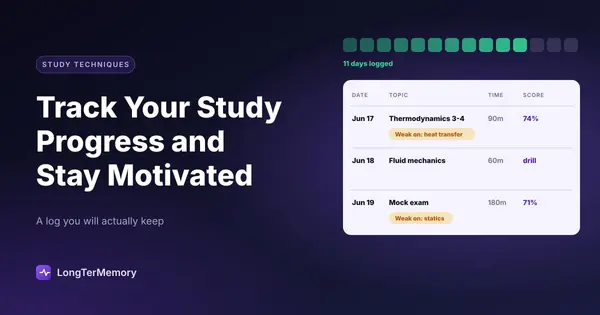
A basic daily log entry can look like this:
| Date | Topics Reviewed | Time | Practice Score | Notes |
|---|---|---|---|---|
| June 17 | Thermodynamics Ch.3-4 | 90 min | Practice: 74% | Weak on heat transfer |
| June 18 | Fluid Mechanics review | 60 min | Flashcard drill | Getting better |
| June 19 | Mock exam, all domains | 180 min | 71% overall | Strong: structures |
This kind of log takes 2 minutes to fill in after each session and gives you an extremely clear picture of your progress over time.
Option 2: Spreadsheet
A simple Google Sheets or Excel spreadsheet gives you the same data as a paper log with the added benefit of automatic charts and calculations. You can graph your practice scores over time, calculate your weekly study hours, and filter by topic to see when you last reviewed something.
If you like visualizing progress, a spreadsheet with a basic line chart of your practice scores over your study period is incredibly motivating. Watching the line trend upward over weeks of work is the kind of concrete evidence of progress that keeps you going when motivation dips.
Option 3: Study Tracking Apps
If you prefer dedicated apps, several exist specifically for study progress tracking:
- Notion or Obsidian for comprehensive study wikis with tracking databases
- Anki stats for built-in tracking if you use Anki for flashcards
- Toggl for time tracking by subject
- Forest or Focusmate for focus session tracking
The app matters less than the consistency. Pick something you’ll actually open every day and stick with it.
Using Progress Data to Make Better Decisions
Tracking is only valuable if you use the data to change your behavior. Here’s how to read your tracking data and act on it.
Weekly review ritual: At the end of each study week, spend 10 minutes reviewing your log. What’s your practice score trend? Which topics have you reviewed this week? Which ones are overdue? What conditions seemed to produce your best sessions?
This weekly review is where tracking pays off. It tells you what to prioritize in the week ahead and confirms whether your study plan is actually working.
The 80% rule: If you’re consistently scoring above 80% in practice on a topic, you can afford to reduce the frequency of reviewing it. Below 70%, that topic should be your priority for the coming week. Between 70 and 80%, maintain your current review schedule. This simple rule keeps your effort distribution aligned with your actual performance.
Adjust, don’t just record. The point of tracking is to enable adjustments. If you notice that your practice scores in a particular domain haven’t improved despite significant review, that’s a signal to change your approach for that domain. Try different practice resources, approach the content differently, or study with someone who understands it well. Data without action is just record-keeping.
How Progress Tracking Sustains Motivation Over Long Study Periods
One of the most underappreciated benefits of tracking is its effect on motivation, not just its effect on study decisions.
Long study periods, whether that’s a semester of coursework, a year of certification preparation, or six months before a board exam, involve inevitable dips in motivation. There will be weeks where you don’t feel like studying, where the material feels impossibly vast, where the exam seems too far away to feel urgent.
During those dips, your tracking log becomes your evidence that you’re making real progress. When you look back and see that your practice scores have gone from 55% to 71% over eight weeks, that’s not a feeling. That’s a fact. And facts are more resistant to low-mood distortion than feelings are.
Celebrate concrete milestones, not just effort. When you complete the initial review of a major content domain, mark it. When your practice score in a subject crosses 75% for the first time, note it. When you finish your first full-length mock exam, acknowledge it. These aren’t vanity metrics, they’re evidence that your system is working, and they’re the kind of concrete wins that fuel continued effort.
Make progress visible. Wherever you study, keep your progress tracker in view. A checklist of domains on a sticky note above your desk. A chart in a notebook you open every day. Visual evidence of how far you’ve come is a powerful antidote to the feeling that you’re not making progress.
A Simple System to Start Today
If you’re reading this before a long study period, here’s the minimal tracking system you can implement immediately:
- Create a list of all major topics or content domains for your exam or course
- Set up a simple daily log (paper, spreadsheet, or app, your choice)
- After every study session, record: date, topics covered, time, and practice scores if applicable
- Every Sunday, do a 10-minute weekly review of your log
- Adjust your upcoming week’s plan based on what the data shows
That’s it. You don’t need a complex system. You need a consistent one.
If you’re using a platform like LongTerMemory, your active recall practice data, including which questions you’re getting right and which ones you keep missing, is tracked automatically. This gives you performance insights without needing to maintain a manual log for that portion of your studying, freeing you to focus on the study work itself.
When Tracking Becomes Counterproductive
One warning: tracking can become a trap if it turns into an end in itself. Some students spend so much time on elaborate planning and logging systems that they cut into actual study time. They have beautiful color-coded spreadsheets and detailed session notes, but they’re not doing enough practice.
The test of a good tracking system is simple: does it take less than 5 minutes per day to maintain, and does it give you data that actually changes how you study? If yes to both, you have a good system. If you’re spending 20 minutes per day on tracking and still making the same study decisions, your system is too complex.
Keep it lean. Keep it useful. And remember that the tracking is in service of the studying, not the other way around.
The Bottom Line
Studying without tracking is like driving without a map. You might eventually get where you’re going, but you’re taking the long route and you won’t know if you’re heading in the right direction until it’s too late to course-correct.
A simple, consistent tracking practice gives you clarity, focus, and the kind of motivation that doesn’t depend on how you feel on a given day. It turns a vague, anxious study period into a systematic progress curve you can see and trust.
Start small. Track one thing. Let the data build up. And watch how differently you feel about a long study period when you can see, week by week, how far you’ve come.