How to Prepare for the USMLE Step 1 on a Compressed Timeline
What's realistic in 6 to 10 weeks of Step 1 prep, which resources matter most, and how to manage Anki and UWorld under tight time pressure.
Table of Contents
The USMLE Step 1 is one of the most high-stakes exams in American medicine. For most medical students, the dedicated study period, the block of time set aside specifically for Step 1 preparation, lasts somewhere between 6 and 12 weeks. But not everyone gets the standard dedicated period. Schedules shift, exams get rescheduled, rotations overlap, and plenty of students find themselves facing Step 1 with less time than they planned for.
If you’re working with a compressed timeline, the approach changes. You can’t study everything. You shouldn’t try. A compressed Step 1 prep requires ruthless prioritization, strategic resource selection, and a daily schedule that treats every hour as precious.
This guide is about making the most of a 6-to-10-week Step 1 preparation window. Everything here is aimed at maximizing your score with limited time.
What’s Actually Realistic in 6 Weeks vs. 10 Weeks
Let’s be honest about what a compressed timeline means before we talk strategy.
In 10 weeks, a structured, disciplined approach can produce strong results. You have enough time to complete First Aid systematically, work through a meaningful volume of UWorld questions, and maintain a substantial Anki deck. Students who commit fully during a 10-week dedicated period regularly achieve competitive scores.
In 6 weeks, the calculus changes. You’re not going to finish UWorld. You’re probably not going to do every First Aid section with the depth you’d want. What you can do is cover the highest-yield content thoroughly, work enough questions to build pattern recognition, and use Anki strategically rather than exhaustively. A passing score, and often a solid one, is achievable in 6 weeks with the right approach.
The worst mistake in a compressed timeline is spending your first week trying to build the perfect study plan. You don’t have time for perfect. You need a good plan executed consistently.
The Resource Stack: Less Is More
One of the most common mistakes in any Step 1 prep, but especially in a compressed one, is using too many resources. Students who try to get through Pathoma, Sketchy, First Aid, Boards and Beyond, Anki, and UWorld all at the same time end up covering nothing deeply and everything shallowly.
For a compressed timeline, your core resources should be:
First Aid for the USMLE Step 1. This is non-negotiable. Every other resource exists to help you understand and remember First Aid content. It’s your primary study document. Everything you read, watch, and practice should be mapped back to First Aid.
UWorld Question Bank. The most important question bank for Step 1 preparation. Work in timed, mixed-subject blocks that mirror the actual exam format. Read every explanation, including for questions you got right, since the explanations teach you clinical reasoning patterns that questions alone don’t.
Anki (strategically). In a compressed timeline, you cannot build or maintain an enormous Anki deck. You have two realistic options: use a pre-made deck (the Anking deck is the most commonly used) and do your daily reviews consistently, or create your own cards only for your highest-priority weak areas. Daily reviews are non-negotiable, since letting cards pile up destroys the spaced repetition benefit.
One systems resource. Pathoma for pathology, Sketchy for microbiology and pharmacology, or Boards and Beyond for systems review. Pick one or two that complement your learning style and stick with them. Don’t rotate between resources.
That’s your stack. Resist the urge to add more.
Managing Anki Under Time Pressure
Anki is one of the most powerful tools in Step 1 preparation, and one of the most time-consuming if you’re not careful. In a compressed timeline, you need a disciplined approach to Anki that keeps reviews manageable without abandoning the system.
Daily new cards: In a compressed prep, keep your new card introduction rate at a level your daily review time can sustain. If you have 2 hours available for Anki per day, adding 50 new cards will eventually create a review burden that consumes your entire available study time, leaving nothing for questions and content review. Most compressed-timeline students do better adding 30 to 50 new cards per day and accepting that they won’t cover the full deck.
Prioritize high-yield cards: The Anking deck has tags organized by resource and yield level. In a compressed timeline, filter for First Aid tagged cards and high-yield organ system content. Suspend low-yield and peripheral cards from the start.
Reviews first, new cards second: Do your daily Anki reviews before starting new content or question blocks. It’s tempting to skip reviews when they pile up, but falling behind on reviews destroys the spaced repetition system and makes the pile-up progressively worse.
Don’t let the deck run you: If you’re spending 4 hours a day on Anki reviews because the pile grew out of control, that’s a problem. It’s better to suspend non-essential cards and reduce the deck to a manageable size than to let Anki consume all your study time at the expense of questions.
UWorld Strategy for Compressed Prep
UWorld is the closest thing to the actual Step 1 exam in question quality and clinical reasoning requirements. In a compressed timeline, you probably won’t finish the entire question bank. That’s okay. How you use the questions matters more than how many you do.
Use tutor mode for the first half, timed mode for the second. Early in your prep, tutor mode (where you see the explanation immediately after each question) helps you learn the reasoning patterns more efficiently. As your exam date approaches, switch to timed mode to build the exam stamina and pace management you’ll need on test day.
Block composition matters. Use mixed-subject, mixed-system blocks rather than subject-specific blocks. The real exam is mixed, and studying in that format builds the kind of rapid clinical differentiation that is actually tested.
Every explanation is a teaching moment. Read all explanations thoroughly, right and wrong. Wrong answer explanations often teach the most, since they explain why an answer that looked plausible is incorrect. Many students race through explanations and miss the bulk of UWorld’s educational value.
Target 40 to 60 questions per day. In a compressed prep, this is a sustainable UWorld volume that still allows time for Anki reviews, First Aid reading, and content supplements. Doing 120 questions per day and racing through explanations will produce worse results than doing 40 questions and reading every explanation carefully.
A Sample Weekly Schedule (6-Week Timeline)
Here’s what a disciplined 6-week compressed prep looks like in practice. This is a full-time dedication, roughly 10 to 12 hours per day.
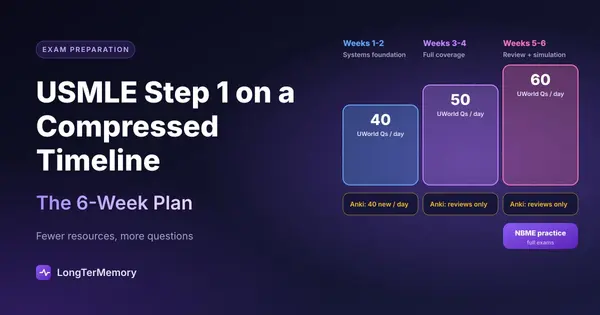
Weeks 1 to 2: Systems foundation
- First Aid: Organ systems (highest-yield sections first)
- UWorld: 40 questions/day, tutor mode
- Anki: Daily reviews plus 40 new cards/day from high-yield FA tags
- Pathoma or Sketchy: 1 to 2 videos per day aligned with systems
Weeks 3 to 4: Full systems coverage
- First Aid: Complete remaining organ systems
- UWorld: 50 questions/day, begin mixing timed blocks
- Anki: Daily reviews only, no new cards if behind
- Weak area focus sessions using question performance data
Weeks 5 to 6: Review and simulation
- First Aid: Review and annotate weak areas
- UWorld: 60 questions/day, timed mixed blocks
- NBME or Free 120: Full practice exams
- Targeted drilling on lowest-scoring question domains
Running NBME practice exams is crucial in the final 2 weeks. Your NBME score is the most reliable predictor of your actual Step 1 performance. Use the results to direct your final days of review toward your highest-impact gaps.
What to Cut Without Remorse
A compressed timeline means accepting that some things won’t happen. Deciding in advance what you’re cutting prevents the anxiety of feeling perpetually behind.
Things you can cut:
- Low-yield First Aid sections (check the First Aid section tags, some topics appear rarely on the exam)
- The entirety of one resource if you find another covers the same content more efficiently for you
- Self-quizzing and note-making beyond what Anki provides (these are time-expensive and lower-value than additional UWorld questions)
- Socializing about studying online (forums can consume time that should go to actual study)
Things you cannot cut:
- Daily Anki reviews (falling behind causes exponential pile-up)
- UWorld explanations (racing through without reading is worse than doing fewer questions)
- NBME practice exams (you need data on your actual performance trajectory)
- Sleep (chronic sleep deprivation actively impairs memory consolidation)
High-Yield Areas by System
When time is short, knowing which topics punch above their weight on Step 1 is critical. These are the areas where your study investment pays off most:
| System | Highest-Yield Topics |
|---|---|
| Cardiology | Heart failure, arrhythmias, murmurs, EKG interpretation |
| Pulmonology | Obstructive vs restrictive disease, PFTs, pneumonias |
| Nephrology | AKI vs CKD, glomerulonephritis, acid-base |
| Neurology | Strokes, cranial nerves, demyelinating disease |
| Psychiatry | DSM diagnoses, medications, developmental milestones |
| Microbiology | Bacterial virulence factors, antifungals, antivirals |
| Pharmacology | Drug mechanisms, toxicities, common interactions |
| Pathology | Cell injury, neoplasia, inflammation mechanisms |
Within each system, use your UWorld performance data to identify which specific topics you’re missing and focus there. Don’t review material you’re already getting right consistently.
The Mindset for Compressed Prep
Six or eight weeks of intensive Step 1 study is a genuine physical and mental challenge. Students who navigate it best tend to share a few characteristics.
They accept imperfection. They don’t finish every resource. They don’t get every card right. They don’t review every explanation twice. They accept that a good score on the actual exam is the goal, not the illusion of complete coverage.
They prioritize consistently over intensity. A student who studies 10 focused hours per day for 6 weeks will outperform one who studies 14 chaotic hours per day for 5 weeks and then burns out in week 5. Sustainability matters even in a compressed timeline.
And they trust their preparation on exam day. After 6 to 10 weeks of intensive work, your brain has processed a lot. Anxiety on exam day is normal, but the students who walk in trusting their preparation consistently perform better than those who walk in feeling like they didn’t do enough.
LongTerMemory can be a useful supplement during Step 1 prep, particularly for students who want to convert their First Aid reading or Pathoma notes into an active recall question set quickly. The automated Q&A generation means less time building cards manually and more time doing actual retrieval practice, which is what drives Step 1 performance.
One Last Thing
The students who are most anxious about compressed Step 1 prep are often the ones who were planning for a longer timeline and had it shortened. That disappointment is real. But it doesn’t change what’s in front of you.
The exam doesn’t know how long you studied. It just tests what you know. Focus on covering the highest-yield content as deeply as time allows, work questions with full engagement, and give your brain the sleep it needs to consolidate what you’ve learned. That approach works in 6 weeks. It works in 10. And it’s the same approach that produces strong scores regardless of timeline.
Go in prepared. Go in focused. You’ve got this.