How to Build a Learning Culture in Your Workplace
Discover what a genuine learning culture looks like, how managers can enable team growth, and how your own study success can inspire colleagues to follow.
Table of Contents
- What a Genuine Learning Culture Looks Like and How to Advocate for It
- Signs That Learning Is Actually Embedded
- How to Advocate for Learning Culture From Any Level
- Practical Steps for Managers to Encourage Team Learning and Certification
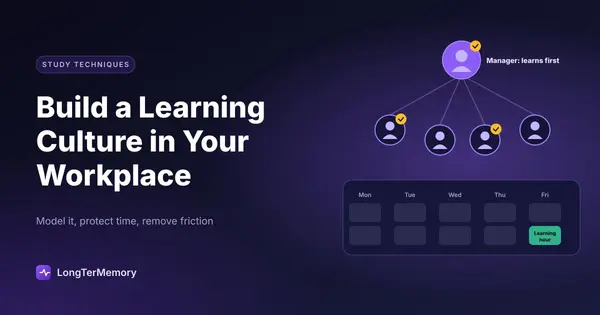
- Model It First
- Create Structured Learning Time
- Remove the Friction
- Celebrate Learning, Not Just Credentials
- Using Your Own Study Success to Inspire and Enable Colleagues
- Share the System, Not Just the Outcome
- Peer Learning Groups
- Normalize Admitting You Do Not Know Things
- Building Sustainable Learning Into Workflow
There is a phrase that gets thrown around a lot in corporate communications: “we are a learning organization.” It usually appears in job postings, annual reports, and town halls, delivered with confidence by someone who has not looked at the professional development budget in six months. What it rarely describes is an actual culture, meaning the day-to-day lived reality of how people at the organization actually spend their time and energy.
Real learning cultures are not built by announcing that learning matters. They are built by the specific behaviors that leaders and individual contributors exhibit consistently, especially when they are busy and under pressure. Which is, of course, most of the time.
This guide is about what those behaviors actually look like, how managers can create conditions where team members genuinely grow, and how your own experience with structured learning can become one of the most powerful levers you have for influencing the culture around you.
What a Genuine Learning Culture Looks Like and How to Advocate for It
The first step in building or advocating for a learning culture is being clear-eyed about what one actually is, versus what it is pretending to be.
Signs That Learning Is Actually Embedded
A genuine learning culture has a few markers that are hard to fake:
Time is protected. People have actual calendar space for learning, not just permission to do it in theory. The difference between “you can take LinkedIn Learning courses” and “Thursday afternoons are protected development time” is the difference between learning culture as slogan and learning culture as practice. If your organization says it values learning but everyone is expected to be fully responsive and productive every hour of every workday, learning is not actually valued. It is aspirational.
Failure is treated as information. In organizations where learning is genuine, people share what did not work without fear of it being held against them. This is not about lowering standards. It is about recognizing that experimentation, by definition, produces some failures, and punishing failure is the fastest way to ensure that nobody experiments again.
Learning is discussed as normal work. In teams where learning culture is real, people talk about what they are studying, what they read, what they are trying to apply. It is embedded in the fabric of regular conversation, not saved for performance reviews.
Promotions and recognition reflect it. If the people who get promoted are consistently those who did exactly what was asked of them and nothing more, the culture signal is clear: expertise and growth are less valued than compliance. If people who expand their skills and bring new capabilities into the organization are recognized for it, the signal is equally clear.
How to Advocate for Learning Culture From Any Level
You do not need to be a senior leader to influence organizational culture. Culture is the aggregate of small behaviors and decisions, which means individual contributors shape it too.
If you are an individual contributor advocating for learning culture, the most effective approach is to be visible about your own learning. Share what you are studying in team meetings. When you apply something new and it works, say so explicitly: “I tried a technique from the certification I am studying and it helped with this problem.” When you apply something new and it does not work as expected, share that too. You are modeling the learning behaviors you want to see normalized.
Ask explicitly for time. Not permission, time. “I want to carve out four hours per week for professional development. Can we block Thursday afternoons in my calendar?” A specific, bounded request is easier to approve than a vague aspiration. And once it is in the calendar, it tends to stay.
If you are a manager advocating upward for learning resources, the language that tends to land best with senior stakeholders is capability and retention, not development for its own sake. Organizations that invest in employee learning see better retention (reducing recruitment and onboarding costs), higher engagement scores, and teams that can take on more complex work without hiring. Those are outcomes that show up in metrics leadership cares about.
Practical Steps for Managers to Encourage Team Learning and Certification
If you are a manager who genuinely wants to build team learning habits, here are the approaches that research and experience show actually work.
Model It First
Nothing you do as a manager to encourage learning will have as much impact as your own visible, ongoing engagement with learning. If your team sees you studying for a certification, reading books about your field, attending conferences and actually talking about what you learned rather than just tweeting a photo from the event, the cultural signal is powerful.
If they see you talking about learning but never doing it yourself, the message is also powerful. Just the wrong one.
This does not mean you need to study constantly or finish every certification you start. It means being genuinely curious, visibly engaged with ideas in your field, and honest about it. Even saying, “I have been reading about a new approach to X and I am not sure yet what I think about it,” signals that ongoing learning is something you take seriously.
Create Structured Learning Time
Protected time is the single biggest structural lever available to managers. Options that work well in practice:
Team learning days or half-days. Once a month or once a quarter, the whole team blocks a half-day for professional development. Everyone chooses what they work on, and at the end there is a brief share-out about what people explored. This normalizes learning as a collective activity, not just a solo pursuit.
Learning as a standing agenda item. Five minutes in every team meeting to answer the question: “What has someone learned this week that is relevant to our work?” This sounds minor. Over months, it changes what people pay attention to because they know they might need to report back.
Pairing certifications with projects. When someone on your team is studying for a certification relevant to their role, look for opportunities to let them apply what they are learning in real work, with appropriate support and low-stakes stakes. Learning that connects immediately to practice sticks far better than learning that exists only in a certification context.
Remove the Friction
The barriers to professional development at work are often logistical rather than motivational. People want to learn. They do not know where to start, they do not have budget clarity, they do not know if their manager will actually support them or just say they do.
Reduce friction:
- Maintain a clear, accessible list of approved resources and platforms (Coursera, certification programs, industry conferences) with a clear process for requesting access or funding
- Make the approval process fast. A two-week approval cycle for a $29 course discourages learning more than any policy ever could
- Explicitly tell your team what the budget is and that you want them to use it. Most professional development budgets go partially unused because people are uncertain whether spending is actually welcome
Celebrate Learning, Not Just Credentials
One pattern that tends to undermine learning culture: organizations celebrate when someone passes a certification exam, but say nothing about the six months of studying that preceded it. This sends the message that the credential is what matters, not the growth. It also subtly penalizes people who are actively developing skills but have not yet completed a formal program.
Create moments to recognize the process, not just the outcome. When someone finishes a difficult course section, mentions an insight they applied from something they studied, or shares a book recommendation with the team, acknowledge it. These micro-recognitions add up.
Using Your Own Study Success to Inspire and Enable Colleagues
If you have recently completed a certification, passed a difficult exam, or built a meaningful learning habit, you have something valuable that your colleagues often lack: a concrete experience of what successful self-directed learning looks and feels like.
Most people who do not pursue professional development are not unmotivated. They are uncertain. They do not know how to study effectively, they do not know which resources are worth the investment, they do not know how to fit study time into already-full lives. They have tried and failed, or they are afraid to try and fail.
Your experience is directly relevant to all of this.
Share the System, Not Just the Outcome
When you talk about having passed a certification, the most useful thing you can share with colleagues is not “I passed.” It is “here is how I structured my studying, here is what did not work initially, here is what I changed, here is about how much time it actually took each week.”
Specificity is what makes shared experience useful. “I used spaced repetition and it really helped” is less useful than “I was spending about two hours a week maintaining my Anki deck and it meant I retained material from October when I was taking my exam in March.” The specific, concrete version gives someone else an actual model to work with.
Peer Learning Groups
One of the most effective structures for spreading learning culture within a team is peer learning groups: small groups of two to four people who are studying adjacent or overlapping material and meet weekly or biweekly to share what they are learning.
This does not require significant organizational investment. It requires two people who are both studying something, agreement to meet for thirty minutes every week or two, and a basic structure for the conversation (what did you work on this week, what stuck, what confused you, what questions came up).
The mechanism is powerful: explaining what you learned to a peer consolidates your own understanding (teaching is one of the strongest memory techniques available), and hearing what your peer learned adds dimensions to your own understanding that solo study would not produce.
Normalize Admitting You Do Not Know Things
This one is simple but often overlooked. In many workplaces, admitting you do not know something carries social risk. People perform expertise they do not fully have to avoid looking uninformed. This makes learning harder, because learning requires acknowledging gaps.
When you model saying “I do not know, I need to look that up” or “I have not studied that yet, can you explain it to me?” you give permission to others to do the same. Over time, this reduces the social cost of uncertainty, which is one of the biggest hidden barriers to workplace learning.
Building Sustainable Learning Into Workflow
The organizations and teams where learning culture is most durable are not those with the largest L&D budgets or the most sophisticated platforms. They are the ones where learning has been integrated into the normal rhythm of work rather than added on top of it.
Some approaches that integrate well:
Pre-mortems and post-mortems. After any significant project, the team reflects on what they would do differently with the benefit of hindsight. This frames every project as a learning event, not just an outcome.
Knowledge transfer as a norm. When someone leaves the team or transitions to a new role, there is a structured expectation that they will document and transfer what they know. This forces explicit articulation of tacit knowledge and creates institutional memory.
Reading lists and resource sharing. A team Slack channel or shared document where people post relevant articles, podcasts, or course recommendations builds a low-friction habit of intellectual sharing.
Learning goals in performance conversations. If professional development goals appear in performance reviews and are actually discussed regularly (not just at annual review), they get treated as real work. If they appear once a year and are ignored otherwise, they are decoration.
The through-line in all of this is consistency. Learning culture is not built in a single initiative or a well-timed all-hands. It is built in the accumulation of small, consistent behaviors over months and years. Which means the most important thing you can do, whether as a manager or an individual contributor, is to start those behaviors now and maintain them even when other priorities are pressing.
If you are building your own professional development practice and want a tool that handles the scheduling and retention work, LongTerMemory automatically generates flashcards and spaced repetition schedules from your study materials. Less time managing your study system means more time actually learning.