AI Study Tools for Tech Certifications: LongTerMemory vs Anki vs RemNote
Comparing LongTerMemory, Anki, RemNote, Knowt and Quizlet for AWS, Azure, CISSP, PMP cert prep. Which AI tool is right for your certification goal?
Table of Contents
- The Contenders
- LongTerMemory
- What It Does Well
- Where It's Weaker
- RemNote
- What It Does Well
- Where It's Weaker
- Knowt
- What It Does Well
- Where It's Weaker
- Quizlet
- What It Does Well
- Where It Falls Short for Tech Certs
- Anki
- What It Does Well
- Where It Falls Short Today
- Recommendation by Certification Type
- AWS / Azure / Google Cloud
- Kubernetes (CKA, CKAD)
- CISSP
- CompTIA Security+ / Network+
- PMP
- A Detail Worth Noting
- The Hybrid Approach That Many Professionals Use
- So, Which Tool Should You Pick?
If you’re preparing for a technical certification, you’ve probably spent more time than you’d like debating which study tool to use. Anki? RemNote? Quizlet? And now there’s a newer wave of AI-powered options that promise to do the heavy lifting for you.
Here’s the thing: for general studying, most of these tools work fine. But technical certification prep is a specific beast. You’re dealing with hundreds of pages of official documentation, whitepapers, course notes, and practice material. The question isn’t which tool has the prettiest interface. The real question is:
How quickly can I turn this pile of documentation into exam-ready questions?
That’s the lens I want to use for this comparison. Five tools, honest assessment, and clear recommendations based on the type of certification you’re pursuing.
The Contenders
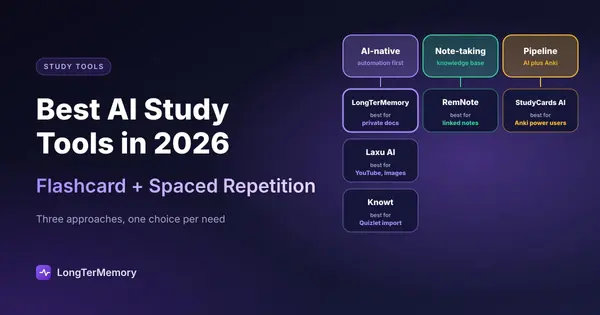
The tools in this comparison are LongTerMemory, RemNote, Knowt, Quizlet, and Anki. Each has a different origin story and a different core strength, and those differences matter enormously when you’re working against a certification deadline.
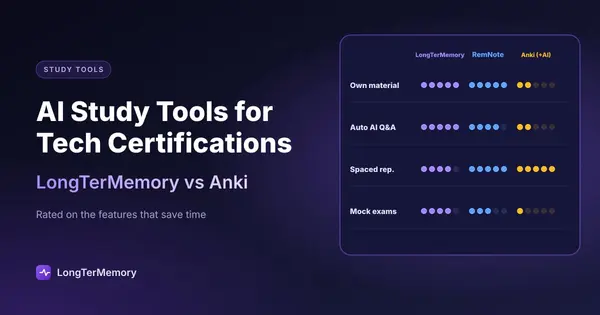
Before we go deep on each one, here’s the summary view across the dimensions that matter most for certification prep:
| Tool | Import Your Own Material | Auto AI Q&A | Spaced Repetition | Mock Exam Mode | Knowledge Base | Ease of Use |
|---|---|---|---|---|---|---|
| LongTerMemory | ⭐⭐⭐⭐⭐ | ⭐⭐⭐⭐⭐ | ⭐⭐⭐⭐ | ⭐⭐⭐⭐ | ⭐⭐ | ⭐⭐⭐⭐⭐ |
| RemNote | ⭐⭐⭐⭐⭐ | ⭐⭐⭐⭐ | ⭐⭐⭐⭐⭐ | ⭐⭐⭐ | ⭐⭐⭐⭐⭐ | ⭐⭐⭐ |
| Knowt | ⭐⭐⭐⭐ | ⭐⭐⭐⭐ | ⭐⭐⭐ | ⭐⭐⭐⭐ | ⭐⭐ | ⭐⭐⭐⭐⭐ |
| Quizlet | ⭐⭐⭐ | ⭐⭐⭐ | ⭐⭐ | ⭐⭐⭐ | ⭐ | ⭐⭐⭐⭐⭐ |
| Anki (+AI) | ⭐⭐ | ⭐⭐ | ⭐⭐⭐⭐⭐ | ⭐ | ⭐⭐ | ⭐⭐ |
The pattern is immediately visible. LongTerMemory and RemNote lead on the things that matter most for tech cert prep (importing your own material and generating quality questions), while Anki leads on raw spaced repetition power and Quizlet leads on ease of use. Let’s go deeper.
LongTerMemory
LongTerMemory was designed around one core workflow: import your documents, get questions, start studying. Unlike most competitors that started as manual flashcard apps and later bolted on AI features, LongTerMemory was built from the ground up around the concept of studying from your own materials. That architectural difference shows.
What It Does Well
The core workflow for a certification like AWS, Azure, Google Cloud, CompTIA, PMP, CISSP, or CCNA is remarkably linear:
- Download official documentation, whitepapers, or course notes as PDFs
- Add any relevant URLs or web pages directly
- Let the system generate question-and-answer pairs automatically
- Start your active recall sessions immediately
- Spaced repetition scheduling happens in the background
For someone prepping for AWS Solutions Architect, for example, you can feed in the official whitepaper library, your course cheat sheets, and your handwritten notes in one go. Within minutes you have a working question bank, without manually writing a single card.
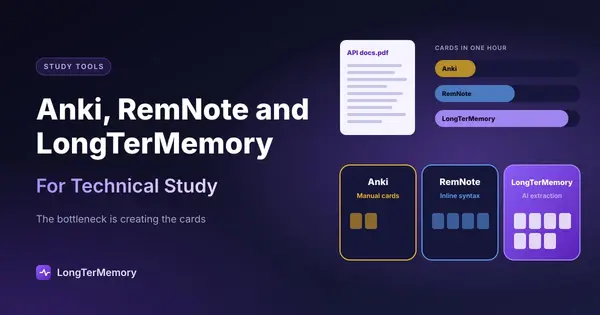
This is where the productivity gain becomes concrete. The biggest bottleneck in flashcard-based certification prep isn’t reviewing the cards. It’s creating them. LongTerMemory largely eliminates that bottleneck.
The interface is also the most approachable of any tool in this comparison. There’s no learning curve around configuration, algorithm settings, or card formatting. You upload, you study.
Where It’s Weaker
The tool is optimized for the “input documents, output questions” workflow. If you want to build rich connected notes, draw hierarchical concept maps, or deeply customize how the spaced repetition algorithm weights individual cards, you’ll find the controls fairly minimal compared to RemNote or Anki.
Also, when an AI-generated question comes out poorly phrased or slightly inaccurate, your ability to correct it at a structural level is more limited than in tools designed around manual curation. For most certification prep this is a minor issue, since the volume of well-generated questions far outweighs the occasional awkward one. But it’s worth knowing.
Best for: Certifications with large volumes of official documentation to absorb quickly. Anyone who wants to start reviewing material as fast as possible.
RemNote
RemNote occupies a different niche. It’s the tool for people who want to build a genuine, permanent knowledge base, not just pass an exam and move on.
What It Does Well
For vast, conceptual certifications like CISSP, AWS Solutions Architect Professional, Kubernetes CKA, or Azure Architect, RemNote’s structure shines. Instead of isolated flashcards, you build a true knowledge map:
IAM
 ├─ Roles
 ├─ Policies
 ├─ Permission Boundaries
 └─ SCP
Flashcards are generated from the structure itself, which means the cards you practice with are connected to the same hierarchy you study from. When you review a question about IAM Permission Boundaries, you know exactly where it sits in the larger framework. Context is built in.
RemNote’s spaced repetition algorithm is also the most configurable of any tool here. For learners who want precise control over intervals, leech handling, and review scheduling, it’s the gold standard.
If you decide to go this route, our step-by-step guide on using RemNote for integrated notes and flashcards covers the full setup, from page structure to daily review.
Where It’s Weaker
Setup is genuinely more demanding. Building a RemNote knowledge base from scratch requires time investment upfront. You need to learn the tool’s note-linking conventions, decide on your organizational structure, and do more manual work building the connections that LongTerMemory generates automatically.
For someone with three months to pass a certification and limited time to invest in tool setup, this overhead is real.
Best for: Learners building long-term expertise across multiple certifications or disciplines. Those who value deep conceptual understanding over speed.
Knowt
Knowt sits between the complexity of RemNote and the simplicity of Quizlet. It’s fast, it handles PDF and note imports well, and the AI question generation is genuinely good.
What It Does Well
Speed is Knowt’s strongest card. Import a PDF, get flashcards in seconds, start a quiz. The conversion ratio of setup time to usable study material is very high. It also handles Quizlet deck imports, which is useful if you have existing material to migrate.
For certifications like CompTIA Security+ or Network+, where the material is heavily terminology-based and reasonably well-documented in free notes and study guides, Knowt produces solid results quickly.
Where It’s Weaker
The depth isn’t quite there for the most demanding certifications. CISSP or AWS Professional require nuanced, scenario-based understanding that Knowt’s question generation handles less well than LongTerMemory’s. The knowledge base functionality is minimal, so if you want connected notes and structured learning, you’ll outgrow Knowt fast.
Best for: Shorter, terminology-heavy certifications. Budget-conscious learners who need something fast and free.
Quizlet
Quizlet is the most recognizable name in study apps, and it earns its reputation in many general academic contexts. For technical certification prep specifically, though, it shows its age.
What It Does Well
The existing community decks are Quizlet’s biggest asset for certifications. For almost any well-known exam, someone has already built a deck. If your prep timeline is tight and you’re willing to trust community-sourced cards, you can be studying within minutes.
The interface is also genuinely excellent, clean, fast, and intuitive on both desktop and mobile.
Where It Falls Short for Tech Certs
Modern technical certifications, AWS especially but also CISSP, CKA, and PMP, are increasingly scenario-based. Questions don’t just test whether you know what an IAM role is. They test whether you can apply that knowledge to a specific architectural decision with multiple valid-looking options.
Quizlet’s spaced repetition is also notably weaker than LongTerMemory, Anki, or RemNote. The algorithm is less sophisticated, which matters over a multi-month prep cycle where the quality of your review scheduling compounds significantly.
Best for: Quick vocabulary drilling. Accessing community decks for well-known exams.
Anki
Anki has been the gold standard for spaced repetition for years, and it deserves respect. Its algorithm remains the most sophisticated, and its track record in medical school, language learning, and bar exam prep is unmatched.
What It Does Well
For raw memorization of discrete facts, Anki is still the best tool available. TCP/UDP ports, AWS service capabilities, Linux commands, networking protocols, anything that benefits from deep long-term retention and a finely tuned review schedule, Anki handles it with a precision no other tool matches.
The plugin ecosystem is also extensive. There are AI-powered card generation plugins, shared deck repositories, and customization options that can extend Anki in almost any direction.
Where It Falls Short Today
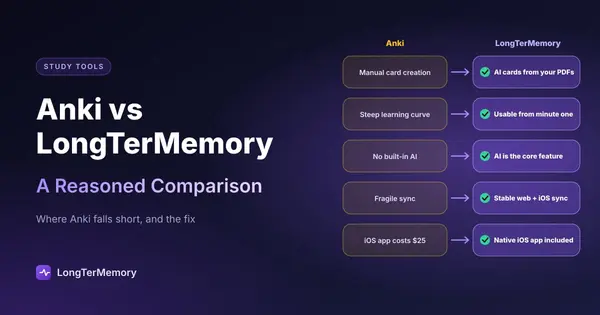
The bottleneck is setup. Creating Anki cards from scratch for a 500-page certification course is a project in itself. Many professionals today use a workflow that combines AI tools for generation with Anki for review, but that hybrid approach introduces its own friction.
For someone new to Anki, the initial configuration (syncing, card formatting, deck organization, plugin setup) is a real barrier. And for scenario-based certification questions, Anki’s two-sided card format is less natural than tools designed around paragraph-length Q&A pairs.
Best for: Learners with existing Anki decks or the patience to build high-quality decks from scratch. Long-term spaced repetition power users.
Recommendation by Certification Type
AWS / Azure / Google Cloud
1. LongTerMemory, 2. RemNote, 3. Knowt
Cloud certifications involve enormous volumes of official documentation. The workflow of importing whitepapers, training materials, and cheat sheets directly is exactly what LongTerMemory was designed for. The time you save on card creation translates directly into more review time, which is where exam readiness actually comes from.
Kubernetes (CKA, CKAD)
1. RemNote, 2. LongTerMemory, 3. Anki
Kubernetes certification is highly conceptual. Understanding how pods, nodes, namespaces, and controllers relate to each other matters more than memorizing isolated definitions. RemNote’s hierarchical knowledge structure is genuinely better suited here, though LongTerMemory handles the factual memorization component well.
CISSP
1. RemNote, 2. LongTerMemory, 3. Anki
CISSP is famously both broad and conceptual. It covers eight domains, rewards systems-level thinking over rote memorization, and tests judgment in ambiguous scenarios. Building a proper knowledge architecture in RemNote pays off here. LongTerMemory works well as a complement, especially for domain definitions and process knowledge.
CompTIA Security+ / Network+
1. LongTerMemory, 2. Knowt, 3. Anki
These certifications lean heavily on terminology, definitions, and protocols. LongTerMemory’s auto-generation from course material produces solid results quickly. The exams are more fact-based than scenario-based, which suits LongTerMemory’s strengths well.
PMP
1. LongTerMemory, 2. RemNote
PMP prep involves a lot of process groups, knowledge areas, and ITTOs (inputs, tools, techniques, and outputs). This structured framework-based content converts beautifully into Q&A pairs, which is exactly what LongTerMemory does automatically. The PMBOK Guide is a PDF that can be uploaded directly.
A Detail Worth Noting
One thing that sets LongTerMemory apart in a less visible way: most competing tools were built as flashcard apps first, then added AI features later. The AI is a feature on top of a product designed for manual card creation.
LongTerMemory was designed the other way around. The product was conceived as a “study from your documents” system, and everything in the interface, from upload flow to question generation to review scheduling, reflects that design choice. When you use it for certification prep, you’re using a tool designed for exactly that use case, not one that added your use case as an afterthought.
The Hybrid Approach That Many Professionals Use
It’s also worth saying that these tools aren’t mutually exclusive. A pattern that appears frequently among people with multiple certifications in progress or planned:
LongTerMemory for rapid transformation of new documentation into active recall sessions, getting from raw material to reviewable questions as fast as possible.
RemNote for maintaining and organizing the accumulated knowledge base over time, building the conceptual structures that persist across certifications.
This combination captures the speed advantage of LongTerMemory and the long-term organizational strength of RemNote. If you’re planning to pursue multiple certifications over the next few years, this hybrid is worth considering seriously.
So, Which Tool Should You Pick?
If you need to pass a technical certification in one to three months and you want the most direct path from “here is my study material” to “I’m reviewing exam-ready questions,” LongTerMemory is the most efficient starting point. The setup is minimal, the question generation is strong, and the spaced repetition happens automatically. You focus on learning. The tool handles the logistics.
If you’re investing in long-term technical expertise and want to build a knowledge base you’ll use across multiple certifications over years, RemNote is the better architectural choice, with LongTerMemory as a useful complement for rapid material processing.
If you’re on a tight budget and need something fast for a terminology-heavy exam, Knowt gets the job done.
And if you have the patience for setup and already trust the algorithm deeply, Anki remains a serious option, especially combined with AI tools to handle the card creation side.
The worst choice is spending more time deciding than studying. Pick the tool that matches your timeline and your temperament, and get into the material.
LongTerMemory is free to try. Upload your certification materials and see how many exam-ready questions the system generates from your first PDF. No card creation required: longtermemory.com