How to Avoid Over-Scheduling Your Study Time (And Actually Stick to a Plan)
Learn why ambitious study schedules fail and how to build a realistic plan based on your actual capacity, past performance, and cognitive limits.
Table of Contents
- Why Ambitious Study Schedules Almost Always Fail
- The Specific Ways Over-Scheduling Hurts You
- What Realistic Planning Actually Looks Like
- Start From Evidence, Not Aspiration
- Build Slack Into Your Schedule
- Use Weekly Targets Instead of Daily Schedules
- The Cost of Consistently Failing Your Own Schedule
- The Two-Day Rule
- Common Over-Scheduling Traps to Watch For
- The "I'll Make Up For It Later" Trap
- The "Weekends Will Save Me" Trap
- The "More Is Always Better" Trap
- How to Build a Schedule That Survives Contact With Reality
- When to Ask for Help
You’ve been there. It’s Sunday evening, you’ve got an exam in six weeks, and you sit down to make a study schedule. An hour in, you’ve got a color-coded spreadsheet that allocates every waking hour with satisfying precision: two hours of biochemistry in the morning, an hour of practice problems at lunch, a full review session in the evening, six days a week, with a rest day you’re already planning to skip when things get busy.
You feel great. You’ve done something. You have a plan.
Monday you stick to it. Tuesday, mostly. Wednesday, a work thing runs late and you miss the evening session. Thursday you’re tired from Tuesday and Wednesday and you skip the morning session, telling yourself you’ll double up over the weekend. Saturday you meant to make up for everything but you can’t quite remember what you were going to cover and you feel vaguely overwhelmed, so you end up doing some reading that probably counts.
By week two, the schedule is fiction. By week three, you’ve stopped looking at it.
Sound familiar? This isn’t a willpower problem. It’s a planning problem. And specifically, it’s one of the most well-documented cognitive biases in psychology: the planning fallacy.
Why Ambitious Study Schedules Almost Always Fail
The planning fallacy is the systematic tendency to underestimate how long tasks will take, how much energy they’ll require, and how many obstacles will appear, while overestimating your future motivation and focus.
Coined by Daniel Kahneman and Amos Tversky, the bias shows up everywhere from construction projects that run over by years to personal to-do lists that never get done to study schedules that look beautiful and get abandoned in week two.
The mechanism is straightforward: when you plan, you imagine a best-case version of yourself executing the plan in ideal conditions. You picture yourself sitting down at the scheduled time, fully focused, with no competing demands, and working productively for the allocated period. What you don’t picture, because it requires uncomfortable honesty, is the tired version of yourself at 9pm after a hard day, or the version of yourself that gets a two-hour emergency at work that wipes out the afternoon, or the version of yourself that sits down to study and spends 40 minutes unable to focus because you’re anxious about something unrelated.
The Specific Ways Over-Scheduling Hurts You
Beyond the failure-to-execute problem, over-scheduling creates psychological damage that compounds across your study period.
It creates a constant sense of failure. When your schedule says you should be doing six hours of study and you manage four, you feel like you’re behind. You’re failing your own plan. Over time, this accumulated sense of inadequacy actually makes it harder to study, because sitting down to study now comes paired with the feeling that you’re already losing.
It destroys your ability to rest guilt-free. Proper rest is part of learning. Sleep consolidates memory. Downtime allows the brain to process and integrate what it’s been working on. When your schedule is over-packed, any rest you take feels like stolen time. You can’t actually recharge because you’re spending your downtime feeling guilty about not studying.
It makes the plan brittle. An over-scheduled plan has no slack. A single disruption, an unexpected meeting, getting sick for a day, a family obligation, breaks the whole structure. When the schedule becomes impossible to follow, most people abandon it entirely rather than adjusting, which leaves them with neither the ambitious schedule nor a realistic replacement.
What Realistic Planning Actually Looks Like
The antidote to over-scheduling is not zero scheduling. Unstructured studying without any plan is usually less efficient than even a mediocre structured plan, because you spend too much time deciding what to work on and too little time actually working.
The goal is a plan that is honest about your actual capacity, flexible enough to survive real life, and clear enough that picking up where you left off after a disruption takes 30 seconds rather than 30 minutes.
Start From Evidence, Not Aspiration
Before you make any schedule for an upcoming exam, look at your actual recent study history. How many hours did you genuinely study in each of the last three weeks? Not how many hours you planned to study, how many hours you actually completed.
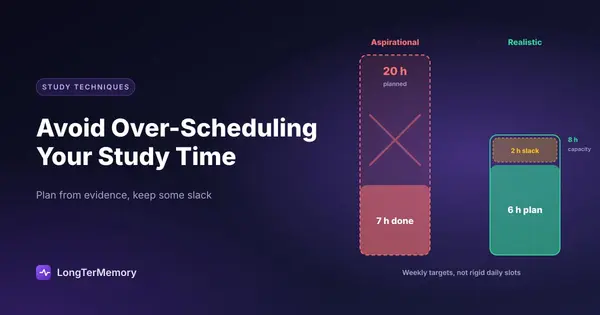
If you planned 15 hours and completed 8, your realistic weekly capacity is probably around 8 hours, not 15. Plan based on 8. You can increase gradually as you build the habit and momentum, but your starting point should be what you’ve actually done recently, not what you aspire to do.
This is genuinely uncomfortable advice because it means your initial schedule will look less impressive than the ambitious one you want to make. But a plan built on 8 actual hours beats a plan built on 15 fantasy hours, every single time.
Build Slack Into Your Schedule
Even your realistic estimate is probably optimistic, because it assumes no disruptions. Life disrupts. Plan for it.
If you’ve determined your realistic weekly capacity is 8 hours, schedule for 6. The extra 2 hours serve as buffer for the disruptions that will come. In a week where nothing goes wrong, you’ll actually overshoot your plan and build positive momentum. In a week where everything goes sideways, you’ll still hit your target.
This is not lowering your standards. This is making your standards survivable.
Use Weekly Targets Instead of Daily Schedules
Daily schedules feel more concrete and satisfying to create, but they’re far more brittle. A missed Monday ripples through the whole week. By Wednesday, you’re “behind,” and behind feels like failure.
Weekly targets are more resilient. If you have a 6-hour weekly target and you only manage 3 hours Monday through Thursday, you still have the weekend to make it up. You haven’t failed, you’re just not done yet. The mental accounting is completely different.
At the start of each week, decide roughly how you’ll distribute your target hours across the available days. Keep it loose. “Two sessions of about an hour each on weekdays, one longer session Saturday” is enough structure to be useful without being brittle.
The Cost of Consistently Failing Your Own Schedule
There’s a psychological cost that accumulates when you repeatedly set targets you don’t meet. Over weeks and months, it erodes your belief in your own planning ability. You start to treat your study schedule as aspirational fiction rather than a real commitment. When the next exam comes around, you make another ambitious plan with the implicit understanding that you won’t actually follow it.
This is a trap. The solution isn’t to stop making plans. It’s to make plans you can actually keep, and to experience the psychological payoff of meeting them.
Meeting a modest goal you set for yourself does something that failing an ambitious one doesn’t: it builds evidence that you can be trusted by yourself. That self-trust accumulates into genuine momentum over a study cycle in a way that the guilt spiral of constant failure never will.
The Two-Day Rule
One practical boundary that helps prevent plan abandonment: never skip more than two consecutive days of studying. A single missed day is fine. Two missed days happens. Three missed days starts to unravel the habit.
The two-day rule doesn’t mean you have to do a full session on day three. It means you do something, even twenty minutes of flashcard review, to maintain the thread. Habit continuity matters more than session length during a disruption period.
Common Over-Scheduling Traps to Watch For
The “I’ll Make Up For It Later” Trap
This is the planning equivalent of taking on debt. You miss a session, you tell yourself you’ll double up later, and the theoretical future session is now carrying the weight of the skipped session plus its own content. These IOUs accumulate rapidly and are almost never repaid.
The fix: when you miss a session, don’t try to make it up entirely. Absorb the loss, continue from where you are, and adjust your expectations if necessary. Catching up is a myth that creates the exact pressure that kills momentum.
The “Weekends Will Save Me” Trap
Many over-schedulers build modest weekday sessions and then plan marathon weekend catch-up blocks: six hours of study on Saturday, another six on Sunday. Weekend sessions of this length are rarely achievable or productive. Cognitive performance deteriorates sharply after three to four hours of intensive study without meaningful breaks, and a six-hour block often produces less real learning than two focused three-hour blocks with proper rest between them.
Plan weekend sessions of two to three hours. If you want to do more, plan two separate sessions with a genuine break (a meal, a walk, not just a different tab open) between them.
The “More Is Always Better” Trap
There’s an assumption buried in most study schedules that more hours studied is always better than fewer. Within limits, this is true. But there’s a ceiling on productive study, and many students regularly exceed it, spending hours sitting at their desk going through the motions of studying while their brain has long since stopped encoding new information effectively.
If you notice that you’ve been at your desk for three hours and you can no longer tell whether what you just read actually made sense, that’s the ceiling. Stop. Do something completely unrelated. Come back tomorrow. Three hours of real studying beats five hours of the going-through-the-motions version, and the additional two hours of apparent studying at the end are often actively counterproductive for retention because encoding under fatigue is weak.
For the research behind a study schedule that holds up in practice, including spacing and the 50/10 structure, read our full guide.
How to Build a Schedule That Survives Contact With Reality
Here’s a concrete approach that integrates everything above.
Step 1: Set your exam date (or deadline) as a fixed anchor. Work backward from it, counting total available weeks.
Step 2: Estimate honest weekly capacity. Look at your recent actual study output. If you have no data, start with a conservative estimate: 5 to 8 hours for a working professional, 10 to 15 for a full-time student. You can revise upward as you build momentum.
Step 3: List all the content you need to cover. Prioritize by importance and your personal confidence level (see the gap-mapping approach from other posts in this series).
Step 4: Assign content areas to weeks, not days. “Week 3: domain 2 of the exam blueprint.” Not “Monday: domain 2, sections 1-3. Tuesday: sections 4-6.” The week-level allocation is enough to guide your sessions without becoming brittle.
Step 5: Schedule one weekly review session. At the end of each week, spend 20 to 30 minutes reviewing what you actually covered, updating your gap map, and planning the following week. This keeps the plan alive and accurate without requiring you to manage it daily.
Step 6: Track actual hours, not planned hours. Keep a simple log of when you studied and for how long. After four weeks, you’ll have real data on your actual capacity that you can use to refine the plan.
When to Ask for Help
Sometimes what looks like an over-scheduling problem is actually a deeper issue: you’re genuinely struggling to retain material, and you’re compensating by scheduling more and more hours without seeing results.
If you find that adding more study time isn’t improving your practice exam scores, the problem is probably the method, not the volume. Passive review (re-reading, highlighting, watching video explanations) feels productive but produces poor retention. Active recall, practice testing, and spaced repetition produce dramatically better outcomes for the same or less time.
LongTerMemory.com is built around this principle: instead of adding more hours to a study schedule that isn’t working, it changes the method. Upload your study materials, generate a spaced repetition flashcard set automatically, and spend your scheduled study hours on active retrieval rather than passive review. The same 6-hour week produces better results when those hours are spent in active recall mode rather than re-reading mode.
The perfect study schedule is not the one that looks most impressive on a spreadsheet. It’s the one you’ll actually execute, week after week, without burning out or giving up.
That schedule is built on honest data about your actual capacity, protected by buffer time that absorbs real-life disruptions, and measured by what you actually do rather than what you plan to do. It feels less heroic than the ambitious color-coded version. But it’s the one that shows up when it matters.
Make a plan you can keep. Then keep it.