How to Prepare for the Certified Ethical Hacker (CEH) Exam
A practical CEH v13 study plan: what the exam tests across its 20 modules, hands-on labs alongside theory, and a practice question strategy for readiness.
Table of Contents
- What the CEH Exam Tests Across Cybersecurity Domains
- Exam facts at a glance
- The 20 CEH modules
- What kind of questions to expect
- Hands-On Lab Practice Alongside Conceptual Study for CEH
- Set up a legal practice environment
- The tools you must recognize
- The lab notebook habit
- Balance theory and labs
- Practice Question Strategy and Domain Weighting for CEH Readiness
- Prioritize by weight and weakness
- How to review practice questions
- Exam day timing
- A 10-Week CEH Study Plan
- Keep a daily spaced review
- Common CEH Prep Mistakes
- Keep the Tool Names and Ports in Memory
- Frequently Asked Questions
- How hard is the CEH exam?
- How long does it take to prepare for the CEH?
- Do I need hands-on experience to pass the CEH?
- What is the passing score for the CEH?
- Is the CEH worth it in 2026?
- The Bottom Line
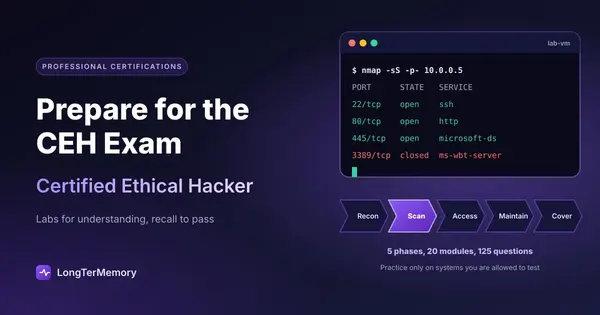
To prepare for the Certified Ethical Hacker (CEH) exam, study the 20 CEH modules in the order of the hacking phases (reconnaissance, scanning, gaining access, maintaining access, covering tracks), practice every major tool in a legal lab, and drill tool names, ports and attack types with spaced flashcards until you score 80% or more on practice tests. Most candidates with basic networking knowledge need 8 to 12 weeks.
When I prepared for the CEH, my first mistake was spending all my time in labs. It was fun, and I learned a lot. Then I took my first practice test and scored 58%. The knowledge exam doesn’t ask you to hack anything. It asks you which Nmap flag performs a stealth scan, which tool cracks WPA2 handshakes, and what stage of the attack lifecycle a scenario describes.
Labs build understanding. Recall wins the exam. This guide shows you how to combine both.
What the CEH Exam Tests Across Cybersecurity Domains
The CEH (312-50) is a 4-hour, 125-question multiple choice exam that tests knowledge of attack techniques, tools and countermeasures across 20 modules. The passing score ranges from about 60% to 85% depending on the exam form, because EC-Council sets cut scores per question set.
Exam facts at a glance
| Detail | CEH knowledge exam |
|---|---|
| Exam code | 312-50 (current version: CEH v13) |
| Questions | 125 multiple choice |
| Time | 4 hours |
| Passing score | 60% to 85%, depending on the form |
| Eligibility | Official EC-Council training, or 2 years of infosec experience plus an approved application |
| Optional practical exam | CEH Practical: 6 hours, 20 hands-on challenges |
| Certification | Valid 3 years, with continuing education credits |
Exam pricing and eligibility rules change, so check the current details on the EC-Council website before you plan your budget.
The 20 CEH modules
The CEH body of knowledge is organized into 20 modules. EC-Council’s exam blueprint groups them into broader domains, and the attack-focused areas (reconnaissance, system hacking, network and web application attacks) carry most of the weight.
| Phase | Modules |
|---|---|
| Foundations | 1. Introduction to Ethical Hacking |
| Reconnaissance | 2. Footprinting and Reconnaissance, 3. Scanning Networks, 4. Enumeration, 5. Vulnerability Analysis |
| System attacks | 6. System Hacking, 7. Malware Threats |
| Network attacks | 8. Sniffing, 9. Social Engineering, 10. Denial-of-Service, 11. Session Hijacking, 12. Evading IDS, Firewalls, and Honeypots |
| Web attacks | 13. Hacking Web Servers, 14. Hacking Web Applications, 15. SQL Injection |
| Wireless, mobile, IoT | 16. Hacking Wireless Networks, 17. Hacking Mobile Platforms, 18. IoT and OT Hacking |
| Cloud and crypto | 19. Cloud Computing, 20. Cryptography |
Study them in this order. It follows the real attack lifecycle, so each module builds on the last.
What kind of questions to expect
CEH questions fall into a few recognizable types:
| Question type | Example |
|---|---|
| Tool identification | ”Which tool is used to crack password hashes offline?” |
| Command and flag | ”Which Nmap option performs a TCP SYN scan?” (-sS) |
| Phase recognition | ”An attacker searches job postings for technologies. Which phase?” |
| Attack identification | ”A user is redirected after DNS cache poisoning. Which attack?” |
| Countermeasure | ”Which control best prevents SQL injection?” (parameterized queries) |
| Concept | ”What is the difference between a vulnerability scan and a penetration test?” |
Notice that most of these reward precise recall. That shapes how you should study.
Hands-On Lab Practice Alongside Conceptual Study for CEH
Pair every module with a short lab: read the concepts first, then use the tools yourself, then write down what each tool and flag did. Labs turn abstract names into memories you can actually retrieve.
Set up a legal practice environment
Only ever practice on systems you own or have explicit written permission to test. Good options:
| Lab option | Cost | Best for |
|---|---|---|
| EC-Council iLabs (with official training) | Included with course | Matches the official curriculum exactly |
| Home lab: attacker VM + intentionally vulnerable VMs | Free | Full control, offline practice |
| Online training platforms with guided rooms | Free tier or low monthly cost | Structured, beginner-friendly exercises |
| Capture the flag (CTF) events | Free | Applying skills under time pressure |
A simple home lab needs only a laptop with 16 GB of RAM, virtualization software, a security-focused Linux distribution as your attacker machine, and one or two deliberately vulnerable virtual machines.
The tools you must recognize
You don’t need mastery of every tool, but you should know what each one does and when to use it:
| Category | Tools to know |
|---|---|
| Reconnaissance | whois, nslookup, theHarvester, Maltego, Google dorking |
| Scanning | Nmap, hping3, Angry IP Scanner |
| Vulnerability analysis | Nessus, OpenVAS, Nikto |
| Exploitation | Metasploit, Hydra, John the Ripper, Hashcat |
| Sniffing | Wireshark, tcpdump, Ettercap |
| Web | Burp Suite, sqlmap, OWASP ZAP |
| Wireless | Aircrack-ng suite |
The lab notebook habit
After each lab, write a short entry:
- Goal: “Find open ports on the target”
- Tool and command:
nmap -sS -p- 10.0.0.5 - What it did: “SYN scan of all 65,535 ports”
- What it looked like: “Found 22, 80, 445 open”
- Countermeasure: “Firewall rules, IDS to detect scans”
This notebook becomes your best revision source, and every entry can become two or three flashcards.
Balance theory and labs
A good weekly split during the learning phase:
| Activity | Share of time |
|---|---|
| Reading or video lessons | 40% |
| Hands-on labs | 35% |
| Flashcard review and practice questions | 25% |
In the final three weeks, flip it: most of your time goes to practice questions and recall.
Practice Question Strategy and Domain Weighting for CEH Readiness
Start practice questions after the first few modules, track your scores by area, and only book the exam once you’re consistently above 80% on fresh question sets. Prioritize your study by weight and weakness.
Prioritize by weight and weakness
The heavier areas, reconnaissance, system hacking, network attacks and web application hacking, deserve the most practice. But your weakest area can still sink you. Track scores like this:
| Area | Practice score | Weight | Action |
|---|---|---|---|
| Reconnaissance and scanning | 85% | High | Maintain |
| System hacking | 68% | High | Top priority |
| Web application hacking | 72% | High | Priority |
| Cryptography | 60% | Low to medium | Targeted review |
| Cloud computing | 80% | Low to medium | Maintain |
How to review practice questions
For every question:
- Got it wrong? Find out why, add the fact to a flashcard, and note the area
- Got it right by guessing? Treat it exactly like a wrong answer
- Got it right confidently? Move on
That review step is where most of the learning happens. The guide on learning from practice test mistakes goes deeper on this.
Exam day timing
125 questions in 240 minutes is nearly 2 minutes per question, which is generous. Most candidates finish early. Use the extra time to review flagged questions, but don’t change answers without a clear reason.
A 10-Week CEH Study Plan
Cover the modules in phase order over seven weeks, then spend three weeks on practice exams and review. Adjust if you’re new to networking.
| Week | Focus |
|---|---|
| 1 | Modules 1 to 2: ethical hacking concepts, footprinting |
| 2 | Modules 3 to 5: scanning, enumeration, vulnerability analysis |
| 3 | Modules 6 to 7: system hacking, malware |
| 4 | Modules 8 to 12: sniffing, social engineering, DoS, session hijacking, evasion |
| 5 | Modules 13 to 15: web servers, web apps, SQL injection |
| 6 | Modules 16 to 18: wireless, mobile, IoT and OT |
| 7 | Modules 19 to 20: cloud, cryptography |
| 8 | First full practice exams, fix weak areas |
| 9 | More practice exams, daily flashcard review |
| 10 | Final review, light practice, rest before exam |
Not confident with networking? Spend two weeks on networking fundamentals first. The CEH assumes you know TCP/IP, ports and common protocols. This guide to studying for networking certifications is a good primer.
Keep a daily spaced review
The CEH has hundreds of small facts: port numbers, tool names, Nmap flags, attack names, encryption algorithms. They fade fast. A 20-minute daily flashcard review from week 1 is the single best habit for this exam.
Useful flashcard topics:
- Common ports (21, 22, 23, 25, 53, 80, 110, 139, 143, 443, 445, 3389)
- Nmap scan types and flags (-sS, -sT, -sU, -sV, -O, -A)
- Hacking phases and which activities belong to each
- Malware types and their characteristics
- Cryptographic algorithms: symmetric, asymmetric, hashing
- OWASP Top 10 categories and countermeasures
Common CEH Prep Mistakes
The most common mistakes are doing labs without recall practice, skipping weaker modules, and relying on memorized question dumps. Also:
- Using brain dumps. They violate EC-Council’s terms, risk your certification, and don’t build real skill.
- Ignoring countermeasures. Many questions ask how to defend, not attack.
- Skipping cryptography and cloud. Smaller areas, but easy points if you prepare.
- Cramming tool names. Hundreds of names can’t be crammed. Spread the review out.
Keep the Tool Names and Ports in Memory
The CEH rewards precise recall of hundreds of details, and writing flashcards for all of them takes many hours. That’s where automation helps.
With LongTerMemory, you can upload your CEH course notes, lab notebook, or study guide PDFs, and it generates question and answer cards automatically: tools, flags, ports, attack types and countermeasures. Spaced repetition then schedules each review, so module 3’s Nmap flags are still sharp when you reach module 20. It saves the hours of card writing so you can spend them in the lab, and the free trial covers your first few modules.
Frequently Asked Questions
How hard is the CEH exam?
It’s moderately difficult. The questions aren’t deeply technical, but they cover a wide range of tools, attacks and countermeasures, so precise recall is essential.
How long does it take to prepare for the CEH?
Most candidates need 8 to 12 weeks at 1 to 2 hours a day. If you’re new to networking, add 2 to 4 weeks for the fundamentals.
Do I need hands-on experience to pass the CEH?
Not for the knowledge exam, but labs make the material much easier to remember. For the CEH Practical, hands-on skills are essential.
What is the passing score for the CEH?
It ranges from about 60% to 85% depending on the exam form. Aim for 80% or more on practice tests before booking.
Is the CEH worth it in 2026?
It’s widely recognized by employers and appears in many government and corporate job requirements. Pairing it with hands-on skills or the CEH Practical makes it more valuable.
The Bottom Line
Preparing for the CEH means following the hacking phases through 20 modules, backing each module with a legal lab, and drilling the details with spaced flashcards and practice questions. Labs give you understanding, but recall and practice tests are what get you over the passing line.
Start this week: set up a basic lab, do module 1 and 2, and write your first ten flashcards from your lab notebook. That’s the rhythm for the next ten weeks.