How to Put Certification Prep on Your Resume Before You Pass
Learn how to list in-progress certification credentials on your resume professionally to boost job search results and career advancement before passing.
Table of Contents
- How to List an In-Progress Certification on Your Resume Professionally
- Choose the Right Section
- Use Precise, Honest Language
- What to Avoid at All Costs
- Using Exam Registration Dates as Credible Resume Evidence
- Why Dates Matter More Than You Think
- How to Present Registration Details
- What If You Have Not Registered Yet?
- When to Emphasize Study Progress in Interviews Before Certification Is Complete
- Reading the Room
- Turning Prep Into Proof of Initiative
- Handling the "Why Haven't You Finished Yet?" Question
- Sample Resume Lines You Can Adapt Today
- How to Actually Pass So This Becomes Permanent
- Final Thoughts
There is a weird, awkward gap in every professional certification journey. It starts the day you commit to the exam and ends the day you pass. In between, you are doing real work. You are learning new frameworks, memorizing standards, and building skills that are genuinely valuable in the job market. But your resume still looks exactly the same as it did before you opened the first textbook.
That gap is a problem, because the average certification prep timeline is not short. According to data from PMI, PMP candidates typically spend 35 to 40 hours preparing for the exam. AWS certification candidates often report 80 to 120 hours of study time. CFA Level I candidates regularly log 300 hours or more. If you are waiting until you pass to update your resume, you are effectively hiding months of skill development from potential employers.
The good news is that you do not have to wait. You can list certification prep on your resume before you pass, and when you do it right, it actually signals initiative, ambition, and relevant technical growth. When you do it wrong, it looks like padding or wishful thinking. This guide will show you exactly how to thread that needle.
How to List an In-Progress Certification on Your Resume Professionally
The core principle is simple: be specific, be honest, and be strategic about placement. An in-progress certification belongs on your resume if it is relevant to the role you are targeting, if you have made measurable progress, and if you can back up every claim in an interview. Vague statements like “studying for PMP” add nothing. Specific entries like “PMP Certification, In Progress, Expected Completion November 2026” tell a completely different story.
Recruiters and hiring managers scan resumes in seconds. A well-formatted in-progress certification catches their eye as active professional development rather than filler. The key is formatting it so it looks intentional, not desperate.
Choose the Right Section
Where you place your in-progress certification depends on how far along you are and how relevant it is to the target role.
Option 1: Within your Education or Certifications section
If you already have a Certifications section on your resume, this is the most natural home. List the credential exactly as you would a completed one, but add a clear status label. For example:
- AWS Certified Solutions Architect, Associate (In Progress, Expected December 2026)
- Certified Public Accountant (CPA) (Exam scheduled, 2 of 4 sections passed)
- Project Management Professional (PMP) (Application approved, exam scheduled for January 2027)
Option 2: In a dedicated Professional Development section
If you are early in the process and have not yet registered for the exam, a Professional Development section can be a better fit. This section signals that you are actively investing in your skills without implying you are further along than you actually are. Examples include:
- Google Data Analytics Certificate (Coursera, 4 of 8 courses completed)
- CISSP Certification Prep (ISC2 official study program, enrolled October 2026)
Option 3: Within your Professional Summary
If the certification is central to the role you are applying for, mentioning it in your professional summary can be powerful. This works best when you are close to completion and the credential is a known requirement in your field. A line like “IT professional with 5 years of infrastructure experience, currently completing AWS Solutions Architect certification (scheduled December 2026)” frames the prep as an asset, not a deficiency.
Use Precise, Honest Language
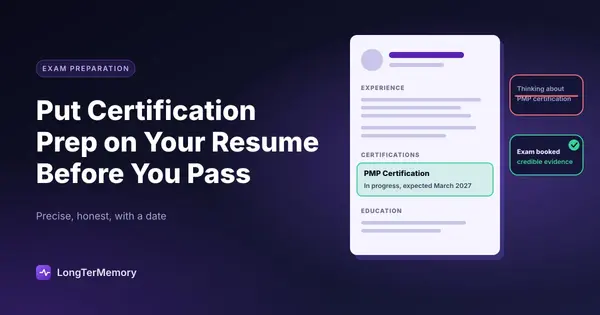
The words you choose matter enormously. Avoid soft language that sounds uncertain. Words like “thinking about,” “considering,” or “exploring” make it sound like you might abandon the effort next week. Instead, use language that reflects commitment and concrete action.
| Weak Phrasing | Strong Phrasing |
|---|---|
| Thinking about PMP certification | PMP Certification (In Progress, Expected March 2027) |
| Studying for the CPA exam | CPA Exam Candidate (2 sections passed, 2 scheduled) |
| Learning AWS | AWS Solutions Architect Associate (Enrolled, Exam Q1 2027) |
| Interested in data analytics | Google Data Analytics Certificate (6 of 8 courses complete) |
The strong phrasing works because it includes three elements: the credential name, your current status, and a timeline. Those three elements transform a vague intention into a credible professional fact.
What to Avoid at All Costs
There are a few common mistakes that can make an in-progress certification backfire on your resume.
Do not list credentials you have not started. If your exam prep consists of bookmarking a study guide and buying a textbook you have not opened, it does not belong on your resume yet. Wait until you have a concrete milestone to report, whether that is course enrollment, exam registration, or completion of a significant study module.
Do not use the abbreviation without explanation. If you are pursuing a less common certification, spell out the full name at least once. A recruiter scanning your resume may not immediately know what “CISM” or “SHRM-CP” stands for, and confusion is not your friend.
Do not pretend it is complete. This should be obvious, but it happens more often than you would think. Listing a certification as complete when you have not passed the exam is misrepresentation. If a background check or credential verification reveals the discrepancy, you will not get the job, and you may burn a bridge permanently.
Using Exam Registration Dates as Credible Resume Evidence
A scheduled exam date is one of the most powerful pieces of evidence you can put on a resume. It transforms abstract study plans into a concrete, time-bound commitment. When a hiring manager sees that you have already paid for and scheduled an exam, they understand that you are serious enough to put money and a calendar date behind your goal.
This matters because actions are more credible than intentions. Anyone can say they are studying for a certification. Not everyone can say they are sitting for the exam on November 14th at 9 AM. That specificity creates trust.
Why Dates Matter More Than You Think
Recruiters are trained to spot fluff. Vague claims about skills and ambitions are everywhere on resumes, and experienced hiring managers develop a kind of immunity to them. A specific date cuts through that noise because it is verifiable and it creates accountability.
If you write “CPA Exam, Section 3 scheduled for November 2026,” a recruiter knows several things immediately. They know you have already passed two sections, which demonstrates competence. They know you are actively moving through the process, which demonstrates persistence. And they know you will likely be fully certified within months, which means the credential will be available to their organization soon.
That is a very different impression than “Studying for CPA,” which could mean anything from “I bought a book yesterday” to “I am taking the exam next week.”
How to Present Registration Details
If you have registered for the exam, you should include the date. The exact format depends on how close the exam is and how much space you have.
For an exam within three months:
- PMP Certification (PMI, Exam scheduled: January 15, 2027)
For an exam further out, or if you want to include additional context:
- Certified Information Systems Security Professional (CISSP) (ISC2, In Progress)
- Exam registered for March 2027
- 250+ study hours completed
- Official practice exam score: 82%
If you have completed prerequisite steps like application approval or prerequisite courses, those are worth mentioning too. They show momentum. A line like “CFA Level I candidate, exam registration approved by CFA Institute, sitting February 2027” carries weight because it proves you have cleared the administrative and eligibility hurdles.
What If You Have Not Registered Yet?
Not everyone is ready to register for an exam when they start job searching. Maybe you are still deciding between exam dates. Maybe you are waiting for your employer to approve reimbursement. Maybe you are completing a prerequisite course first.
In these cases, focus on what you have accomplished rather than what you have not scheduled. Concrete study milestones can still be impressive if you frame them correctly.
Consider these alternatives:
- AWS Solutions Architect Associate Prep (80+ study hours, practice exams consistently scoring 80%+, planning to register Q1 2027)
- SHRM-CP Certification Prep (SHRM Learning System completed, local study group participant, exam registration planned for early 2027)
These lines work because they include quantifiable progress. Eighty study hours is a real number. An 80% practice exam score is a real number. Completion of an official prep program is a real achievement. Those specifics create credibility even without a registered exam date.
When to Emphasize Study Progress in Interviews Before Certification Is Complete
On your resume, your in-progress certification is a line item. In an interview, it is a conversation. The difference matters because interviews give you a chance to explain the context, demonstrate your knowledge, and turn a partial credential into proof of your professional qualities.
You should emphasize your study progress when it directly addresses a qualification gap, when it demonstrates skills relevant to the role, or when it shows initiative the employer values. If you are applying for a cloud engineering role and you are three weeks away from your AWS certification, that is highly relevant. If you are applying for a marketing role and casually studying for a real estate license, it is probably a distraction.
Reading the Room
The right moment to bring up your in-progress certification depends on the flow of the conversation. There are three natural openings.
First, when you are asked about your qualifications or background. This is the most obvious moment. If the interviewer says, “Tell me about your technical skills,” you can include your certification prep as part of your answer. “I have five years of hands-on AWS experience, and I am currently completing the Solutions Architect Associate certification, which has deepened my knowledge of cost optimization and high-availability design patterns.”
Second, when you are asked about your professional development. Many interviewers explicitly ask how you stay current or what you are doing to grow. This is a perfect opening. You can describe your certification prep, the study methods you are using, and what you have learned so far.
Third, when a known qualification gap exists. If the job posting prefers or requires a certification you do not yet hold, addressing it proactively is almost always better than hoping they do not notice. “I want to flag that I am currently three weeks away from completing my PMP certification. I have passed the application review and my exam is scheduled for November 20th. My project management experience exceeds the credential requirements, and I expect to have the certification in hand well before the start date for this role.”
That last approach is powerful because it removes uncertainty. The employer may have been wondering whether you lack the credential entirely. By addressing it head-on with a specific timeline, you turn a potential objection into a non-issue.
Turning Prep Into Proof of Initiative
One of the most underappreciated benefits of discussing certification prep in an interview is that it lets you showcase soft skills that are hard to prove on a resume. Self-directed learning, time management, goal setting, and persistence are all visible in the certification process.
When you describe your prep, focus on the process, not just the outcome. Instead of saying “I am studying for the CISSP,” say something like:
“I committed to the CISSP about six months ago because I saw our industry moving toward stricter compliance requirements. I put together a study plan that fit around my work schedule, completed the ISC2 official training, and built a spaced repetition system to retain the security frameworks long term. I am scoring consistently in the mid-80s on practice exams and my exam is scheduled for December.”
That answer communicates discipline, planning, industry awareness, and technical depth all at once. It also gives the interviewer specific details they can ask follow-up questions about, which turns a monologue into a real conversation.
Handling the “Why Haven’t You Finished Yet?” Question
Sometimes an interviewer will ask directly why you do not already have the certification. The instinct is to get defensive, but the best response is straightforward and forward-looking.
Do not blame external factors. Saying “I have been too busy at work” sounds like you cannot manage priorities. Saying “it is really hard” sounds like you are struggling. Instead, anchor your answer in a clear timeline and concrete progress.
A strong response sounds like this: “I started the process in June after my last major project wrapped, which gave me the bandwidth to do it properly rather than rushing through. I am about 75% through my study plan and my exam is scheduled for January. I wanted to make sure I actually understood the material rather than just cramming to pass.”
That answer reframes the delay as thoughtful planning rather than procrastination. It also signals that you value mastery over checking a box, which most employers respect.
Sample Resume Lines You Can Adapt Today
Here are specific examples for common certifications and situations. Adapt the format to match your own progress and timeline.
For IT and Cloud Certifications:
- AWS Certified Solutions Architect, Associate (In Progress, Exam scheduled: December 2026)
- CompTIA Security+ (Enrolled, Expected completion: Q1 2027)
- Certified Kubernetes Administrator (CKA) (Linux Foundation, Coursework 80% complete, exam planned for February 2027)
For Project Management:
- Project Management Professional (PMP) (PMI, Application approved, exam scheduled January 2027)
- Certified Associate in Project Management (CAPM) (In Progress, 35 contact hours completed)
For Finance and Accounting:
- Certified Public Accountant (CPA) (Candidate, FAR and AUD sections passed, BEC and REG scheduled for Q4 2026)
- Chartered Financial Analyst (CFA) Level I (CFA Institute, Registered for February 2027 exam)
For Human Resources:
- SHRM Certified Professional (SHRM-CP) (SHRM, Prep course completed, exam scheduled March 2027)
- Professional in Human Resources (PHR) (HRCI, In Progress, Expected Q2 2027)
For Early-Stage Progress:
- Google Project Management Certificate (Coursera, 3 of 6 courses completed)
- DataCamp Data Scientist Professional Certificate (12 of 23 courses complete, ongoing)
How to Actually Pass So This Becomes Permanent
All of this advice only works if you follow through. An in-progress certification on your resume is a promise, and promises on resumes carry an implied expiration date. If you list an exam for January 2027 and it is now June 2027 with no update, that line item starts to look like a failure rather than an asset.
The most common reason certification prep stalls is not lack of motivation. It is inefficient study systems. Most people reread chapters, highlight passages, and take notes in ways that feel productive but do not actually build long-term retention. The result is that they spend months preparing, forget key material, and either fail the exam or delay it indefinitely.
If you want to move from “in progress” to “certified” as quickly as possible, you need a study system designed for retention, not just familiarity. That means active recall instead of rereading. It means spaced repetition instead of cramming. It means studying in a way that strengthens memory over time rather than creating a false sense of confidence that evaporates on exam day.
That is exactly what LongTerMemory is built for. Our platform uses automatic spaced repetition to schedule your review sessions at the optimal intervals for your brain, so you retain more of what you study without wasting time on material you already know. You can import PDFs, web articles, and notes directly into the system, turning any study resource into reviewable flashcards. Instead of managing a pile of textbooks and hoping you remember the content, you get a structured, personalized review schedule that adapts to what you actually need to work on.
Certification prep is already a significant time investment. The average candidate spends dozens or even hundreds of hours preparing. LongTerMemory helps you make those hours count by cutting out inefficient review and focusing your energy where it produces the best results. If you are serious about getting that credential off your “in progress” list and into your qualifications, start your free trial and see how much faster you can move from studying to certified.
Final Thoughts
Listing certification prep on your resume before you pass is not just acceptable, it is smart career strategy when done correctly. The key is specificity. Name the credential, describe your status with concrete details, include a timeline, and be ready to discuss your progress with confidence in interviews.
The professionals who advance fastest are not necessarily the ones who already have every credential. They are the ones who know how to communicate their growth in progress. Your certification prep is real work. It deserves a real place on your resume.