How to Study for a Promotion Exam at Work: A Practical Guide
Practical strategies for preparing for a workplace promotion exam while managing your current job, with proven methods for applied knowledge retention.
Table of Contents
- First: Understand What the Exam Is Actually Testing
- Factual Knowledge of Rules, Policies, and Procedures
- Situational Judgment
- Applied Competency
- Building a Study Plan That Fits Around Your Job
- Start With an Honest Time Audit
- Set a Target Hours-Per-Week, Not a Daily Schedule
- Build Review In From Day One
- What to Study: Prioritizing When You Can't Cover Everything
- Use the Pareto Principle Aggressively
- Make a Content Map
- Convert Policies Into Principles
- Studying While Employed: Specific Tactics
- Morning Sessions Are Worth More Than Evening Sessions
- Use Commute Time for Review, Not New Learning
- Tell the Right People
- How to Actually Retain What You Study
- Active Recall Over Re-Reading
- Make It Contextually Relevant
- Practice Situational Questions Aloud
- The Final Week
- On the Day
There’s a particular kind of pressure that comes with a promotion exam at work. It’s not just academic stakes, it’s your career, your salary, your standing with colleagues, and your relationship with the same people who will keep working alongside you whether you pass or fail. That combination of professional and personal stakes makes these exams genuinely stressful in a way that academic tests rarely are.
What makes it even harder is that you’re studying in the margins: before work, during lunch, after dinner, when you’re already tired from the job you’re trying to get promoted out of. You don’t have the student’s luxury of full days to prepare. You’re working at capacity and trying to add something substantial on top.
This guide is built around that reality. Everything here assumes you have limited time, high stakes, and a need for efficient preparation that actually sticks under pressure.
First: Understand What the Exam Is Actually Testing
This step is obvious, but a surprising number of candidates skip it and just start studying everything. Promotion exams are not the same as academic exams, and the distinction matters enormously for how you prepare.
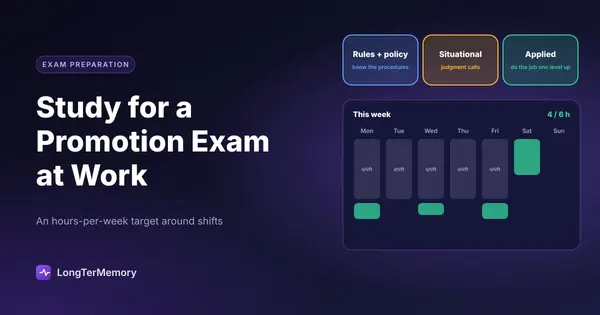
Most promotion exams, whether internal assessments or civil service exams, are testing one of three things (or some combination):
Factual Knowledge of Rules, Policies, and Procedures
These exams test whether you know the organization’s policies, relevant legislation, standard operating procedures, or field-specific regulations. Think civil service exams for law enforcement or firefighting ranks, or internal HR exams for management roles.
The study approach here is close to traditional academic prep: learn the material, use active recall to test yourself, and use spaced repetition to maintain retention across multiple domains.
Situational Judgment
These exams present scenarios, often drawn from real workplace situations, and ask what you would do. They’re testing your judgment, your values alignment with the organization, and your understanding of how policy applies in messy real-world situations.
Memorizing rules helps here, but it’s not sufficient. You need to understand the reasoning behind the rules, not just the rules themselves, so you can apply them correctly in novel situations.
Applied Competency
Some promotion exams include practical components, writing exercises, case studies, or oral boards where you demonstrate the actual skills of the higher-level role. These require practice, not just study.
Before you build a single study plan, get as specific as possible about which type or types of exam you’re facing. If you can find the official exam content outline, read it carefully. Talk to colleagues who’ve taken it before. Find out the format, the weighting of sections, and what the most commonly tested areas are.
Building a Study Plan That Fits Around Your Job
The single biggest mistake promotion exam candidates make is building an idealized study plan and then failing to execute it because it doesn’t account for the realities of a working life.
Here’s a more honest approach.
Start With an Honest Time Audit
Before you schedule anything, spend one week tracking where your actual time goes. Not where you think it goes, where it actually goes. Most people discover they have more usable time than they thought, it’s just scattered across small windows that feel too short to bother with.
Those small windows are exactly where promotion exam prep happens. Twenty minutes on the train. Fifteen minutes at lunch. Thirty minutes after dinner before the cognitive shut-down of evening TV. These aren’t ideal study conditions, but strung together consistently over several weeks, they add up to something real.
Set a Target Hours-Per-Week, Not a Daily Schedule
Daily schedules feel good to make and are miserable to maintain when work gets unpredictable, which it always does. A weekly target is more resilient. If you decide you’ll do eight hours of study this week, you can front-load Tuesday and Wednesday when you know you have a lighter day, and coast Thursday and Friday when you’ve got a big project wrapping up.
The total is what matters, not which specific minutes you used to get there.
Build Review In From Day One
Most candidates study new content right up until exam day and arrive having covered everything but retained only the most recent material solidly. This is a consequence of linear studying: you learn Chapter 1, you move to Chapter 2, Chapter 1 fades.
The fix is to reserve a portion of each study session (20 to 30 percent of your time) for reviewing previously covered material. Use flashcards with a spaced repetition system to keep older content active. It feels slower, but you’ll actually retain everything you’ve studied, not just the last week of it.
What to Study: Prioritizing When You Can’t Cover Everything
With limited time, you almost certainly can’t go deep on every topic. The skill of smart preparation is knowing where to focus.
Use the Pareto Principle Aggressively
In most promotion exams, roughly 20 percent of the content appears in roughly 80 percent of the questions. Identify what that 20 percent is for your specific exam (past exams, the content outline, and colleagues who’ve already taken it are your best sources) and make sure you have that material mastered before you worry about the edges.
This isn’t about cutting corners. It’s about accepting that given your time constraints, excellent mastery of the core is more valuable than surface familiarity with everything.
Make a Content Map
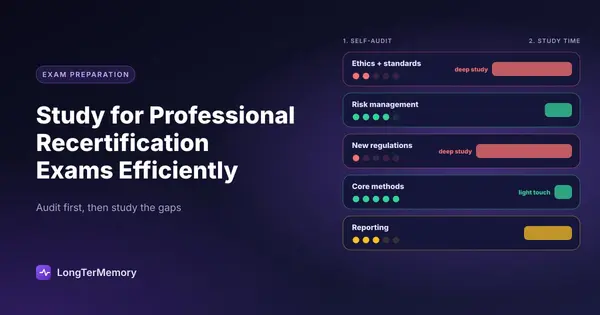
Before you dive into studying, create a one-page map of all the topics the exam covers. Then rate your current confidence on each topic: strong, okay, or weak. This gives you a clear picture of where to spend your limited time.
| Topic | Your Confidence | Priority |
|---|---|---|
| Core regulations | Weak | High |
| Situational scenarios | Okay | Medium |
| Departmental policy | Strong | Low |
| Leadership principles | Weak | High |
Work from the bottom of the confidence column up. Your strong areas need maintenance (flashcard reviews), not new study. Your weak areas need active learning.
Convert Policies Into Principles
For policy-heavy exams, don’t try to memorize every rule verbatim. Instead, understand the principle behind the policy. Why does this rule exist? What problem is it solving? What values is it expressing?
When you understand the principle, you can often reconstruct the specific rule even if you’ve forgotten the exact wording, and you can apply it correctly to novel situational scenarios that don’t match any specific case you’ve studied.
Studying While Employed: Specific Tactics
Morning Sessions Are Worth More Than Evening Sessions
Cognitive research on timing is clear: your prefrontal cortex, responsible for focus, analysis, and learning, is most effective in the hours after waking. If you can carve out even 30 minutes before work, that time will produce more learning per minute than the same amount of time late in the evening when mental fatigue has set in.
Not everyone can make this work with their schedule or family responsibilities. But if you can shift even some of your study time to mornings, do it.
Use Commute Time for Review, Not New Learning
Commuting (especially if you’re driving) is not a great time to tackle new, complex material. It is a good time for spaced repetition review using audio or quick flashcard sessions on your phone. Review what you already know, reinforcing older material, rather than trying to learn something new when your attention is split.
Tell the Right People
Consider letting your manager know you’re preparing for the promotion exam. This isn’t a guarantee of accommodation, but many managers will respect the initiative and may adjust your workload during the heaviest study periods, or at minimum will understand if your lunch breaks get shorter for a few weeks.
Be strategic about who else you tell. Some colleagues will be supportive. Others may be competing for the same promotion, which changes the dynamic. You don’t need to broadcast it widely, but having one or two people who know what you’re doing provides accountability and support.
How to Actually Retain What You Study
Reading materials for a promotion exam is easy. Retaining them under the pressure of sitting in an exam room weeks later is the hard part.
Active Recall Over Re-Reading
Every time you read through material, you’re doing passive review. It creates a feeling of familiarity that your brain often mistakes for mastery. But familiarity is not recall.
After reading any section of your study material, close it and write down everything you can remember without looking. Then check what you missed. This active retrieval attempt, even when it’s uncomfortable and incomplete, is the mechanism that actually builds durable memory.
Make It Contextually Relevant
One powerful advantage you have over a regular student is that you already work in the environment the exam is testing. Connect every concept to something you’ve actually seen in your job.
When you study a policy rule, think of a real incident from your work where that rule was relevant. When you learn a leadership principle, think of a manager you’ve had who either exemplified or violated it. These concrete connections from abstract rule to real experience create stronger memory traces than any amount of re-reading.
Practice Situational Questions Aloud
If your exam includes situational judgment components or oral boards, practice your answers out loud. This feels embarrassing but it’s essential. Knowing what you’d do in a scenario and being able to articulate it clearly and confidently under pressure are completely different skills.
Get a trusted colleague, friend, or partner to run mock scenarios with you. Have them push back on your answers. Get comfortable defending your reasoning, not just stating your conclusion.
The Final Week
The week before your exam, your goal shifts from learning new material to consolidating what you already know.
Stop trying to cover anything new. If you haven’t learned it by now, a frantic cram in the final days is unlikely to stick under exam pressure. Instead, focus your final week on:
- Running your full flashcard decks through spaced repetition review
- Doing practice questions from any available past exams or practice tests
- Reviewing your content map and doing a final pass on any genuinely weak areas
- Getting your sleep in order
That last point is not optional. Sleep is when your brain consolidates what you’ve learned during the day. Poor sleep in the week before an exam undoes a significant portion of the preparation you’ve done. Whatever your normal sleep schedule looks like, protect it in the final week, and on the night before the exam, prioritize rest over any last-minute reviewing.
On the Day
Eat a normal meal before the exam. Avoid loading up on caffeine beyond what you usually consume, since extra caffeine increases anxiety without proportionally increasing performance. Arrive early so you’re not rushed.
During the exam, trust your preparation. For questions you’re unsure about, mark them and move on rather than sitting stuck. Your brain often surfaces an answer after you’ve moved away from a question and come back to it.
For situational questions, if you’re genuinely unsure what the “correct” answer is, ask yourself: what would the organization’s stated values and policies say about this? What would a reasonable senior person in this role do? These questions often lead you to the intended answer even when the specifics of the scenario feel unfamiliar.
Promotion exams are genuinely hard to prepare for, especially while working full-time. But the candidates who succeed aren’t usually the ones who have the most time. They’re the ones who use their limited time most efficiently: they know exactly what the exam tests, they focus their study on the highest-priority content, they use active recall instead of passive reading, and they show up having maintained everything they’ve learned, not just the last week of it.
LongTerMemory.com can help with that last part, particularly for policy-heavy exams with a lot of material to retain. Upload your study documents and let the platform generate flashcard sets automatically, feeding them into a spaced repetition schedule that keeps everything active without requiring you to build and manage it manually. Useful when your time is already stretched thin.
The promotion is worth preparing for properly. Start earlier than you think you need to, study smarter than just re-reading, and trust that consistent effort compounds into real results.