How to Choose Which Certification to Study for First
Not sure which certification to pursue first? Learn how to align credentials with your goals, compare ROI, and use the stepping-stone strategy.
Table of Contents
- Aligning Certifications With Your Career Goals and Current Role
- What's the outcome you're actually after?
- Ask people in the role you want
- Comparing Difficulty, ROI, and Study Time Across Similar Certifications
- Difficulty
- Return on Investment
- Study Time
- The Stepping-Stone Strategy: Which Certifications Build on Each Other
- Sequential credential tracks
- When to skip foundational credentials
- Cross-domain stepping stones
- Building Your Decision Framework
- Don't let perfect be the enemy of started
- A Note on Timing
- The Bottom Line
If you’ve ever typed “which certification should I get” into a search engine, you already know the problem. The results are a wall of competing opinions, each one confident that whatever certification the author happened to get is the obvious right starting point for everyone. IT certifications, project management certifications, HR credentials, financial analyst designations, green building credentials, cybersecurity certs, healthcare licenses, the list goes on and it doesn’t narrow itself down based on who you are or what you’re actually trying to accomplish.
The truth is that the best first certification is the one that creates the most leverage for your specific situation. That sounds obvious, but most people skip the work of figuring out what their situation actually is before they start researching certs. They look at what’s popular, what their colleagues have, or what seems impressive, and end up studying for something that doesn’t move the needle in their career.
This guide is about making that decision well. We’ll look at how to align certifications with your goals, how to compare your real options honestly, and how to think about the order in which credentials build on each other.
Aligning Certifications With Your Career Goals and Current Role
Before you compare any specific certifications, you need to be clear on what you’re actually trying to achieve. This sounds like generic advice but it changes everything about which cert makes sense to pursue first.
What’s the outcome you’re actually after?
There are a few distinct reasons people pursue certifications:
To qualify for a role they don’t currently hold. If you’re trying to move into project management, cloud engineering, or cybersecurity from a different field, a foundational certification in that area serves as a signal to hiring managers that you’ve made a deliberate transition, not just a random application. Here, the cert’s role is credential-as-ticket.
To earn more in a role they already hold. Some certifications are strongly linked to salary increases in specific industries. AWS certifications, for example, carry documented salary premiums in cloud computing roles. PMP certification is similarly correlated with higher compensation in project management. Here, the cert’s role is credential-as-leverage.
To meet a compliance or professional requirement. In some fields, you simply have to hold specific credentials to practice or advance past a certain level. FINRA licenses in finance, state board exams in healthcare, bar passage in law. Here, you don’t really have a choice, the requirement defines the cert.
To demonstrate commitment and deepen knowledge. Sometimes the certification process itself is the point, not the credential on paper. Going through a rigorous structured curriculum, even if the credential isn’t particularly famous, makes you genuinely better at your job. Here, the cert’s role is credential-as-education.
Knowing which category applies to you changes how you evaluate options. Someone trying to qualify for a new role should prioritize certifications with high employer recognition in their target job market. Someone trying to earn more in their current role should look at which credentials are actually tied to salary data in their industry.
Ask people in the role you want
One of the most underused research strategies for certification selection is simply talking to people who already hold the role you’re targeting and asking what credentials they have, which ones they actually found valuable, and what they’d do differently if they were starting over.
LinkedIn makes this easier than it’s ever been. Search for people with your target job title and look at their education and certifications sections. If you see the same credential appearing over and over, that’s a strong signal it’s valued in that field. If a certification you were considering barely shows up among actual practitioners, take that as useful data.
Comparing Difficulty, ROI, and Study Time Across Similar Certifications
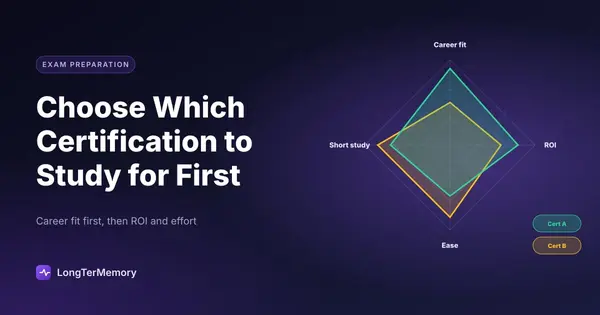
Once you’ve narrowed down to a realistic shortlist of options in your target area, the next task is comparing them honestly against each other. The three dimensions that matter most are difficulty, return on investment, and study time required.
Difficulty
Difficulty affects whether you pass on your first attempt, how long you need to prepare, and in some cases, how much weight the credential carries in the job market. A hard-to-pass certification is often more valuable precisely because fewer people hold it.
That said, difficulty needs to be assessed relative to your starting point, not in absolute terms. A certification that’s challenging for someone new to a field might be relatively straightforward for someone with years of direct experience in it. Always assess difficulty in the context of where you’re starting from, not just what the general reputation of the exam is.
Some quick heuristics:
| Certification Type | Typical First-Pass Rate | Study Time (Est.) |
|---|---|---|
| Entry-level IT (CompTIA A+, Cloud+) | ~60-70% | 60-120 hours |
| Associate cloud (AWS SAA, AZ-900) | ~65-75% | 40-80 hours |
| Professional/Expert cloud | ~40-60% | 100-200+ hours |
| PMP (Project Management) | ~55-65% | 100-150 hours |
| CFA Level 1 | ~38-45% | 250-300 hours |
| Bar Exam (varies by state) | ~50-80% | 400-600+ hours |
Note that these ranges vary considerably by state, by year, and by individual background. Use them as rough orientation, not guarantees.
Return on Investment
ROI on a certification has two components: the direct financial return (salary increase, job qualification) and the career option value (what doors does this open).
For salary impact, look at actual compensation data rather than certification provider marketing. Sources like the IT Skills and Salary Survey (published by Global Knowledge / Skillsoft), Bureau of Labor Statistics data, LinkedIn Salary Insights, and Glassdoor all provide salary data by credential that’s more grounded than anything a certification body publishes about itself.
For career option value, think about which certifications are recognized by the most employers in your target field, which ones are prerequisites for more advanced credentials you might want later, and which ones remain valuable even if you shift your focus somewhat in the future.
Foundational credentials tend to have high option value because they’re recognized broadly. CompTIA A+ or Security+ are good examples: widely recognized across many employers, not tied to a single vendor, and relevant across a range of roles. Similarly, a Project Management Professional (PMP) is recognized across industries, not just in IT.
Vendor-specific credentials tend to have higher salary premiums in roles centered on that vendor’s technology, but lower portability if you shift away from that ecosystem. AWS certifications are extremely valuable if you’re working in AWS-heavy environments, but less transferable to a role that runs primarily on Azure or GCP.
Study Time
Study time matters because it’s the cost side of the ROI calculation, and because it affects whether a certification is realistic to pursue given your current life constraints. If you’re working full time and have significant personal obligations, a certification that requires 300 hours of preparation is a multi-month commitment. That’s not disqualifying, but it needs to be acknowledged honestly.
Our guide on studying while working covers the practical mechanics of fitting serious study into a busy professional schedule in detail, including how to use micro-study sessions, leverage weekends effectively, and automate your review process to maintain momentum.
The Stepping-Stone Strategy: Which Certifications Build on Each Other
One of the most valuable frames for thinking about certification selection is the stepping-stone approach: choosing your first certification not just for its standalone value, but for the pathway it opens to subsequent credentials.
Sequential credential tracks
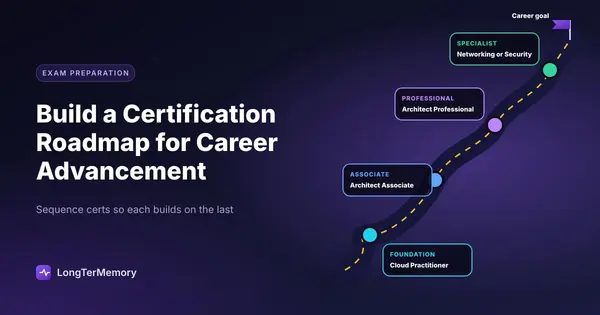
Most major certification programs are explicitly designed as sequences. AWS, for example, has a clear progression from foundational (AWS Cloud Practitioner) to associate level (Solutions Architect, Developer, SysOps Administrator) to professional level (Solutions Architect Professional, DevOps Engineer Professional) to specialty certifications. Starting with the Cloud Practitioner gives you the vocabulary and conceptual framework that everything else builds on.
Similarly, ISACA’s cybersecurity credentials have a natural sequence: CISA (information systems audit) or CISM (information security management) as established mid-career certifications, with the CGEIT and CRISC representing more senior governance and risk credentials. Our detailed guide on CISM and CISA study preparation walks through how to approach both of these in sequence.
Project management has a similar pattern: PMI’s CAPM (Certified Associate in Project Management) is designed as an entry-level credential for people who don’t yet meet the experience requirements for the PMP. Getting the CAPM first, then accumulating the required project hours, then sitting for the PMP is a well-traveled path.
When to skip foundational credentials
Sometimes it makes sense to skip an entry-level credential and go straight to the intermediate one. This is worth considering if:
Your existing experience already demonstrates competence at the foundational level, and the entry credential doesn’t add signal to your resume given what you already have. A software engineer with 10 years of experience probably doesn’t need CompTIA A+ on their resume to signal technical competence.
The foundational credential is primarily designed to help you pass the next one, and you’re confident you can pass the next one without it. AWS Cloud Practitioner, for example, is partly a stepping stone to associate certifications, but a technically experienced person with some AWS exposure might go straight to the Solutions Architect Associate without needing the Cloud Practitioner as an intermediate step.
When in doubt, look at what people in your target role actually have on their profiles. If practitioners at that level hold the foundational credential, you probably need it. If they don’t, you might be able to skip it.
Cross-domain stepping stones
Some certifications are valuable not just for the direct role they lead to but for the multi-domain literacy they provide. The PMP is a good example: it creates a common vocabulary for project management that’s useful whether you subsequently go deeper into construction management, IT service delivery, healthcare operations, or financial services. It’s a horizontal credential that makes you more effective across different specializations.
Similarly, the SHRM-CP (Society for Human Resource Management Certified Professional) establishes HR competency that’s useful across virtually every industry, and is often a prerequisite for more specialized HR credentials in compensation, benefits, and talent acquisition. Our guide for new HR professionals pursuing SHRM-CP covers how to approach that certification specifically.
Building Your Decision Framework
Rather than agonizing indefinitely, use a simple framework to make your decision:
Step 1: Define your career outcome. Write it down specifically. Not “advance my career,” but “qualify for a cloud architect role at a mid-size tech company” or “earn a salary increase in my current project management role.”
Step 2: Identify what’s required. Look at 20 to 30 job postings for your target role or similar roles. What credentials appear in the requirements or preferred qualifications sections? What do practitioners in that role actually have on LinkedIn?
Step 3: Shortlist 2 to 3 options. Pick the credentials that appear most frequently and are most aligned with your specific outcome. Don’t keep 10 options in play indefinitely.
Step 4: Assess your current starting point. For each shortlisted option, estimate how much study you’d realistically need given what you already know. Be honest. A certification that looks attractive on paper but requires 200 hours you don’t have in the next 6 months might not be the right first choice.
Step 5: Choose the one with the highest ratio of impact to realistic study investment. That’s your first certification. Start studying.
Don’t let perfect be the enemy of started
The most common mistake in certification planning is paralysis. People spend weeks or months researching options instead of committing to one and starting. The reality is that most foundational certifications in a field are reasonably good choices. The returns compound over time through the combination of credentials you accumulate, not through any single perfect first choice.
Pick one. Use a good spaced repetition system to make your study efficient. Tools like LongTerMemory let you generate personalized flashcards from your study materials and review them on an optimized schedule, meaning you retain more of what you study and need fewer hours overall to reach exam readiness.
The best certification to study for first is the one you actually start studying for.
A Note on Timing
One factor that often gets overlooked is timing relative to your current work situation. If you’re actively job searching, a certification in progress can be almost as valuable on a resume as a completed one, as long as you clearly note the expected completion date. Hiring managers often view a candidate who is pursuing relevant credentials as motivated and forward-thinking, even before the test is passed.
On the other hand, if you’re in a stable role and your goal is a salary increase or internal promotion, timing your credential completion ahead of a review cycle or a specific job opening makes sense. Some certifications (PMP, CFA, AWS professional level) carry enough weight that landing the credential before a critical career conversation, rather than after, makes a real difference.
The Bottom Line
Choosing your first certification is a meaningful career decision, but it’s not as complicated as the internet makes it seem. The core questions are simple: What am I trying to accomplish? What do employers in that space actually value? What’s realistic given my current schedule and starting knowledge? And what opens the most doors for what I might want to do next?
Answer those questions honestly, pick the credential that comes out on top, and commit to a structured study plan that uses your time efficiently. The market rewards people who demonstrate consistent professional development over time, and every certification you earn makes the next one easier to pursue.
The first step is just deciding to start.