How to Learn Information Security Concepts for the CISSP
Learn CISSP security concepts the way the exam tests them: a management mindset, the right concept vs technical balance, and flashcards for frameworks.
Table of Contents
- What the CISSP Actually Tests
- Building a Security Management Mindset for the CISSP Exam
- The priorities that decide most questions
- Learn every concept with three questions
- Translate technical terms into business terms
- Conceptual vs. Technical Knowledge Balance in CISSP Preparation
- Where concepts matter most
- Where technical depth pays off
- Signs your balance is off
- Using Flashcards for CISSP Principles, Policies, and Risk Frameworks
- What to put on CISSP flashcards
- Frameworks worth their own cards
- How many cards and how often
- Mistakes with CISSP flashcards
- Practice Questions: Training the Judgment
- Common Mistakes When Learning CISSP Concepts
- Keep All Eight Domains Fresh
- Frequently Asked Questions
- Is the CISSP more conceptual or technical?
- How do I think like a manager for the CISSP?
- Are flashcards useful for the CISSP?
- How many hours does it take to learn CISSP concepts?
- Which CISSP domain should I study first?
- The Bottom Line
To learn information security concepts for the CISSP, study each topic from the viewpoint of a security manager (risk, business goals, governance), aim for broad conceptual understanding rather than deep technical detail, and lock in definitions, principles and frameworks with spaced flashcards. The exam rewards knowing why a control exists and when it’s the right choice, not how to configure it.
I’ve seen brilliant engineers fail the CISSP and project managers with modest technical backgrounds pass it on the first try. The difference was almost never knowledge. It was how they had learned the concepts: as technical facts, or as management decisions.
This guide is about that learning process. If your concern is coverage of domains you’ve never worked in, my colleague’s article on passing the CISSP without experience in every domain covers the 90-day plan. Here, we focus on how to actually learn and retain the concepts.
What the CISSP Actually Tests
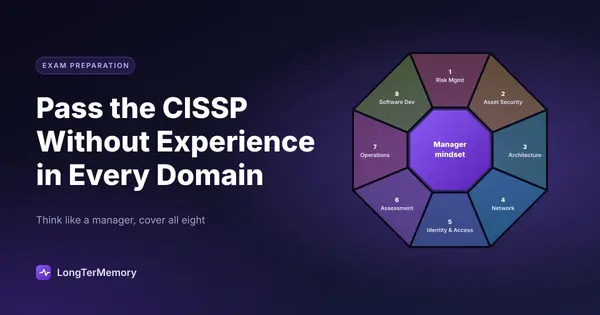
The CISSP tests whether you can make sound security decisions for an organization across eight domains, using a CAT exam of 100 to 150 questions in three hours, with 700 out of 1,000 needed to pass. Its scope is wide and its depth is moderate.
Under the ISC2 exam outline in effect since April 2024, the domains and weights are:
| Domain | Weight |
|---|---|
| 1. Security and Risk Management | 16% |
| 2. Asset Security | 10% |
| 3. Security Architecture and Engineering | 13% |
| 4. Communication and Network Security | 13% |
| 5. Identity and Access Management (IAM) | 13% |
| 6. Security Assessment and Testing | 12% |
| 7. Security Operations | 13% |
| 8. Software Development Security | 10% |
ISC2 revises the outline periodically, so confirm the current version on the ISC2 website before you start. Either way, Domain 1 sets the tone for everything else: risk management is the lens for the whole exam.
Building a Security Management Mindset for the CISSP Exam
The CISSP mindset is: you are an advisor to senior management, your goal is to protect the business at a reasonable cost, and people’s safety always comes first. Every concept you learn should be filed under that viewpoint.
The priorities that decide most questions
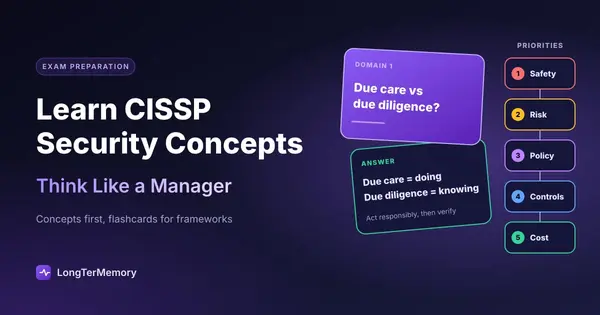
When a question is ambiguous, these priorities usually decide it:
- Human life and safety come before everything
- Senior management is ultimately responsible for security
- Risk management drives decisions, not technology preferences
- Policy and process come first, technical controls implement them
- Cost must be justified by the value of what’s protected
- Root cause beats quick fix
Learn every concept with three questions
When you study a new topic, don’t stop at “what is it?” Ask:
| Question | Example: encryption at rest |
|---|---|
| What risk does it reduce? | Disclosure of data if storage is stolen |
| Who decides to use it? | Data owner, based on classification |
| When is it the wrong choice? | When the cost exceeds the asset value, or when key management isn’t in place |
That third question is the one that makes you a CISSP thinker. Many exam answers are technically correct but wrong for the scenario.
Translate technical terms into business terms
Practice turning every technical topic into a management sentence:
- “Firewall rules” becomes “a preventive technical control that enforces network policy”
- “Patch management” becomes “a process that reduces vulnerability exposure, with change control”
- “Penetration test” becomes “an assessment that requires written management approval and a defined scope”
If you can say it in management language, you understand it at CISSP depth.
Conceptual vs. Technical Knowledge Balance in CISSP Preparation
For the CISSP, aim for roughly 70% conceptual understanding and 30% technical knowledge. You need to recognize technologies and their purpose, but you rarely need command-level detail.
The famous phrase in the CISSP community is “a mile wide and an inch deep.” It’s mostly true, with a few exceptions where more depth pays off.
Where concepts matter most
| Topic | What to know |
|---|---|
| Risk management | Risk = threat x vulnerability x impact, risk responses (accept, avoid, mitigate, transfer) |
| Governance | Policies, standards, procedures, guidelines and their hierarchy |
| Roles | Data owner, custodian, steward, processor, controller |
| Legal and ethics | Due care vs due diligence, the ISC2 Code of Ethics canons |
| Business continuity | BIA, RTO, RPO, MTD and the order of recovery planning |
| Access control models | DAC, MAC, RBAC, ABAC and when each fits |
Where technical depth pays off
| Topic | Level of detail needed |
|---|---|
| Cryptography | Symmetric vs asymmetric, hashing, digital signatures, PKI basics |
| Networking | OSI model layers, common protocols and ports, secure protocols |
| Security models | Bell-LaPadula (confidentiality), Biba (integrity), Clark-Wilson |
| Authentication | Factors, Kerberos, SAML, OAuth vs OpenID Connect |
| Secure SDLC | Testing types, code review, common vulnerabilities |
Signs your balance is off
- You can explain AES key schedules but not the difference between RTO and RPO: too technical
- You know risk vocabulary but can’t say which OSI layer a protocol works on: too abstract
- Your practice scores are high on technical domains and low on Domain 1 and 7: mindset gap
Using Flashcards for CISSP Principles, Policies, and Risk Frameworks
Flashcards work extremely well for the CISSP because the exam depends on precise definitions, distinctions and sequences that are easy to confuse. The key is writing cards that test understanding, not just vocabulary.
What to put on CISSP flashcards
The highest-value card types:
| Card type | Example front | Example back |
|---|---|---|
| Distinction | Due care vs due diligence? | Due care: doing the right thing (acting). Due diligence: researching and verifying (knowing) |
| Sequence | Order of the NIST RMF steps? | Prepare, Categorize, Select, Implement, Assess, Authorize, Monitor |
| Purpose | Why use separation of duties? | Prevents one person from completing a sensitive task alone, reduces fraud |
| Scenario | Breach discovered: what first? | Follow the incident response plan, not ad hoc action |
| Model | Which model is “no read up, no write down”? | Bell-LaPadula, confidentiality |
| Metric | RPO vs RTO? | RPO: maximum acceptable data loss (time). RTO: maximum time to restore |
Frameworks worth their own cards
You won’t be asked to recite every framework, but you should know what each one is for:
- NIST Risk Management Framework (and NIST CSF functions)
- ISO/IEC 27001 and 27002 (ISMS and controls)
- COBIT (IT governance)
- OCTAVE and FAIR (risk assessment approaches)
- STRIDE (threat modeling)
- Common Criteria (evaluation assurance levels)
One card per framework: “What is it used for, and who would use it?”
How many cards and how often
Most successful candidates I’ve worked with end up with 600 to 1,200 cards across all eight domains. That sounds like a lot, but with spaced repetition, daily review typically takes 20 to 30 minutes.
Spaced repetition matters here because the CISSP is broad. If you study domains one after another, Domain 1 fades while you’re on Domain 6. Research on the testing effect, such as Roediger and Karpicke (2006), showed that students who practiced recall remembered far more after a week than those who restudied the same material. Flashcards are recall practice, scheduled.
Mistakes with CISSP flashcards
- Cards that are too long. One concept per card. Split lists into smaller pieces.
- Only definitions. Add scenario and “which is better” cards for judgment.
- Starting cards late. Start in week 1, so early domains get many review cycles.
- Skipping the “why.” Always include the reason on the back.
Practice Questions: Training the Judgment
Practice questions turn concepts into exam decisions, so start them early and review explanations more than scores. Flashcards build knowledge; questions build the CISSP judgment.
A good routine:
- After each domain, do 50 to 100 questions on it
- Read every explanation, especially for questions you got right by luck
- Turn insights into cards: “Why was ‘consult policy’ better than ‘isolate the system’?”
- In the last month, switch to mixed-domain sets, like the real exam
- Before booking, aim for consistent scores of 75 to 80% on quality question banks
Also watch your reasoning on “first,” “best,” and “most important” questions. They’re where the management mindset shows up most.
Common Mistakes When Learning CISSP Concepts
The biggest mistakes are studying like a technician, memorizing without understanding, and letting early domains fade. Others:
- Over-reading. The official study guide is long. Read for understanding, then switch to recall.
- Ignoring ethics. The ISC2 Code of Ethics canons and their order appear on the exam.
- One-resource tunnel vision. Combine a study guide, a video course, flashcards and a question bank.
- No review schedule. Breadth without spacing means forgetting half of what you studied.
Keep All Eight Domains Fresh
The hardest part of CISSP study is keeping eight domains in memory at the same time. That’s exactly what spaced repetition solves, if you have good cards.
With LongTerMemory, you can upload your CISSP study guide chapters, notes, or the official outline as PDFs, and it generates question and answer cards automatically, from distinctions like due care vs due diligence to framework steps. Spaced repetition then schedules every review, so Domain 1 is still sharp when you reach Domain 8. It saves dozens of hours of card writing, and the free trial is enough to set up your first few domains and see the difference.
Frequently Asked Questions
Is the CISSP more conceptual or technical?
Mostly conceptual. It tests security management decisions across eight domains. You need technical familiarity, but not hands-on configuration detail.
How do I think like a manager for the CISSP?
Focus on risk, business goals, governance and safety. Ask what risk a control reduces, who decides, and when it would be the wrong choice.
Are flashcards useful for the CISSP?
Yes. The exam relies on precise definitions, distinctions and sequences. Spaced flashcards keep all eight domains fresh, especially when combined with practice questions.
How many hours does it take to learn CISSP concepts?
Most candidates study 150 to 300 hours over 3 to 6 months, depending on experience. Consistent daily study works better than long weekend sessions.
Which CISSP domain should I study first?
Start with Domain 1, Security and Risk Management. It sets the management mindset that every other domain is tested through.
The Bottom Line
Learning CISSP concepts means thinking like a security manager, balancing broad concepts with enough technical depth, and using spaced flashcards to keep eight domains in memory. Ask what risk each control reduces, who decides, and when it’s the wrong choice, and you’ll start answering questions the way the exam expects.
Today, take one concept you think you know, like encryption or access control, and answer the three questions: what risk, who decides, when is it wrong? That’s the CISSP mindset in practice.