How to Build a Spaced Repetition System Without an App
Build a paper spaced repetition system with index cards, a Leitner box, or a calendar, and learn when a manual SRS beats digital flashcard apps.
Table of Contents
- How Spaced Repetition Works (In 60 Seconds)
- Paper-Based Spaced Repetition: Index Cards and Leitner Boxes
- What you need
- How the boxes work
- Writing good paper flashcards
- Calendar-Based Scheduling for Manual Interval Review
- A simple 16-day rotation
- The date-on-card method
- Keeping the daily load manageable
- When a Manual System Is Better Than Digital SRS
- Paper wins in these situations
- Digital wins in these situations
- The hybrid approach
- Common Mistakes With Paper Spaced Repetition
- When You Outgrow the Box
- Frequently Asked Questions
- Does spaced repetition work without an app?
- How many boxes should a Leitner system have?
- How long should I review each day?
- Is writing flashcards by hand better for memory?
- Can I use a manual SRS for a big exam like the USMLE?
- The Bottom Line
You can build a spaced repetition system without an app by using index cards and a Leitner box: cards you answer correctly move to a box you review less often, and cards you miss go back to the box you review every day. A simple paper calendar can do the scheduling. It takes about 20 minutes to set up, costs a few dollars, and works on the same memory principle that every flashcard app is built on.
Spaced repetition apps are great. I’ve recommended them for years. But I keep meeting students who’ve tried three different apps and quit all of them. The interface felt like homework. The phone kept pulling them into notifications. Or they just didn’t like typing their cards.
If that sounds like you, here’s some good news: spaced repetition is a method, not a piece of software. People were using it with paper decades before smartphones existed. And for some learners and some subjects, paper actually works better.
How Spaced Repetition Works (In 60 Seconds)
Spaced repetition means reviewing information at gradually increasing intervals, so each review happens shortly before you would forget. Every successful recall makes the memory more durable, which lets the next interval be longer.
This idea goes back to Hermann Ebbinghaus, who described the forgetting curve in 1885: memories fade quickly at first, then more slowly. Modern research has backed it up again and again. A 2006 meta-analysis by Cepeda and colleagues, reviewing hundreds of experiments, found that spaced study beats massed study (cramming) for long-term retention almost every time.
The two ingredients you need are:
- Retrieval: you have to try to recall the answer before looking (that’s what makes flashcards work).
- Spacing: easy material gets reviewed less often, hard material more often.
An app automates the second part. Without an app, you need a physical system that does the sorting for you. That’s exactly what the Leitner box does. If you want the deeper science, see the science of spaced repetition.
Paper-Based Spaced Repetition: Index Cards and Leitner Boxes
The Leitner system sorts flashcards into numbered boxes, where each box is reviewed less often than the one before it. German science journalist Sebastian Leitner popularized it in his 1972 book So lernt man lernen (“How to learn to learn”), and it’s still the most popular manual SRS.
What you need
- A pack of index cards (3x5 inches is the classic size, 100 to 300 cards to start)
- A box with 5 compartments (a shoebox with cardboard dividers works fine, or a recipe card box)
- A pen, and optionally a few colored markers
- A small calendar or notebook to track review days
How the boxes work
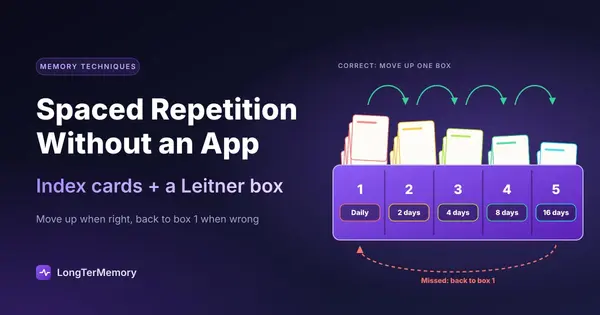
| Box | Review frequency | What’s inside |
|---|---|---|
| Box 1 | Every day | New cards and cards you just missed |
| Box 2 | Every 2 days | Cards answered correctly once |
| Box 3 | Every 4 days | Cards answered correctly twice in a row |
| Box 4 | Every 8 days | Cards answered correctly three times |
| Box 5 | Every 16 days | Well-learned cards |
The rules are simple:
- Correct answer? The card moves up one box.
- Wrong answer? The card goes all the way back to Box 1.
- Card in Box 5 answered correctly? It “graduates” to an archive. You can review the archive once before your exam, or just retire it.
Some versions send a missed card back only one box instead of all the way to Box 1. That’s gentler and works well for large decks. The strict version is better when you need near-perfect recall, like for medical terms or exam formulas.
Writing good paper flashcards
Writing cards by hand is slower than typing, and that’s actually part of the benefit. You think more about each one. A few rules:
- One idea per card. “What are the three branches of government?” is fine. “Explain the entire US Constitution” is not.
- Question on the front, short answer on the back. If the answer needs more than three lines, split the card.
- Use drawings. Paper’s big advantage is that you can sketch a diagram, a molecule, or an anatomy outline in seconds.
- Write the date on the corner. It helps you notice cards that keep failing for weeks.
For more on card writing, our guide to active recall techniques has practical examples.
Calendar-Based Scheduling for Manual Interval Review
The easiest way to know which boxes to review each day is a fixed rotation calendar that you check off day by day. Without one, it’s easy to forget whether today is a Box 3 day, and that’s where most paper systems fall apart.
A simple 16-day rotation
Here’s a rotation that matches the intervals in the table above. Box 1 every day, Box 2 every second day, Box 3 every fourth day, and so on:
| Day | Boxes to review |
|---|---|
| 1 | 1, 2 |
| 2 | 1, 3 |
| 3 | 1, 2 |
| 4 | 1, 4 |
| 5 | 1, 2 |
| 6 | 1, 3 |
| 7 | 1, 2 |
| 8 | 1, 5 |
| 9 | 1, 2 |
| 10 | 1, 3 |
| 11 | 1, 2 |
| 12 | 1, 4 |
| 13 | 1, 2 |
| 14 | 1, 3 |
| 15 | 1, 2 |
| 16 | 1 |
Then you start again at Day 1. This keeps each box on a steady interval without any math. Print it, tape it inside the lid of your box, and put a paperclip on today’s row.
If you want something even more detailed, language learning author Gabriel Wyner shared a well-known 64-day Leitner calendar in his book Fluent Forever, with up to 7 levels. It’s a good next step once the basic version is a habit.
The date-on-card method
An alternative to boxes is writing the next review date directly on each card. You keep the deck sorted by date, and each day you pull the cards with today’s date or earlier.
A common interval sequence:
| Review | Next interval if correct |
|---|---|
| 1st | 1 day |
| 2nd | 3 days |
| 3rd | 7 days |
| 4th | 14 days |
| 5th | 30 days |
| 6th | 60 days |
If you miss a card, it goes back to a 1-day interval. This is closer to how apps schedule cards, but it takes more pencil work. I recommend it for small decks (under 200 cards) and the Leitner box for anything bigger.
Keeping the daily load manageable
Limit new cards to 10 to 20 per day, or Box 1 will swell and you’ll quit. A rough guide to daily review time:
| New cards per day | Approximate daily review time |
|---|---|
| 5 | 5 to 10 minutes |
| 10 | 10 to 20 minutes |
| 20 | 20 to 35 minutes |
These are estimates, since it depends on how hard the material is, but they’re a useful sanity check before you commit. If you find yourself skipping days, cut new cards in half rather than abandoning the system.
When a Manual System Is Better Than Digital SRS
A paper system is better when handwriting, drawing, or freedom from screens matters more than automation and scale. For huge decks or exams with thousands of facts, an app usually wins.
Here’s an honest comparison:
| Factor | Paper (Leitner box) | Digital SRS app |
|---|---|---|
| Setup cost | A few dollars | Free to subscription |
| Card creation speed | Slow (handwritten) | Fast, or automatic with AI |
| Drawings and diagrams | Excellent | Clunky on most apps |
| Distraction | None | Phone notifications nearby |
| Scheduling accuracy | Approximate | Precise, adaptive algorithms |
| Deck size that’s comfortable | Up to roughly 500 to 1,000 cards | Thousands of cards |
| Portability | Bulky box | Always in your pocket |
| Works without battery or internet | Yes | Usually needs a device |
Paper wins in these situations
- Learning to write. Chinese characters, Japanese kana, Arabic script, or math notation all benefit from writing by hand. Your hand learns the shapes too.
- Highly visual subjects. Anatomy, organic chemistry, circuit diagrams, and geography are much faster to sketch than to build in an app.
- Kids and younger students. A physical box is concrete and motivating. Moving a card up a box feels like progress.
- Screen fatigue. If studying on your phone means ending up on social media, paper removes the temptation completely.
- Small, focused decks. Learning 150 vocabulary words for a trip or 80 key dates for a history exam? Paper is perfect.
Digital wins in these situations
- Large exams like USMLE, the bar exam, or professional certifications, where decks reach thousands of cards
- Long time horizons, because a paper box can’t easily handle intervals of 6 months or more
- Studying on the go, during commutes or short breaks
- When card creation is the bottleneck, because writing 2,000 cards by hand simply takes too long
The hybrid approach
Many students do both. They keep a small Leitner box for the visual or handwritten material (diagrams, characters, formulas) and use an app for the big pile of text-based facts. There’s no rule that says you have to pick one.
Common Mistakes With Paper Spaced Repetition
The most common mistakes are adding too many cards, skipping days, and peeking at answers. Here are the ones that break manual systems most often:
- Adding 50 cards on day one. Box 1 becomes a monster. Start with 10 to 20.
- Skipping the rotation calendar. Without it, you’ll review Box 1 forever and forget the others exist.
- Reading the answer too quickly. Say or write the answer before flipping. Otherwise it’s just rereading.
- Being too generous. “I sort of knew it” is a miss. Back to Box 1.
- Never retiring cards. Graduate cards from Box 5, or the box gets too heavy to use.
When You Outgrow the Box
Paper is a great way to learn how spaced repetition feels. But if your material is growing (a full semester of lecture notes, a certification syllabus, a pile of PDFs), writing every card by hand can eat the time you’d rather spend reviewing.
That’s where LongTerMemory can take over the heavy lifting. You upload your PDFs or notes, it generates question and answer pairs automatically, and it schedules every review with spaced repetition, so there’s no calendar to track. The free trial lets you load one course or exam’s material and compare it with your paper box. Keep the box for diagrams and handwriting, and let the app handle the volume.
Frequently Asked Questions
Does spaced repetition work without an app?
Yes. Spaced repetition is a scheduling principle, not software. A Leitner box with index cards and a review calendar applies the same idea: correct cards are reviewed less often, missed cards more often.
How many boxes should a Leitner system have?
Five is the most common and works well for most learners. Some systems use 3 for small decks or 7 for long-term language learning.
How long should I review each day?
Most people do well with 10 to 20 minutes a day. If reviews take much longer, reduce the number of new cards you add.
Is writing flashcards by hand better for memory?
Handwriting makes you process each card more carefully, and it’s especially helpful for visual material and writing systems. The bigger factor for retention, though, is regular retrieval practice on a spaced schedule.
Can I use a manual SRS for a big exam like the USMLE?
You can, but it becomes hard to manage beyond about 1,000 cards. For very large decks, an app or a hybrid approach is more practical.
The Bottom Line
A spaced repetition system without an app needs only index cards, a 5-compartment box, and a rotation calendar. Move cards up when you get them right, back to Box 1 when you miss them, and review the boxes on schedule.
Start today: write 10 cards on what you’re studying this week, put them in Box 1, and tape the 16-day rotation inside the lid. Review tomorrow. That’s the whole system.