How to Use Spacing Effects to Study for Annual Compliance Training
Why once-a-year compliance training is forgotten within weeks, and how spaced review and short refreshers keep compliance knowledge fresh all year long.

Table of Contents
- Why Once-a-Year Compliance Training Produces Minimal Retention
- The forgetting curve doesn't care about policy
- Massed training is the worst format for retention
- Completion is not competence
- What the Spacing Effect Is (and Why It Works)
- Using Spaced Review Throughout the Year
- A spaced compliance calendar
- What to put on your cards
- Scenario cards beat definition cards
- Designing Self-Directed Compliance Refreshers Between Trainings
- Step 1: Identify your high-risk topics
- Step 2: Extract the content
- Step 3: Build 15 to 30 question cards
- Step 4: Schedule reviews
- Step 5: Update when policies change
- For managers and L&D teams
- Common Mistakes When Refreshing Compliance Knowledge
- How LongTerMemory Makes This Effortless
- Frequently Asked Questions
- Why do employees forget compliance training so quickly?
- How often should I review compliance training material?
- What is spaced learning in compliance training?
- Does microlearning improve compliance retention?
- Can I build my own compliance refresher without company support?
- The Bottom Line
Annual compliance training is forgotten quickly because it’s delivered all at once, once a year, which is exactly the opposite of how memory works. The fix is the spacing effect: break the content into small pieces and review them at increasing intervals throughout the year. Even 5 to 10 minutes a week of spaced review can keep critical rules fresh between mandatory sessions.
Be honest. Think back to your last annual compliance training. Maybe it was data privacy, anti-bribery, workplace safety, information security, or anti-money laundering. Now, without looking anything up: what was the reporting deadline for a data breach? What’s the gift value limit for clients? Which documents are you supposed to shred?
If you’re drawing a blank, you’re not a bad employee. You’re a normal human being who was given a three-hour training module in January and is being asked to remember it in October.
The good news is that the science of memory has a well-established fix for this, and it’s surprisingly easy to apply on your own.
Why Once-a-Year Compliance Training Produces Minimal Retention
Once-a-year training creates a single learning event followed by months of zero review, so most of the content decays within weeks. It’s a design built for completion tracking, not for remembering.
The forgetting curve doesn’t care about policy
In the 1880s, Hermann Ebbinghaus showed that we forget new information rapidly after learning it, with the steepest drop in the first days. Modern replications, including a 2015 study by Murre and Dros, have confirmed the same general pattern. The precise percentages vary depending on the material and how meaningful it is, but the shape is consistent: without review, a large share of new information is lost within a few weeks.
Now apply that to compliance training:
| Time after training | Typical state of knowledge |
|---|---|
| Same day | Fresh, you just passed the quiz |
| 1 week | Main ideas remembered, specifics fading |
| 1 month | Vague sense of “there was a rule about that” |
| 6 months | Mostly gone, except what you use daily |
| 11 months | Ready to “learn” it all again |
Massed training is the worst format for retention
Annual compliance modules are a textbook example of massed practice: lots of content crammed into a single session. Learning science has compared massed and spaced practice for over a century, and spacing wins consistently. A large 2006 meta-analysis by Cepeda and colleagues reviewed hundreds of experiments and found that spreading study over time leads to better long-term retention than concentrating it in one block.
Completion is not competence
Most compliance programs measure success by completion rate: did everyone click through and pass the quiz? But passing a quiz minutes after reading the content only shows short-term recognition. It says very little about whether you’ll remember the right action when a real situation comes up months later.
That’s the gap. And it matters, because compliance failures often happen not from bad intent but from simply not remembering the rule at the moment it applies.
What the Spacing Effect Is (and Why It Works)
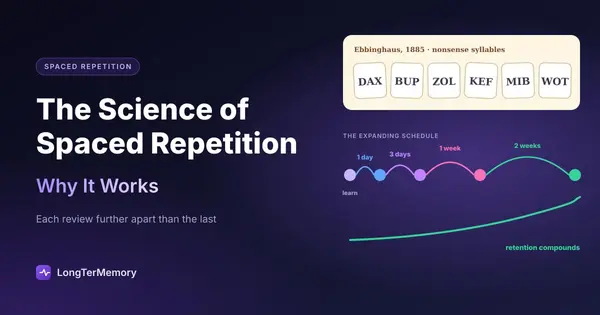
The spacing effect is the finding that information reviewed several times with gaps in between is remembered much longer than the same information studied all at once. Each spaced review strengthens the memory and slows down future forgetting.
There are a few reasons it works:
- Retrieval strengthens memory. Each time you recall a rule after a gap, you rebuild and reinforce the memory trace.
- Desirable difficulty. Recalling something that’s slightly faded takes effort, and that effort signals to your brain that this information is worth keeping.
- Multiple contexts. Reviewing at different times and places links the memory to more cues, making it easier to retrieve later.
This isn’t just a lab finding. Price Kerfoot and colleagues at Harvard ran randomized trials with physicians and trainees using “spaced education”: short questions delivered by email over weeks. They found improved long-term knowledge retention, and in one trial, spaced education even changed clinical behavior, reducing inappropriate PSA screening. If it works for doctors facing complex guidelines, it’ll work for your data privacy policy.
Want the full research story? Read our guide on the science of spaced repetition.
Using Spaced Review Throughout the Year
The simplest approach is to turn your training into a small set of question cards and review them on a spaced schedule: a few days after training, then after a week, a month, and every couple of months after that. That’s only a handful of short reviews per year.
A spaced compliance calendar
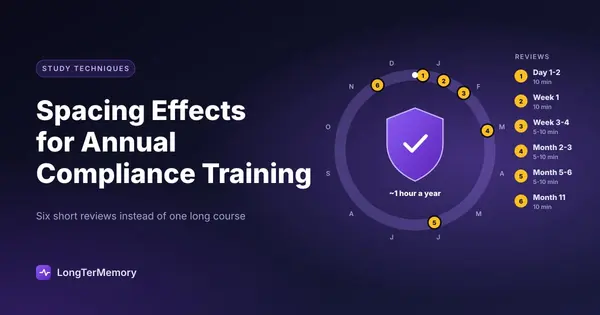
Here’s a simple schedule you can follow after your annual training:
| Review | When | Time needed |
|---|---|---|
| 1 | 1 to 2 days after training | 10 minutes |
| 2 | 1 week after | 10 minutes |
| 3 | 3 to 4 weeks after | 5 to 10 minutes |
| 4 | 2 to 3 months after | 5 to 10 minutes |
| 5 | 5 to 6 months after | 5 to 10 minutes |
| 6 | 1 month before next annual training | 10 minutes |
That’s about an hour of total effort over a full year. Compare that to the cost of a compliance mistake, or the cost of re-learning everything from scratch next year.
What to put on your cards
Don’t try to memorize the entire module. Focus on what actually matters when you’re on the job:
- Decision points: “A client offers me concert tickets worth $300. What do I do?”
- Deadlines and thresholds: “How soon must a suspected data breach be reported internally?”
- Who to contact: “Who do I escalate a suspected bribery issue to?”
- Red flags: “What are three warning signs of a phishing email?”
- Prohibited actions: “Can I forward client data to my personal email to work from home?”
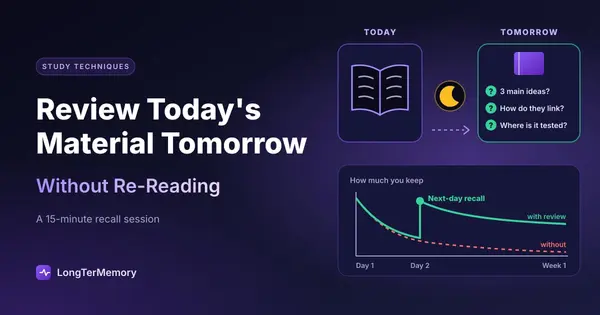
Write them as questions, not statements. Answering questions is retrieval practice, which strengthens memory far more than rereading. Our post on active recall techniques explains why.
Scenario cards beat definition cards
Compliance is about applying rules in context. So, where possible, build cards around short scenarios:
| Weak card | Strong card |
|---|---|
| ”What is personal data?" | "A colleague asks for a customer’s home address to send a gift. Can you share it?" |
| "Define a conflict of interest." | "Your partner owns a supplier your team is evaluating. What must you do?" |
| "What is phishing?" | "An email from ‘IT’ asks you to confirm your password via a link. What’s your next step?” |
Scenario cards train the skill that matters: recognizing a situation and responding correctly.
Designing Self-Directed Compliance Refreshers Between Trainings
You don’t need your company to redesign its program: you can build a personal refresher system in under an hour using the training materials you already have. Pick the high-risk topics, turn them into questions, and schedule short reviews.
Step 1: Identify your high-risk topics
Not every rule matters equally for your role. A salesperson needs anti-bribery and gift policies front and center. An engineer needs security and data handling. A manager needs harassment reporting and HR procedures.
Ask yourself: “Which rules, if I forgot them, could cause real harm or real trouble?” Start there.
Step 2: Extract the content
Download the policy PDF or training slides (most learning platforms allow this) and highlight the actionable parts: thresholds, deadlines, steps, contacts, and prohibited actions.
Step 3: Build 15 to 30 question cards
That’s enough to cover the essentials for most compliance topics. More than that and you’ll stop reviewing.
Step 4: Schedule reviews
Use a spaced repetition app, or simply put recurring reminders in your calendar using the schedule above. Monday morning with coffee works well for a lot of people. Our guide to habit stacking shows how to attach reviews to routines you already have.
Step 5: Update when policies change
Compliance rules change. When you get an updated policy, adjust the affected cards so you’re never memorizing outdated information.
For managers and L&D teams
If you’re responsible for training others, spacing can be built into your program:
- Microlearning bursts: short 3 to 5 minute refreshers monthly instead of one long annual module.
- Spaced quiz questions: send a couple of scenario questions every few weeks.
- Real-world prompts: tie refreshers to moments when rules apply (before travel, before year-end gift season, before audits).
- Measure retention, not completion: test knowledge months later, not just at the end of the module.
Our article on building a workplace learning culture has more ideas for making learning stick across a team, and how professionals retain knowledge covers the individual side.
Common Mistakes When Refreshing Compliance Knowledge
The most common mistakes are rereading slides instead of testing yourself, making too many cards, and reviewing only right before the next annual session. Avoid these and your system will actually work.
- Rereading the policy: Feels productive, but recognition isn’t recall. Test yourself instead.
- Making 200 cards: You’ll abandon it. Keep it lean.
- Cramming before the annual quiz: That gets you a pass, not lasting knowledge.
- Ignoring rules you think are obvious: Those are often exactly the ones people get wrong in real situations.
- Not updating: Old thresholds can be worse than no knowledge at all.
How LongTerMemory Makes This Effortless
The hardest part of a self-directed refresher system is turning dense policy documents into good questions. That’s where most people give up.
LongTerMemory solves that step. Upload your compliance policy PDF or training material, and it automatically generates question and answer pairs from the content. Then it schedules reviews using spaced repetition, so you see each item at the right time without managing a calendar yourself. A few minutes a week keeps your compliance knowledge fresh all year, and when the annual training comes around, it feels like a review instead of a first encounter.
It also works well for other recurring requirements, like professional recertification. See our guide to spaced repetition for certification maintenance.
Frequently Asked Questions
Why do employees forget compliance training so quickly?
Because it’s usually delivered once a year in a single session, followed by no review. Memory research shows unreviewed information fades rapidly within weeks.
How often should I review compliance training material?
A few days after training, then after one week, one month, two to three months, and six months. That’s roughly an hour of total review per year.
What is spaced learning in compliance training?
It’s breaking compliance content into short pieces and reviewing them at increasing intervals over time, which greatly improves long-term retention compared to one annual session.
Does microlearning improve compliance retention?
Yes, especially when short sessions are spaced over time and include questions or scenarios, rather than just short videos.
Can I build my own compliance refresher without company support?
Absolutely. Download your training materials, write 15 to 30 scenario-based questions, and review them on a spaced schedule using an app or calendar reminders.
The Bottom Line
Annual compliance training fails because memory needs repetition over time, not a single yearly dose. Use the spacing effect: a handful of short, question-based reviews spread across the year will keep the rules that matter ready when you need them.
This week, open your most recent compliance module, write five scenario questions about the rules most relevant to your role, and set a reminder to review them in seven days. That’s your first spaced refresher.
LongTerMemory Team
LongTerMemory editorial team
The team that builds LongTerMemory, the AI study app that turns your own PDFs, slides and notes into practice questions and schedules them with spaced repetition. We write about study methods and learning science, and we link the research behind our advice.