How to Build a Study System for Non-Traditional Students
Back in school with a job, kids or both? Build a study system around real life, using short sessions, your experience as an advantage and campus support.
Table of Contents
- Who Counts as a Non-Traditional Student?
- Unique Challenges and Advantages of Non-Traditional Learning
- Your Experience Is a Real Learning Advantage
- About Age and Memory
- Adapting Study Methods to Adult Life Obligations
- 1. Audit Your Actual Week
- 2. A Sample Week That Isn't a Fantasy
- 3. Use Methods With the Highest Return
- 4. Make Every Task Interruption-Proof
- 5. Plan for the Weeks When Everything Goes Wrong
- Tie Study to Existing Habits
- Talk to Your Instructors Early
- Campus Resources and Online Tools for Non-Traditional Learner Success
- On-Campus and College Resources
- Online Tools That Fit Around Your Life
- Find Your People
- Putting It Together: Your First Two Weeks
- Let Software Handle the Tedious Part
- FAQ
- What makes a student non-traditional?
- How many hours a week should a working adult study?
- Am I too old to go back to school?
- How can I study with kids at home?
- Should I study part time or full time?
- The Bottom Line
Your classmate has an entire Tuesday to spend in the library. You have 25 minutes in the car while your kid’s at soccer practice, and an exam on Thursday.
If you’re a non-traditional student, most study advice wasn’t written with you in mind. “Block out four hours”, “join an evening study group”, “visit office hours at 2 p.m.”, none of that fits a life with a job, a family and a mortgage.
What you need is a study system, a small set of routines that keep working when your week falls apart. Good news: you’ve got advantages that younger students don’t, and the most effective learning methods happen to suit short, scattered sessions. Here’s how to build yours. For the exams themselves, our exam study plan fits into the same short sessions.
Who Counts as a Non-Traditional Student?
You’re probably more typical than you think. The National Center for Education Statistics (NCES) has long used seven characteristics to describe non-traditional undergraduates, and a student might have just one or several:
- Delayed enrollment after high school
- Attending part time
- Working full time while enrolled
- Being financially independent
- Having dependents
- Being a single parent
- Not having a standard high school diploma
Many people also use the label for anyone aged 25 or older. By these definitions, a large share of today’s college students qualify, and research from the Institute for Women’s Policy Research has put student parents alone at about one in five US undergraduates. So you’re far from alone, even if you feel like the oldest person in the lecture hall.
Unique Challenges and Advantages of Non-Traditional Learning
Your main challenge is limited and unpredictable time. Your main advantage is experience, motivation and practice at getting things done. A good system reduces the first and takes full advantage of the second.
| Common challenge | The advantage on the other side | How to use it |
|---|---|---|
| Little time | You’ve learned to prioritize | Study what’s graded, not everything that’s assigned |
| Constant interruptions | You’re used to switching tasks and picking things up again | Keep each study task small enough to finish in one sitting |
| Rusty study skills | You’ve solved real problems for years | Connect new ideas to situations you’ve actually faced |
| Feeling out of place | You have clear reasons to be here | Write down why you enrolled, and look at it when things get hard |
| Fatigue after work | You’ve got discipline and routines | Attach study to habits that already exist |
| Rusty math or writing | You know how to ask for help | Use tutoring early, not after your first bad grade |
Your Experience Is a Real Learning Advantage
It’s not just a nice thing to say. New information sticks better when it can attach to what you already know. Prior knowledge is one of the strongest predictors of how easily people learn new material, which is why a nurse picks up pharmacology differently from an 18-year-old with no clinical experience.
So use it deliberately. Whenever you hit a new concept, ask yourself: “Where have I seen this in real life?” Supply and demand might connect to something you saw in your store. Group dynamics might sound a lot like your last team at work. This habit is called elaboration, and our guide on elaboration has more ways to use it.
About Age and Memory
Many returning students worry that they’re too old to learn. The evidence is more reassuring than that fear. Some kinds of processing speed do slow with age, but knowledge and vocabulary tend to hold up well, and the methods that help younger students work well for older learners too. We’ve covered this in depth in our guide to studying as an older adult.
More often the real issue is simply that you haven’t studied in years. Studying is a skill, and you can rebuild it quickly with the right methods.
Adapting Study Methods to Adult Life Obligations
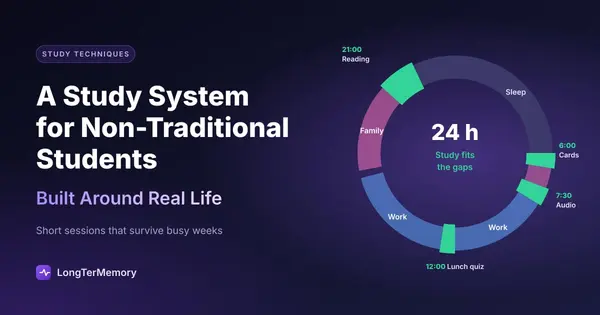
The system comes down to five parts: know your real hours, split work into small tasks, use retrieval rather than rereading, spread your review out, and plan ahead for disruption.
1. Audit Your Actual Week
Before you plan anything, track your time for a week, and be honest about it. Most people find it falls into three categories.
| Type of time | Typical length | What it’s good for |
|---|---|---|
| Deep blocks | 60 to 120 minutes | Hard reading, problem sets, writing assignments |
| Short blocks | 15 to 30 minutes | Flashcards, practice questions, outlining |
| Micro moments | 3 to 10 minutes | A few cards while waiting, one audio segment, reviewing a single idea |
A working parent might have only two deep blocks a week, but ten short blocks and a dozen micro moments. That adds up to much more than you’d think, as long as you’ve decided in advance what each block is for.
2. A Sample Week That Isn’t a Fantasy
Here’s what a week could look like for someone who’s working full time, has a family and is taking two courses:
| When | Time | Task |
|---|---|---|
| Mon to Fri, lunch | 20 min | Flashcards or practice questions |
| Mon to Fri, commute | 20 min | Recorded lecture or audio review (if you drive), or cards on the train |
| Tue and Thu, after bedtime | 60 min | Reading plus self-testing |
| Saturday morning | 2 hours | Hardest assignment or problem set |
| Sunday evening | 20 min | Plan the next week and check your deadlines |
That comes to around 8 hours a week, without a single heroic all-nighter. Adjust it to fit your life: you might be a night-shift worker whose best hours are at 9 a.m. If you’re working around a job, see our guide to studying while working.
3. Use Methods With the Highest Return
When your time is short, you can’t afford low-yield techniques. Dunlosky and colleagues’ major 2013 review of study techniques rated practice testing and spaced practice as “high utility”, while highlighting and rereading were rated “low utility”.
That’s good news for a busy adult:
- Active recall works in small doses. You can answer five questions in a parking lot. You can’t meaningfully reread a chapter there.
- Spacing rewards scattered schedules. Fifteen minutes on each of four days generally beats a single hour on one night. Your fragmented week is less of a handicap than you think.
- Retrieval is more resilient to interruption. If your child walks in after question three, you’ve still completed three useful retrievals.
4. Make Every Task Interruption-Proof
Interruptions are a fact of life, so plan for them rather than fighting them.
- Shrink your tasks. “Read chapter 6” is too big. “Read pages 112 to 118 and write 3 questions” is something you can finish.
- Leave a note for yourself. Before you stop, jot down exactly what’s next. A note like “start at the graph on page 119” saves you several minutes of working out where you were.
- Keep your materials portable. Have your notes, reading and flashcards on your phone so that any spare moment can become study time.
- Set expectations at home. Agree on a signal or a time slot. Even kids can learn that “when the timer’s on, I’m studying until it rings”, especially if they’re doing homework next to you.
5. Plan for the Weeks When Everything Goes Wrong
Sick kids, overtime and broken cars will all happen. Decide in advance what your plan looks like in each kind of week.
| Mode | When to use it | Minimum |
|---|---|---|
| Normal | Most weeks | Your full schedule |
| Reduced | Busy period at work, minor illness | Lectures plus daily cards, and only graded work |
| Survival | Real crisis | 10 minutes of review a day, and email your professor |
Having a survival mode keeps a bad week from becoming a dropped course. Our guide to building a study schedule with resilience goes further into this.
Tie Study to Existing Habits
Willpower is in short supply at the end of a long day. Attach study to routines you already have: flashcards with your morning coffee, or 20 minutes as soon as the kids go down. Here’s more on how habit stacking works. Also, protect your sleep. It’s tempting to trade it for study time, but sleep is when memories consolidate, so giving it up tends to backfire.
Talk to Your Instructors Early
Tell your professors about your situation before you have a problem. A short note in the first week could say: “I work full time and I’m committed to this course. If a work emergency affects a deadline, what’s the best way to handle that?” Instructors are usually much more flexible with someone who raises an issue early than with someone who’s asking after the deadline. You’re also an adult with professional experience, so you can talk to them as one.
Campus Resources and Online Tools for Non-Traditional Learner Success
Most colleges offer far more support than returning students realize, and it’s already paid for through your tuition and fees. Check out what’s on offer in your first two weeks, before you actually need any of it.
On-Campus and College Resources
| Resource | How it helps you | What to ask |
|---|---|---|
| Adult or returning student office | Advice designed for your situation, sometimes dedicated scholarships | ”What do you offer for students like me?” |
| Academic advisor | Course load, sequencing and credit transfers | ”Can I get credit for prior learning or work experience?” |
| Tutoring and writing center | Refreshing rusty math and writing skills | ”Do you offer online or evening appointments?” |
| Financial aid office | Grants, emergency funds, part-time options | ”Are there funds for student parents or returning students?” |
| Disability services | Accommodations, including for diagnoses you received as an adult | ”What documentation do I need?” |
| Counseling | Stress, burnout, big life transitions | ”Can I book a telehealth session?” |
| Child care support | Campus care or subsidies, where they exist | ”Is there a waitlist, and how early should I apply?” |
| Library | Free access to databases, books and quiet space | ”Can I use the databases from home?” |
Availability varies a lot between schools, so ask directly. Also check whether your employer offers tuition assistance, since many people don’t know theirs does.
Online Tools That Fit Around Your Life
You only need a few tools, and each should have a clear job.
| Job | Examples | Tip |
|---|---|---|
| Single calendar | Google Calendar, Outlook | Put family, work and school in one place, or conflicts will sneak up on you |
| Spaced repetition | Anki, LongTerMemory | Use it in your micro moments |
| Audio review | Recorded lectures, podcasts | Great for commutes, but test yourself afterward |
| Free study material | Khan Academy, OpenStax | Good for refreshing old skills before a course |
| Notes on all devices | Notion, OneNote, Google Docs | Keeps your work reachable from anywhere |
If you want to compare your options for flashcards, take a look at our guide to the best spaced repetition apps. Don’t spend your scarce time building an elaborate system in an app, though. A plain calendar and a flashcard app will take you a long way.
Find Your People
You don’t have to study alone. Look for classmates in a similar situation and set up a small group chat. Two working parents sharing notes on a Sunday evening will likely get more done than a large study group that needs everybody in a library on a weekday afternoon. Video calls after the kids’ bedtime work too, and so does simply checking in with one another on what you’re planning that week.
Putting It Together: Your First Two Weeks
If you’ve just gone back to school, don’t try to do all of this at once. Here’s a good order.
Week 1
- Record every deadline from all your course syllabi in one calendar.
- Track your time for a week.
- Choose your deep, short and micro blocks.
- Meet your advisor and find out about adult student support.
Week 2
- Start the daily flashcard habit, even if it’s only 10 minutes.
- Change one reading session to include self-testing.
- Write a short note to each instructor.
- Define your “reduced” and “survival” modes.
After that, spend 20 minutes each Sunday looking at the week ahead. That one habit will catch most of the problems before they become crises.
Let Software Handle the Tedious Part
Writing flashcards is often where a busy adult’s study system stalls, because who has an hour to make cards after a full day? LongTerMemory does that for you. Upload your lecture notes or textbook PDFs and it generates question-and-answer pairs, then schedules your reviews automatically with spaced repetition. So when you get ten free minutes at the dentist’s, the right questions are already waiting. You can try it free with the readings for your next class.
FAQ
What makes a student non-traditional?
There’s no single definition. NCES describes characteristics like delayed enrollment, part-time attendance, working full time, financial independence, having dependents, being a single parent or lacking a standard diploma. Many colleges also use age 25 or older as a guide.
How many hours a week should a working adult study?
A common rule is 2 to 3 hours per credit hour each week, though this varies by course. If that isn’t possible with your job and family, reduce your course load instead of cutting your sleep. Taking fewer courses and passing them is faster than retaking them.
Am I too old to go back to school?
No. Experience and motivation are real strengths, and effective methods like retrieval and spacing work well at any age. The rustiness most returning students feel usually fades within a few weeks of regular practice.
How can I study with kids at home?
Use short, clearly defined tasks, and fit them around your children’s routines. Study when they’re asleep or doing homework, and use a visible timer so they know when you’ll be available. Trade child care with another parent or a partner for your deeper blocks.
Should I study part time or full time?
It depends on your income, responsibilities and how quickly you need to finish. Part time is more sustainable for many working adults, though it may affect aid or take longer. Speak with your advisor and your financial aid office before deciding, since the rules vary.
The Bottom Line
You’re not behind other students, you’re just playing a different game. Stop trying to study like an 18-year-old with free afternoons. Audit your real week, keep your tasks small, test yourself instead of rereading, spread your review out and use the support you’re already paying for. When life gets in the way, drop into a smaller mode of study instead of quitting. That’s a system that’ll get you to graduation.