How to Document Your Learning Journey for Career Growth
Document your learning journey to build a career portfolio. Learn what to track, how to present it to employers, and how to plan your next development step.
Table of Contents
- What to Document from Your Study and Certification Process
- The Minimum Viable Learning Record
- The Learning Journal
- Evidence of Skill, Not Just Completion
- Building a Learning Portfolio That Demonstrates Expertise to Employers
- What Goes In a Learning Portfolio
- Where to Host Your Learning Portfolio
- Tailoring Portfolio Presentation to Different Audiences
- Using Documented Learning to Guide Your Next Professional Development Step
- The Gap Map
- The ROI Filter
- Using Your Learning History to Predict Learning Effort
- The Teaching Test
- Making Documentation a Habit, Not a Project
- The Bottom Line
Most professionals treat learning as a private activity. You study for a certification, you pass, you add it to your LinkedIn profile, and you move on. The certification lives in a folder somewhere, the textbooks go on a shelf, and the months of preparation you put in become invisible to everyone, including, over time, yourself.
This is a missed opportunity on two levels. First, employers and hiring managers respond to demonstrated learning journeys, not just credential lists. Second, you personally benefit from having a structured record of your own development when it comes time to plan what comes next.
Documenting your learning journey is not about creating extra work. It’s about capturing the evidence that already exists as a byproduct of studying and making it visible, usable, and career-accelerating. Here’s how to do it deliberately.
What to Document from Your Study and Certification Process
The raw material of your learning documentation is already being generated while you study. You’re just not capturing most of it. Let’s change that.
The Minimum Viable Learning Record
At the very minimum, for any serious study effort, you should track:
What you studied: The certification name, course, or subject area. Be specific. “AWS certification” is less useful than “AWS Solutions Architect Associate (SAA-C03).”
Why you studied it: The business need, career goal, or skill gap that motivated it. This is the narrative employers and future-you will care about most.
The timeline: Start date, study hours per week, total hours invested, exam date, and result. These numbers tell a story about your discipline and commitment.
Resources used: Books, courses, practice exams, study tools, communities. This is useful for your own reference when preparing for related certifications, and it’s useful to share with colleagues or reports who ask how you did it.
Key things you learned: Not a summary of the curriculum, but the specific insights, frameworks, or mental models you came away with that changed how you think or work.
How you applied it: Even before you’ve formally passed the exam, what have you already changed or improved in your work based on what you’re learning?
The Learning Journal
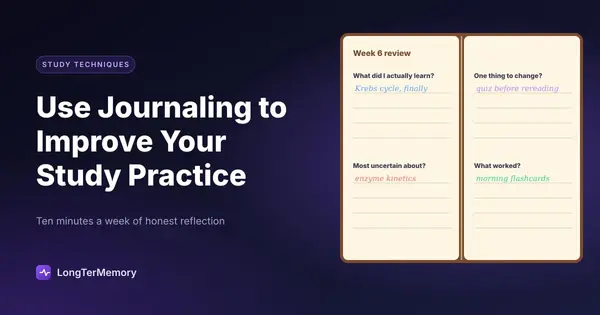
A learning journal is the practice of writing briefly after each study session, not about what you covered (that’s your notes), but about what it meant to you. Three to five minutes of reflection, a few times a week, creates a qualitative record of your development that no credential can replicate.
Good learning journal prompts:
- What was the most surprising thing I learned today?
- What is one thing from today’s session I can apply directly to my current work?
- What concept am I still fuzzy on and what do I need to do about it?
- What’s a question this material raises for me that I haven’t been able to answer yet?
Over weeks and months, this journal becomes a rich, first-person account of how your thinking evolved. When you’re preparing for a job interview and someone asks “tell me about a time you had to learn something entirely new,” this journal is your source material. You won’t be grasping for a vague memory. You’ll have a specific, detailed narrative you lived through and documented in real time.
Evidence of Skill, Not Just Completion
Certifications and completed courses are credentials, which demonstrate that you passed a standard measure. Skill evidence is different. It’s the concrete output that shows you can actually do something with what you learned.
For technical learners, skill evidence might be:
- Code repositories showing projects built using newly learned frameworks or tools
- Architecture diagrams or system designs you created after studying cloud certifications
- Bug fixes, performance improvements, or automation scripts tied to something you learned
For non-technical learners, skill evidence might be:
- A revised policy document that reflects HR knowledge you gained from SHRM preparation
- A project plan that applies PMP methodology you studied
- A financial model or analysis that reflects CFA-level thinking
- Training materials you developed to teach your team something you just learned
The goal is to have artifacts, not just credential dates. Artifacts are what make your LinkedIn profile and your resume stand apart from someone who simply lists the same certifications.
Building a Learning Portfolio That Demonstrates Expertise to Employers
A learning portfolio is a curated, organized presentation of your documented learning journey. It’s not a transcript. It’s not a resume section. It’s evidence of your capacity as a learner and a professional, told through selected examples and outcomes.
What Goes In a Learning Portfolio
A strong learning portfolio includes:
Credentials with context: Not just “PMP certified, 2025,” but: “Earned PMP certification after six months of self-directed study while working full-time. Immediately applied methodology to restructure our team’s project tracking, reducing deadline overruns by 30% in the following quarter.”
That’s a credential plus a learning narrative plus a measurable outcome. Three sentences. Genuinely compelling.
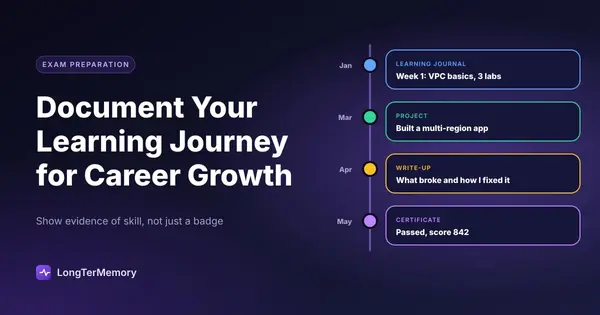
A learning timeline: A visual or narrative overview of how your professional development has progressed over time. This demonstrates intentionality. It shows that your certifications aren’t random, that each one built on the last, that there’s a direction to your growth.
Curated skill evidence: Two or three strong examples of applying your learning in practice. Quality over quantity. One detailed example of how you used what you learned is more persuasive than a long list of certifications with nothing attached to them.
Current learning: What you’re studying right now, and why. Employers value people who are actively developing. Showing that your learning journey is ongoing, not complete, is often more impressive than a long list of past credentials.
Where to Host Your Learning Portfolio
The simplest option for most professionals is LinkedIn. The platform has more features than most people use:
- The Featured section lets you pin documents, links, and media to your profile
- Licenses and Certifications with dates and verification links
- Projects section for skill evidence
- Long-form posts and articles that demonstrate thinking and expertise in your field
For technical professionals, GitHub is a natural home for code-based skill evidence. A well-organized GitHub profile with clear README files explaining what each project demonstrates and what you learned can be more persuasive than a certification list.
For people in consulting, HR, finance, or other fields where artifacts may be confidential, a personal website with anonymized or hypothetical examples works well. There are simple platforms (Notion public pages, Carrd, or a basic WordPress site) that require no web development skills.
The medium matters less than the intentionality. What you want is a place where your documented learning journey is organized and accessible, so that when an opportunity arises, you can direct someone there rather than trying to reconstruct your story from memory.
Tailoring Portfolio Presentation to Different Audiences
A recruiter, a hiring manager, and a senior executive will respond to different aspects of your learning portfolio.
Recruiters are scanning for credentials, keywords, and timeline. Make sure your certifications are visible, current, and formatted in a way that passes through applicant tracking systems. Your LinkedIn headline and summary should reflect your most relevant recent learning.
Hiring managers care about what you can actually do. They want the skill evidence, the examples of application, the outcomes. If you have a portfolio conversation in an interview, lead with one or two strong examples of how your learning produced a measurable result.
Senior executives and stakeholders respond to the narrative of intentional growth. They want to understand your trajectory: where you were, where you are now, and where you’re going. The learning timeline and your articulation of “why” you pursued what you pursued will resonate most with this audience.
Prepare different-length versions of your learning narrative: a 30-second version for introductions, a 2-3 minute version for interview questions, and a detailed written version for your portfolio itself.
Using Documented Learning to Guide Your Next Professional Development Step
Here’s the dimension of learning documentation that gets almost no attention: using your own records to make better decisions about what to study next.
The Gap Map
Once you have a documented record of what you’ve learned and where you’ve applied it, you can build a gap map: an honest assessment of the distance between where you are and where you want to go.
Start with a concrete target. Not “I want to advance my career,” but something specific: “I want to be promoted to VP of Engineering within three years” or “I want to move into data science from my current analytics role” or “I want to earn 25% more by passing the CFA and moving to asset management.”
Then map backwards from that target:
- What skills and credentials does someone in that role typically have?
- Which of those do you already have? (Check your portfolio)
- Which are you actively developing? (Current study)
- Which are completely absent? (The real gap)
The gap map turns “I should probably develop professionally” from a vague intention into a specific development agenda. Each item on the gap map is a candidate for your next learning investment.
The ROI Filter
Not all learning investments are equal, and your time is finite. Once you’ve identified your gaps, filter them through a return on investment lens:
Impact: How much will closing this gap affect your ability to reach your target outcome? A gap in a core competency for your target role is high impact. A gap in a “nice to have” skill is low impact.
Effort: How much time and money will it take to close this gap? Some certifications require 6 months and thousands of dollars. Others can be earned in 3 weeks. If two gaps have similar impact, pursue the lower-effort one first.
Urgency: Is there a near-term opportunity that requires this credential or skill? A job you’re actively targeting, a project that needs this expertise, a team that’s about to make a promotion decision?
Filter your gap map through impact, effort, and urgency, and your next development priority becomes obvious rather than overwhelming.
Using Your Learning History to Predict Learning Effort
One practical benefit of documenting your learning timeline is that you accumulate data about yourself as a learner. After documenting three or four learning cycles, you’ll start to see patterns:
- How long does it typically take you to move from “no background” to “exam-ready” in a given type of content?
- Which formats work best for you: self-study, instructor-led, video, text?
- What study schedule do you actually maintain versus what you plan?
- How do you perform on first attempts versus retakes?
This self-knowledge makes your future learning plans more realistic. Instead of planning an optimistic 3-month preparation for a certification that historically takes you 6 months, you build in the realistic timeline. That reduces the frustration of falling behind your own plan and increases your completion rate.
The Teaching Test
One final indicator that your documented learning has reached a level worth showcasing: can you teach it?
When you find yourself able to explain something clearly to a colleague who knows nothing about it, and when you can do so using examples from your own experience, you’ve moved from theoretical knowledge to professional expertise. That’s the moment to document specifically: “I can teach X,” with an example of when you did.
This is also a useful forcing function. If you’re struggling to explain something you supposedly learned, your documentation of that gap is more valuable than a line on your resume claiming the knowledge.
Making Documentation a Habit, Not a Project
The biggest reason professionals don’t document their learning is that they think of it as a separate, large project that will take significant time to do properly. That framing ensures it never happens.
The alternative: treat documentation as a five-minute practice layered on top of things you’re already doing.
After each study session, three sentences in a learning journal. After each certification exam, ten minutes to write a brief summary of the experience and the immediate application plan. Once a month, fifteen minutes to review and update your portfolio.
That’s less than thirty minutes a week, total. Over a year, it produces a comprehensive, nuanced record of your professional development that would take months to reconstruct if you tried to do it retroactively.
If you use LongTerMemory for your certification prep, you already have a built-in record of what you studied and how you performed across review sessions. That data is a natural starting point for your learning documentation. The flashcards you built, the materials you uploaded, the progress over time: these are ready-made artifacts of your learning process.
The Bottom Line
A learning portfolio and a documented learning journey are not things you build for other people. You build them for yourself first: to understand where you’ve been, to make better decisions about where to go, and to have honest data about how you learn.
The career benefits, being more compelling in interviews, standing out in a crowded field, being seen as someone who actively develops, are real and significant. But they’re byproducts of a practice that serves you regardless of what happens in the external job market.
Start today. After your next study session, write three sentences. That’s the beginning of something genuinely useful.