How to Study for Professional Recertification Exams Efficiently
Smart strategies for professional recertification exam prep: leverage prior knowledge and build an efficient review plan that fits your schedule.
Table of Contents
- Recertification Is Not the Same as Original Certification
- Step One: Audit Your Knowledge Before You Start Studying
- Step Two: Identify What Has Changed
- Step Three: Build a Targeted Review Plan
- Allocate Time by Gap Size, Not by Content Volume
- Don't Neglect Strong Areas Entirely
- Using Continuing Education to Double Up
- Practice Exams: The Non-Negotiable
- Handling the "I Haven't Studied in Years" Feeling
- Recertification Exam Day: What's Different From the First Time
- A Note on Recertification Timelines
There’s something slightly disorienting about having to study for an exam you already passed. You earned the credential. You’ve been working in the field for years. And now here’s the certification body telling you that if you don’t pass this recertification exam (or accumulate these continuing education credits by this deadline), you’re going to lose the letters after your name that took you months or years to earn in the first place.
Recertification is a real part of professional life across dozens of fields: nursing, medicine, project management (PMP), cybersecurity (CISSP, CISM), financial planning (CFP), law, pharmacy, engineering, and many more. And while most professionals understand it’s necessary, the preparation for recertification is often approached less seriously than the original certification, which creates a specific kind of risk.
This guide covers how to prepare for recertification exams efficiently, how to use your existing knowledge as an advantage rather than an excuse to under-prepare, and how to build a review plan that fits around a professional’s schedule.
Recertification Is Not the Same as Original Certification
Before anything else, it’s worth being clear about this: recertification prep is different from original certification prep, and conflating the two leads to either over-studying (wasting time you don’t have) or under-studying (overestimating how much you’ve retained).
The differences matter:
| Factor | Original Certification | Recertification |
|---|---|---|
| Prior knowledge | Little to none | Substantial, but partially faded |
| Time since last exam | N/A | Often 3-5+ years |
| Content changes | N/A | Some areas may have changed |
| Emotional stakes | High, proving yourself | High, defending existing status |
| Time available | Often more flexible | Usually limited (working professional) |
| Study approach | Build from scratch | Gap analysis and targeted review |
The key insight is that you are not starting from zero. You have a mental model of your field. The goal is to bring that model up to current standard, fill in the gaps that have developed over years of focus on specific areas of practice, and handle the updated content that may have changed since you last sat for this exam.
Step One: Audit Your Knowledge Before You Start Studying
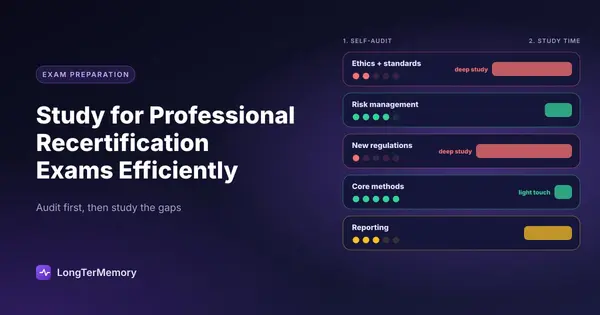
The single most efficient thing you can do before touching any study material is to figure out exactly what you actually remember and what has faded.
Most recertification programs publish a detailed content outline or exam blueprint, the same document they make available for original certification candidates. Pull this out and go through it systematically.
For each domain or topic area:
- Rate your current confidence on a 1 to 5 scale
- Note whether your day-to-day work keeps you active in this area or whether you rarely encounter it
- Flag any areas you know have changed since you last certified
This gives you a personal gap map that is specific to you, not to the average candidate. Someone who works in risk management all day and is recertifying their CISM will have completely different gaps than someone in a general IT leadership role who hasn’t touched risk frameworks in two years. Generic study plans don’t account for this. Your personal gap map does.
Expect to spend one to two hours building this map. It will save you many more hours than that in misdirected study.
Step Two: Identify What Has Changed
One of the most common recertification failures is treating the exam content as static. Certification bodies update their exams, sometimes significantly. New domains are added, existing domain weights change, outdated content is removed, and new best practices replace old ones.
Compare the current exam blueprint against the blueprint from when you originally certified. If you don’t have your original study materials handy, the certification body will often publish release notes about major exam updates on their website. Look for these specifically.
Focus your “new content” study on areas that have changed or been added. These are the areas where your existing knowledge gives you the least advantage, because what you learned years ago may be genuinely outdated or simply not covered by the updated exam.
For example, if you’re recertifying a project management credential and the body has added substantial new content around agile methodologies since your original exam, that’s a real gap even if you passed the original exam confidently. Don’t assume your general PM knowledge covers it, check whether it does.
Step Three: Build a Targeted Review Plan
Once you have your gap map and you know what’s changed, you can build a study plan that actually matches your situation.
Allocate Time by Gap Size, Not by Content Volume
The standard recertification study mistake is to work through all the material sequentially, spending roughly equal time on everything. This feels thorough but is inefficient. If you score 4 or 5 out of 5 on half the content because you work with it daily, spending significant review time there is largely wasted.
Allocate your study time roughly as follows:
- Weak areas (score 1-2): Deep study, practice questions, concept review
- Medium areas (score 3): Focused review, practice questions to confirm understanding
- Strong areas (score 4-5): Light maintenance, quick flashcard review to prevent last-minute forgetting
If you have six weeks and 30 available study hours, something like this might fit:
| Week | Focus |
|---|---|
| 1 | Gap mapping and content review of updated/new areas |
| 2-3 | Deep study of weak areas |
| 4 | Targeted review of medium areas |
| 5 | Practice exams and gap closure |
| 6 | Light review, consolidation, rest |
Don’t Neglect Strong Areas Entirely
The temptation with areas you feel strong in is to ignore them completely. This is a mistake. Even genuinely strong areas will have some content that’s faded from non-use, and feeling confident and actually being able to retrieve under pressure are different things.
A quick weekly pass through your strong-area flashcards (5 to 10 minutes) is enough maintenance. What you’re preventing is the embarrassing scenario where you sit down to a question about something you theoretically know well and find that the specific terminology or a specific rule has slipped.
Using Continuing Education to Double Up
Most recertification programs require both passing an exam (or accumulating CE credits) and completing a specific number of continuing education hours. If you’re in a program that allows CE credits rather than a formal exam, this is an opportunity to align your CE activities with your study gaps.
If you have a weak area in your gap map and there’s a relevant CE course on that topic, that course is doing double duty: it’s counting toward your CE requirements and it’s filling a study gap. This is smarter than completing CE in areas where you’re already strong and then separately studying your weak areas.
For professionals managing CE credits over a multi-year cycle, building a CE calendar at the start of each cycle that maps planned CE activities to known weak areas makes the whole process more intentional and less last-minute. The worst CE strategy is accumulating random credits that happen to be available rather than credits that align with either your professional development goals or your recertification content gaps.
Practice Exams: The Non-Negotiable
Regardless of how well-prepared you feel from content review alone, you need to do practice exams before the real thing. This is not optional.
Practice exams serve several functions simultaneously:
They reveal hidden gaps. Your confidence map, built from self-assessment, is imperfect. Practice questions will surface specific areas of confusion that you didn’t know you had. You may feel strong on a domain conceptually but find that you consistently miss application questions in a specific sub-area.
They recalibrate exam mechanics. Sitting for a professional exam has specific cognitive demands: sustained concentration over two to four hours, decision-making under time pressure, multi-step reasoning questions. These are skills that atrophy when you’re not practicing them. A few practice exams rebuild exam stamina.
They give you confidence calibration. Overconfidence is a real risk for recertification candidates. You know this field. You’ve been doing it for years. But knowing something in practice is not the same as answering exam questions about it correctly. Practice exams tell you where that gap exists for you specifically.
Use the official practice materials from the certification body first. Then supplement with third-party question banks if they exist for your credential. For most major professional certifications, several reputable third-party question banks are available.
Handling the “I Haven’t Studied in Years” Feeling
One of the most common experiences among recertification candidates is a kind of intellectual vertigo: you sit down with your study materials and realize that material you once knew well now feels unfamiliar. You know you knew this. You can feel it somewhere. But retrieving it reliably feels harder than it should.
This is normal, and it has a name: retrieval inhibition after a long period without practice. Your knowledge hasn’t disappeared, but the retrieval pathways have weakened from disuse.
The good news is that relearning forgotten material is dramatically faster than learning it for the first time. Even if a concept feels completely unfamiliar when you read about it, when you do a practice question on it your performance will usually be better than you’d expect. The underlying understanding is still there. The retrieval just needs re-practice.
Resist the temptation to treat everything in the content outline as completely new material. Work through practice questions first, and let your actual performance (not your subjective confidence) tell you how much review time each area needs.
Recertification Exam Day: What’s Different From the First Time
You’ve been through this kind of exam before. That experience is genuinely an advantage, in ways you might not have thought about:
You know how you personally handle exam pressure. You know whether you tend to second-guess yourself, whether you tend to rush or go slowly, whether you get distracted by hard questions. You’ve already diagnosed your exam-day behavior once. Apply what you learned.
You know the format. There’s no mystery about what kind of questions appear, how they’re structured, or what the interface looks like. You can skip the mental overhead of orienting to an unfamiliar format and go straight into performance mode.
Your professional experience adds context. Years of working in your field means you’ll encounter questions about scenarios you’ve actually faced. Use that experience, carefully. Exam questions are about official best practice and tested knowledge, not necessarily what your specific organization does. When your experience conflicts with what you know the official answer to be, go with the official answer.
A Note on Recertification Timelines
The single most avoidable recertification failure is letting the deadline sneak up on you. Most professionals know their recertification deadline in advance, sometimes years in advance, and most professionals underestimate how long preparation will take while overestimating how much time they’ll have to prepare as the deadline approaches.
Work backward from your deadline. If your exam date is in six months and you want four weeks of serious preparation, you have two months of lighter ramp-up time before that window. Mark the start of your intensive preparation period in your calendar now, not when the deadline starts feeling urgent.
If your recertification program allows you to schedule the exam yourself, schedule it before you feel ready. Having a fixed exam date creates accountability that “I’ll get to it” never does.
Recertification isn’t just bureaucratic maintenance. Done well, it’s a genuine opportunity to update and sharpen a knowledge base that professional practice inevitably narrows over time. You start your career knowing the field broadly. Years later, you know your corner of it deeply but may have drifted from areas you don’t touch regularly. Recertification forces a reconnection with the full scope of the credential, which makes you better at your job even if it’s temporarily inconvenient.
LongTerMemory.com can help with the preparation process: upload your recertification study materials, official blueprints, and review guides, and the platform auto-generates spaced repetition flashcard sets from them. Particularly useful for high-volume content exams where manual flashcard creation would take more time than you have. Try the free trial if you’re heading into a recertification cycle.
Prepare smarter, not longer. Your credential is worth defending properly.