
Most people who struggle to study consistently don’t have a motivation problem. They have a systems problem. Motivation is unreliable, it comes and goes with energy levels, stress, how recently you slept well, whether the subject you’re studying is engaging, and a dozen other factors you can’t fully control. A system, when it’s well designed, runs in the background whether you feel motivated or not.
Habit trackers are one of the simplest, most effective systems for building study consistency. At their core, they do one thing: they create a visible record of whether you showed up. That record turns out to be surprisingly powerful as a behavioral driver. Seeing a chain of completed days builds momentum. Seeing a gap makes you want to close it. The tracker doesn’t do the studying for you, but it creates the kind of feedback loop that makes showing up feel like something more than just a chore.
This guide is about how to use habit trackers effectively for study, specifically: which format (digital vs. paper) fits different situations, how to set the habit you’re tracking at the right level of ambition, and how to actually read the data your tracker generates to improve your study approach over time.
Digital vs. Paper Habit Trackers for Study Consistency
The first question most people ask is which tool to use. The honest answer is that both digital and paper trackers work, and the best one is whichever you’ll actually use consistently. But they do have meaningfully different strengths.
Paper Habit Trackers
Paper trackers have a certain tangibility that a lot of people find satisfying in a way that apps struggle to replicate. There’s something about physically drawing an X through a box or coloring in a cell on a habit grid that feels more deliberate and more rewarding than tapping a button on a phone.
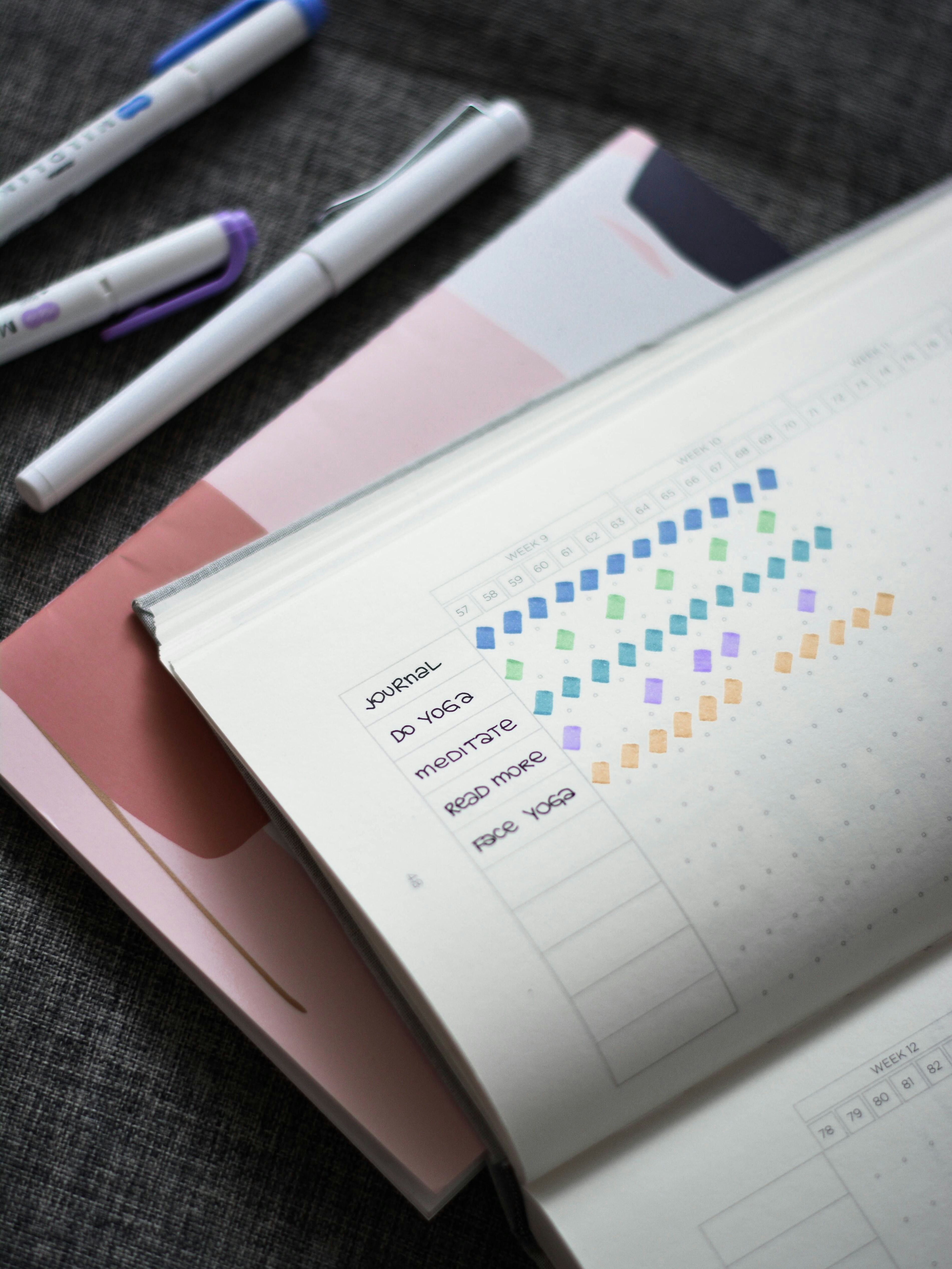
The most common paper format is the monthly habit grid: a table with days of the month across the top and habits down the side, where you mark each completed habit each day. You can set one up in 5 minutes in any notebook, or find printable templates online, or buy a dedicated habit tracker journal.
Paper trackers also have zero friction to open. No app to launch, no notifications to dismiss, no loading screen. If your tracker notebook is sitting on your desk, the visual reminder alone has value.
The downside of paper is that it doesn’t give you any analysis. You can see your streak visually, but counting your completion rate or identifying patterns across weeks requires manual effort. For simple habits where all you need is a streak record, this is fine. For more nuanced analysis, paper’s limitations show.
Digital Habit Trackers
Digital trackers range from simple apps designed specifically for habit tracking to more complex systems embedded in productivity tools. Some popular options:
Habitica turns your habits into a role-playing game. You gain experience and level up your character for completing habits, and lose health for missing them. This gamification works well for some people, particularly those who are motivated by achievement mechanics.
Streaks (iOS) is a clean, focused app that tracks up to 12 habits and emphasizes streak maintenance. It’s simple and well-designed for people who want a minimal daily check-in.
Notion or Obsidian allow you to build custom habit trackers inside a larger productivity system. If you’re already managing your study notes and schedules in one of these tools, adding a habit tracker there keeps everything in one place.
Google Sheets or Excel offer the most flexibility for people who want custom tracking beyond what a dedicated app provides. You can track multiple metrics per habit, calculate completion rates automatically, and visualize trends over time. More setup, more power.
The major advantage of digital trackers is analysis. You can see your completion rate over time, compare different periods, and notice trends that a paper grid doesn’t easily surface.
The Real Decision Criterion
Don’t agonize over this. Pick one, commit to it for a month, and see if you actually use it. If you don’t use it, switch. The format doesn’t matter much. Consistency of logging matters enormously.
One practical approach: start with paper for simplicity, and add a digital tracker later if you want more analytical visibility.
Setting the Right Minimum Habit to Track for Long-Term Study
This is the part of habit tracking that most guides get wrong, or at least underemphasize. The habit you choose to track is not “study for this certification” or “prepare for my exam.” Those are goals, not habits. A habit needs to be a specific, repeatable, binary action that you either did or didn’t do today.
And the minimum threshold for the habit needs to be set much lower than your ambition.
Why your minimum should feel almost embarrassingly small
If you set “study for 2 hours” as your daily habit, what happens on the day you’re exhausted, sick, overwhelmed with work, or traveling? You miss it. Missing becomes normal. The streak breaks, the momentum collapses, and the habit loop falls apart.
If your minimum is “open my study material for 10 minutes,” almost nothing can legitimately stop you from completing it. And on most days, you’ll study longer than 10 minutes once you’ve started. The minimum is the activation threshold, not the ceiling.
This approach comes directly from behavioral science research on habit formation. The goal of a minimum isn’t to limit your study sessions, it’s to make it essentially impossible to miss, so the streak never breaks and the habit identity (“I’m someone who studies every day”) stays intact.
Examples of well-set minimum study habits
“Review at least 5 flashcards.” Can be done in 3 minutes. Almost never genuinely impossible.
“Read one page of my study material.” Low bar. Usually leads to reading more.
“Spend at least 10 minutes on exam practice questions.” Specific, short, doable.
“Open my SRS app and complete today’s review cards.” If you’re using a spaced repetition system, this is often already a short daily commitment that feels light but compounds significantly over time.
The key is that the minimum is a floor, not a target. On a normal day you’ll probably do more. On a hard day, doing the minimum keeps the streak alive and the habit identity strong. Both outcomes serve the long-term goal.
Tracking intensity alongside completion
If you want more granularity than binary (did it or didn’t), consider tracking the intensity of your sessions alongside completion. A simple scale works: mark a dot for completing the minimum, a half-circle for a medium session, and a full circle for a full focused session. This gives you a visual record of not just whether you showed up but how engaged you were.
This approach is particularly useful during long preparation periods for things like professional certifications or university finals, where understanding your energy and engagement patterns across weeks and months helps you plan your study schedule more intelligently.
What Habit Data Reveals About Your Actual Study Patterns
Most people use their habit tracker as a simple streak counter: they check off the habit, feel good, move on. This is fine as far as it goes, but it leaves a lot of value on the table. Over time, a habit tracker builds a dataset about how you actually behave, and that dataset is genuinely informative if you look at it.
Completion rate by day of week
After 4 to 6 weeks of tracking, look at your completion rate broken down by day of week. Most people have predictable patterns they’re not consciously aware of. Maybe you almost always study Monday through Thursday and frequently miss on Fridays and Saturdays. Or maybe weekends are when you do your best sessions. Or maybe Wednesday is where your streak always dies.
Knowing this allows you to either accept the pattern and design around it (don’t expect high-intensity study on Fridays, keep the Friday minimum truly minimal, treat Saturday as a catch-up day), or to actively address the specific friction that’s causing the pattern (if Friday is consistently missed, what’s actually happening on Fridays that makes study hard?).
Session intensity patterns
If you’re tracking intensity alongside completion, you’ll often find that your high-intensity sessions cluster around certain times of day or certain days of the week, which tells you something about your chronotype and your energy rhythms.
For most people, cognitive performance peaks in a predictable window that reflects their natural alertness cycle. If your data shows that you almost always have mediocre sessions in the afternoon but strong ones in the morning or evening, that’s actionable: schedule your most demanding study content during your peak window, and use lower-peak times for review and less demanding tasks.
Our piece on building a study habit around your chronotype goes deeper on this, including how to identify your peak window and restructure your schedule around it.
The effect of other variables
Over time, you may notice correlations between your study performance and other factors: sleep quality, exercise, stress levels, whether you had a particularly demanding day at work. This is valuable self-knowledge that helps you be more strategic about when and how you study.
Some people find it useful to add a second tracked variable alongside study completion: something like sleep hours or a simple 1 to 5 energy rating. Correlating these with your study completion and quality data over several weeks can reveal patterns that aren’t obvious day-to-day.
When streaks break: recovery data
Everyone breaks their streak eventually. How you respond to a broken streak is as important as how you build one. Tracker data lets you see your recovery patterns: how quickly do you typically get back on track after a miss? Do you tend to spiral (one miss becomes a week of misses) or recover quickly (miss one day, back at it the next)?
If you notice a spiral pattern, build a deliberate rule into your habit system: “I’m allowed to miss one day, but never two in a row.” This is a simple heuristic that breaks the spiral before it starts. The rule isn’t in your tracker, it’s in your commitment about how you use it.
Combining Habit Trackers With Your Study System
A habit tracker is most powerful when it’s integrated into a broader study system rather than operating in isolation.
Anchor your tracker to your review schedule
If you’re using a spaced repetition system like Anki, Remnote, or LongTerMemory for your study material, your daily SRS review is the perfect thing to track. It’s a specific, time-bounded action that you can reliably complete in a defined window (most people’s daily SRS review takes 10 to 20 minutes), and it compounds powerfully over time as your review deck grows.
Making “complete today’s SRS review” your trackable habit means your tracker is directly tied to the activity that produces the most durable learning. Every day you complete your review, your retention improves. Every day the tracker shows a check, you know something real happened.
Use your tracker to reinforce good study days, not punish bad ones
The most effective mindset for habit tracking is to use it as a record of progress, not a moral scorecard. Missing a day doesn’t make you a bad student or a lazy person. It means you missed a day, which happens to everyone. The question is whether you get back on track tomorrow.
Trackers work as motivation when they show you the momentum you’ve built. They backfire when they become a source of shame that makes you want to avoid looking at them. Keep the tone positive. Celebrate streaks. Take missing days in stride. The streak is a tool, not a verdict.
Building the Habit Tracker Habit
There’s a certain irony in the challenge of building a habit around using your habit tracker. The tracker only works if you consistently update it, and updating it consistently is itself a habit that needs to be built.
The solution is the same as for any habit: attach it to an anchor. After you complete your study session, before you close your computer or put down your phone, update your tracker. Make it the last step of studying, not a separate thing to remember. Once the sequence is automatic, it costs you nothing.
It also helps to keep your tracker visible. A paper tracker on your desk is hard to forget. An app pinned to your home screen takes one tap. Whatever format you’re using, frictionless access means you’re more likely to maintain it.
Reviewing your tracker weekly
Once a week, take 2 to 3 minutes to look at your tracker data from the past week. Note your completion rate, whether there’s a pattern in the days you missed, and whether your session quality is trending up or down. This brief weekly review is where you extract the learning from the data and use it to adjust your approach.
If you’ve been missing Thursdays consistently for a month, Thursday is a problem to solve, not just an anomaly to ignore. If your intensity scores are consistently low despite high completion, your sessions are happening but not doing much, which might mean your study content is too easy, too hard, or that you’re showing up tired.
The data is only useful if you look at it.
The Bottom Line
Habit trackers are not magical. They don’t do the studying. They don’t make the material easier to learn or the exam less challenging. What they do is give you a simple, reliable mechanism for showing up consistently, and in studying, as in most skill development, consistency over time is the thing that actually produces results.
Set your minimum habit low enough that it’s genuinely non-optional. Track completion honestly, including the misses. Look at the data and learn from it. And integrate your tracker with a study system (especially a spaced repetition system) that makes those daily minutes count.
The combination of consistent daily review and a tool like LongTerMemory that automatically generates personalized flashcards from your study materials means that your daily habit tracker check is backed by a learning system that actually moves information from your study sessions into long-term memory. That’s the combination that builds real, lasting knowledge rather than just a sense of having been productive.
Show up consistently. Build the streak. Trust the system.