How to Prepare for the AWS DevOps Engineer Professional Exam (DOP-C02)
A practical DOP-C02 study guide: exam domains, key AWS services and CI/CD concepts, practice question strategy, and a spaced repetition plan to retain it all.
Table of Contents
- DOP-C02 at a Glance
- What the DevOps Professional Exam Tests Across Deployment and Operations
- How the Questions Feel
- Key AWS Services and CI/CD Concepts for DOP-C02 Readiness
- CI/CD and Deployment Services
- Deployment Strategies You Must Compare
- Infrastructure as Code
- Monitoring, Logging, and Incident Response
- Containers and Resilience
- Security and Compliance
- A 10-Week Study Plan
- Hands-On Beats Passive Study
- Practice Question Strategy for the DevOps Professional Exam Format
- How to Read a Scenario Question
- Pacing
- Build an Error Log
- Retain It With Spaced Repetition
- High-Yield Comparisons to Memorize
- Common Mistakes Candidates Make
- Exam Week and Exam Day
- Frequently Asked Questions
- Is the AWS DevOps Engineer Professional exam hard?
- Do I need an associate certification first?
- How long should I study?
- Does passing earn the Associate certifications too?
- Can I retake the exam if I fail?
- The Bottom Line
The AWS Certified DevOps Engineer Professional exam (DOP-C02) tests whether you can automate, monitor, and secure the full software delivery lifecycle on AWS, using scenario questions where several answers look right. The best way to pass is to combine hands-on practice with CI/CD and infrastructure as code, learn the trade-offs between similar services, and use spaced repetition to retain the details until exam day.
I have coached a lot of people through professional-level cloud exams, and the pattern is always the same. Candidates who only read or watch videos feel confident, then hit the scenario questions and freeze. Candidates who build pipelines, break them, and fix them tend to pass. This guide gives you the map, and then a plan.
Exam details change, so always confirm the current format, price, and objectives on the official AWS certification page before you book.
DOP-C02 at a Glance
| Detail | What to know |
|---|---|
| Exam code | DOP-C02 |
| Level | Professional |
| Format | Multiple choice and multiple response |
| Number of questions | 75 (some unscored) |
| Time allowed | 180 minutes |
| Passing score | 750 on a scale of 100 to 1000 |
| Cost | About 300 USD at the time of writing |
| Validity | 3 years |
| Recommended experience | Two or more years provisioning, operating, and managing AWS environments |
Associate-level certifications are not formally required, but many candidates find that Developer Associate or SysOps Administrator Associate knowledge makes the professional exam far less painful.
What the DevOps Professional Exam Tests Across Deployment and Operations
The exam is split into six weighted domains, and the biggest one, SDLC automation, is worth roughly a fifth of your score. Check the official exam guide for the latest weights, but they have looked like this.
| Domain | Approx. weight | What it covers |
|---|---|---|
| 1. SDLC automation | 22% | CI/CD pipelines, testing, artifacts, deployment strategies |
| 2. Configuration management and IaC | 17% | CloudFormation, CDK, multi-account setups, automation |
| 3. Resilient cloud solutions | 15% | High availability, scaling, disaster recovery |
| 4. Monitoring and logging | 15% | CloudWatch, metrics, logs, dashboards, tracing |
| 5. Incident and event response | 14% | EventBridge, automated remediation, troubleshooting |
| 6. Security and compliance | 17% | IAM, policy as code, secrets, auditing |
How the Questions Feel
Expect long scenarios, often four or five sentences, followed by a requirement such as “with the least operational overhead” or “the most cost-effective solution.” Two answers usually work technically. The correct one matches the exact constraint in the question.
That means memorizing service names is not enough. You must know why you would pick one service over another.
Key AWS Services and CI/CD Concepts for DOP-C02 Readiness
Master the CodeSuite pipeline services, CloudFormation, and the monitoring and event stack first, because they appear in a large share of questions. Below is a focused checklist.
CI/CD and Deployment Services
| Service | Core job | Exam angle |
|---|---|---|
| CodeCommit, GitHub, and similar sources | Source control | Know source stages and triggers |
| CodeBuild | Build and test | buildspec.yml, caching, VPC access, reports |
| CodeDeploy | Deploy to EC2, Lambda, ECS | appspec.yml, lifecycle hooks, rollbacks |
| CodePipeline | Orchestrate stages | Manual approvals, cross-account and cross-region |
| CodeArtifact | Package repositories | Dependency management |
| Elastic Beanstalk | Managed app platform | Deployment policies |
Deployment Strategies You Must Compare
Be able to explain, from memory, how each strategy behaves for downtime, rollback speed, and cost.
| Strategy | Downtime | Rollback | Extra cost | Typical use |
|---|---|---|---|---|
| All at once | Yes | Slow (redeploy) | None | Dev or test |
| Rolling | Reduced capacity | Slow | None | Simple updates |
| Rolling with additional batch | None | Moderate | Small | Keep full capacity |
| Immutable | None | Fast | Temporary doubling | Safer production releases |
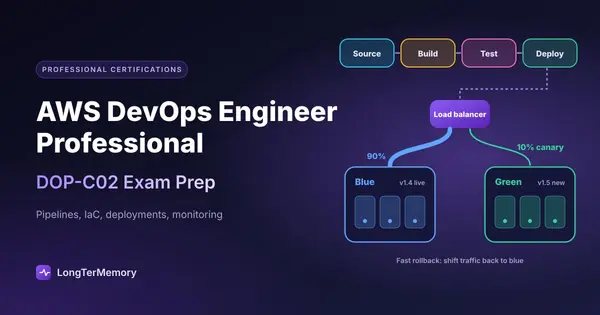
| Blue/green | None | Very fast | Duplicate environment | Critical workloads |
| Canary or linear | None | Fast | Small | Gradual traffic shifting |
Infrastructure as Code
- CloudFormation: stacks, change sets, drift detection, nested stacks, StackSets, DeletionPolicy, custom resources,
cfn-initandcfn-signalwith creation policies. - AWS CDK: constructs, synthesis, and how it compiles to CloudFormation.
- Systems Manager: Parameter Store, Automation documents, Patch Manager, State Manager.
- AWS Organizations and Control Tower: multi-account governance, service control policies.
Monitoring, Logging, and Incident Response
- CloudWatch: metrics, alarms, composite alarms, Logs Insights, metric filters, subscription filters.
- X-Ray: distributed tracing.
- EventBridge: event patterns, rules, cross-account event buses, automated remediation.
- CloudTrail and AWS Config: auditing, compliance rules, auto-remediation.
- Lambda, SNS, and Step Functions: glue for automated responses.
Containers and Resilience
- ECS and EKS: deployment models, task roles, blue/green with CodeDeploy.
- Auto Scaling: lifecycle hooks, warm pools, scaling policies.
- Route 53, ELB, multi-AZ and multi-Region: failover patterns.
- Backup and DR: know the four classic strategies (backup and restore, pilot light, warm standby, multi-site active-active) and their RTO and RPO trade-offs.
Security and Compliance
- IAM roles, cross-account access, permission boundaries, and SCPs
- Secrets Manager vs Parameter Store
- KMS key policies and encryption at rest and in transit
- Security Hub, GuardDuty, Inspector, and Config conformance packs
A 10-Week Study Plan
Ten weeks at around 8 to 10 hours per week suits most working engineers who already know AWS basics. Compress or stretch it to fit your experience.
| Week | Focus | Hands-on task |
|---|---|---|
| 1 | Exam guide, gap analysis, CodeCommit/CodeBuild | Build a small app pipeline |
| 2 | CodeDeploy and CodePipeline | Deploy blue/green to ECS or EC2 |
| 3 | CloudFormation fundamentals | Write and update a stack with change sets |
| 4 | Advanced CloudFormation, CDK, StackSets | Deploy across two accounts or Regions |
| 5 | Monitoring: CloudWatch, X-Ray | Build dashboards and alarms |
| 6 | Event-driven remediation | EventBridge plus Lambda auto-fix |
| 7 | Resilience and DR | Test a failover |
| 8 | Security and compliance | Config rules with remediation |
| 9 | Practice exams and weak spots | Review every wrong answer |
| 10 | Final review and rest | Light recap, sleep |
Hands-On Beats Passive Study
Reading about CodeDeploy lifecycle hooks is one thing. Watching a deployment fail at the BeforeInstall hook because of a typo in appspec.yml is something you never forget. Use the AWS Free Tier carefully, set a budget alarm, and delete resources when done to avoid surprise bills.
Practice Question Strategy for the DevOps Professional Exam Format
Treat practice questions as a learning tool, not a score check: the real value comes from analyzing why each wrong option is wrong. Take your first full practice exam after about six weeks of study, not at the very end.
How to Read a Scenario Question
- Read the last sentence first. It states the actual requirement.
- Underline constraints. Look for phrases such as “least operational overhead,” “without downtime,” “most secure,” “lowest cost,” or “fastest recovery.”
- Eliminate by constraint. Remove options that break a stated rule.
- Choose managed over custom when overhead is a concern.
- Flag and move on if stuck, since you have around 2.4 minutes per question on average.
Pacing
| Checkpoint | Target |
|---|---|
| After 60 minutes | About 25 to 30 questions done |
| After 120 minutes | About 50 to 55 questions done |
| Last 20 minutes | Review flagged questions only |
Build an Error Log
After each practice set, record for every miss:
- The concept you got wrong
- Why your answer was wrong
- Why the right answer was right
- The service comparison involved
Patterns show up quickly. You may find that you keep confusing CodeDeploy deployment configurations, or Parameter Store vs Secrets Manager.
Retain It With Spaced Repetition
The DevOps Professional exam is a memory problem as much as a skills problem. You must recall service limits, behaviors, and differences weeks after learning them. This is where LongTerMemory fits in: upload your AWS whitepapers, FAQs, or your own notes as PDFs, and it generates question and answer flashcards automatically, then schedules reviews using spaced repetition. You skip hours of manual card creation and spend that time building pipelines instead. If you want a deeper look at how retrieval works, see our guide to active recall techniques.
High-Yield Comparisons to Memorize
Professional-level AWS questions are mostly “A vs B” decisions, so flashcards built around comparisons pay off. Start with these.
| Comparison | Key difference |
|---|---|
| CloudFormation vs CDK | CDK is code that synthesizes to CloudFormation templates |
| Parameter Store vs Secrets Manager | Secrets Manager adds built-in rotation, with a higher cost |
| CodeDeploy in-place vs blue/green | Blue/green provisions new instances and switches traffic |
| CloudWatch Logs vs CloudTrail | Application and system logs vs API activity history |
| Config vs CloudTrail | Resource state and compliance vs who did what |
| SNS vs SQS vs EventBridge | Pub/sub fan-out vs queue vs event routing with filtering |
| SCP vs IAM policy | SCPs set the maximum permissions for accounts, they do not grant any |
| Canary vs linear deployment | Canary shifts a small share first, linear shifts equal increments over time |
Common Mistakes Candidates Make
- Skipping hands-on labs. Video-only prep leaves scenario questions feeling abstract.
- Ignoring CloudFormation depth. It shows up across several domains, not just one.
- Memorizing without understanding trade-offs. The exam rewards judgment.
- Using outdated material. DOP-C02 replaced DOP-C01, so check that your resources match the current version.
- Cramming. Professional exams need weeks of spaced review, not a weekend sprint.
- Poor time management. Do not burn 8 minutes on a single question.
Exam Week and Exam Day
In the final week, stop learning new material and focus on reviewing your error log and flashcards. Take one last full practice exam about five days out, review it, and then ease off.
- Sleep well in the three nights before the exam.
- Confirm your testing method (test center or online proctored) and ID requirements.
- For online exams, test your equipment and clear your desk in advance.
- Eat something before the test and bring water if allowed.
- During the exam, flag long questions, finish the easy ones first, and leave time to review.
If you are a non-native English speaker, check whether AWS offers an accommodation such as extra time, which has historically been available on request.
Frequently Asked Questions
Is the AWS DevOps Engineer Professional exam hard?
Yes, it is widely considered one of the more demanding AWS exams because of long scenarios and the depth required. Strong hands-on experience makes a big difference.
Do I need an associate certification first?
It is not required, but Developer Associate or SysOps Administrator Associate knowledge is very helpful.
How long should I study?
Most working engineers need 8 to 12 weeks at 8 to 10 hours per week. Experienced AWS practitioners may need less.
Does passing earn the Associate certifications too?
No. AWS has rules about this over time, so check the current policy, but you should not count on one exam covering another.
Can I retake the exam if I fail?
Yes, after a waiting period (typically 14 days), and you pay the exam fee again. Use your score report to find weak domains.
The Bottom Line
To pass DOP-C02, know the six domains, build real pipelines, compare similar services until the differences are automatic, and drill scenario questions with a careful error log. Layer spaced repetition on top so the details are still there on exam day, not just the week you studied them.
Start this week: download the official exam guide, list your weakest domains, and build one small CI/CD pipeline from scratch. Momentum beats perfection, and your future certified self will thank you.