How to Study for Exams: A Science-Based Method
How to study for exams with a method backed by research: plan backwards, learn actively, test yourself, space your reviews and prepare for exam day.
Table of Contents
- Why Most Exam Studying Doesn't Work
- The 5-Step Method
- Step 1: Map the Exam
- Step 2: Plan Backwards From the Exam Date
- Step 3: Learn Actively
- Step 4: Test Yourself and Space Your Reviews
- Step 5: Rehearse the Exam
- The Last Week and Exam Day
- Short on Time?
- Common Mistakes
- Do the Slow Part Automatically
- Go Deeper
- FAQ
- How many hours a day should I study for an exam?
- How far in advance should I start studying?
- What is the best way to study for a test?
- Is it better to study in the morning or at night?
- Does re-reading notes help at all?
- The Bottom Line
The short answer: test yourself instead of re-reading, spread your study over several weeks, and practice in the same format as the exam. Those three habits, retrieval, spacing and realistic practice, are the most consistently supported findings in learning research, and almost every effective exam method is a way of organizing them.
This guide turns them into a step-by-step method you can use for any subject, from a high school final to a professional certification: how to plan, how to study each topic, how to review, and what to do in the last week and on the day itself.
Why Most Exam Studying Doesn’t Work
Ask students how they prepare and the answers are remarkably consistent: re-reading notes, highlighting, rewriting summaries, and a long session the night before. These methods feel productive. They are also the ones research rates lowest.
In a 2013 review of ten common study techniques, Dunlosky and colleagues rated re-reading and highlighting “low utility”. Only two techniques earned “high utility”: practice testing and distributed practice (spreading study over time). The problem with re-reading is the fluency illusion: material you’ve just read feels familiar, and familiarity feels like knowledge. Then the exam takes the page away and asks you to produce the answer, and recognition isn’t enough.
The good news is that the methods that work don’t take more time. They take different time.
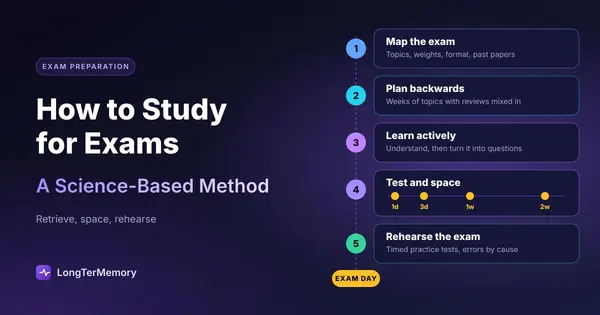
The 5-Step Method
- Map the exam: know exactly what will be tested and how.
- Plan backwards: spread topics and reviews across the weeks you have.
- Learn actively: understand each topic, then turn it into questions.
- Test and space: retrieve from memory at growing intervals.
- Rehearse the exam: timed practice tests in the real format.
Each step is explained below, with the research behind it.
Step 1: Map the Exam
Before you study anything, find out what you’re studying for:
- The content: syllabus, learning objectives, official exam outline or blueprint. For standardized and professional exams, the outline usually gives a weight to each domain. Use it.
- The format: multiple choice, short answer, essays, problems, oral, open book? Format changes how you should study. Multiple choice rewards precise recognition and elimination; essays reward organized recall and argument; problem sets reward procedure under time pressure.
- The conditions: length, number of questions, time per question, allowed materials, calculator or formula sheet.
- Past papers and practice questions: collect every one you can find. They are the single most useful resource you have.
Then make a one-page list of topics, each with its weight and a quick self-rating: confident, shaky, or no idea. That list drives everything that follows.
Step 2: Plan Backwards From the Exam Date
Start from the exam date and work backwards:
- Last 2-3 days: light review only, plus sleep. No new material.
- Last 1-2 weeks: full timed practice tests and targeted review of weak topics.
- Everything before that: learn the topics, a few per week, with reviews of earlier topics mixed in.
The mixing matters. Spaced practice beats massed practice for long-term retention: a meta-analysis of hundreds of experiments by Cepeda and colleagues (2006) found the advantage in the large majority of comparisons. Instead of finishing topic 1 and never seeing it again, you return to it a day later, then a few days later, then a week later, while new topics are added.
A simple weekly rhythm for a course or a single big exam:
| Day | New material | Review |
|---|---|---|
| Mon | Topic A | Last week’s topics |
| Tue | Topic A (practice questions) | Topic A recall |
| Wed | Topic B | Topic A |
| Thu | Topic B (practice questions) | Topics A + B |
| Fri | Topic C | Older topics, mixed |
| Sat | Mixed practice test | Errors from the test |
| Sun | Rest or light review |
How long you need depends on the exam, but for a typical university final, three to four weeks of regular sessions beats twice the hours crammed into the last few days. If you don’t know where to begin, start with how to create a study plan and the guide to optimizing your study schedule.
Step 3: Learn Actively
Understanding comes first: you can’t retrieve what you never understood. But understanding is built by doing something with the material, not by reading it again.
For each topic:
- Skim first. Headings, summary, figures, end-of-chapter questions. Know the shape before the details.
- Read or watch one section at a time. At the end of each section, close it and explain the main idea in your own words.
- Ask why. Why is this true? How does it connect to the previous topic? Generating explanations, even imperfect ones, deepens encoding.
- Turn the section into questions. Write two to five questions it answers, like the ones an examiner would ask. These become your review material.
Step 4 is the one that changes everything: notes made of questions can test you; notes made of sentences can only be re-read. Writing them is the slow part, which is where an AI flashcard generator can help, as long as you check the cards it produces. If your course material is in PDFs, you can turn a PDF into flashcards directly.
Step 4: Test Yourself and Space Your Reviews
This is the core of the method, and it rests on two of the strongest effects in memory research.
Retrieval practice. Pulling information out of memory strengthens it far more than reviewing it. In Karpicke and Roediger’s 2008 study, students who kept testing themselves on vocabulary they had learned recalled about 80% a week later; students who stopped testing and only kept re-studying recalled roughly a third. This is active recall, and it’s why every review session should start with a question, not a page.
Spacing. Each review is most effective when it comes just as you’re starting to forget, and every successful recall lets you wait longer before the next one. A practical schedule for each topic: review after 1 day, 3 days, a week, two weeks. That’s spaced repetition, and it’s how you keep early topics alive while you learn new ones.
Ways to test yourself:
- Flashcards: answer before flipping; spend more time on the cards you miss.
- Blank page: write everything you remember about a topic, then check what’s missing (the blurting method).
- Question lists: go through the questions you wrote in Step 3, answering out loud or on paper.
- Explain it: teach the topic to someone, or to an empty room, without notes.
- Mixed problem sets: for math and science, mix problem types instead of doing ten of the same kind in a row. Interleaving feels harder and produces better test performance.
Always check your answers against the source. Retrieval without feedback can reinforce mistakes.
Step 5: Rehearse the Exam
In the last one or two weeks, shift from topics to the exam itself:
- Take full practice tests under real conditions: same time limit, same materials, no phone, in one sitting.
- Review every error by cause: didn’t know it, misunderstood the question, careless slip, or ran out of time. Each cause has a different fix. See how to learn from practice test mistakes.
- Turn errors into new questions and add them to your reviews.
- Practice the format: for multiple choice, train elimination and pacing (how to study for multiple choice exams); for essays, outline answers from memory under time (how to study for an essay exam); for open-book exams, organize your materials for fast lookup (open-book exams).
Practice tests also tell you when you’re ready. If you’re consistently scoring comfortably above the pass mark on realistic practice, extra hours have diminishing returns; spend them on sleep instead.
The Last Week and Exam Day
The last few days. Light reviews of everything, extra time on weak spots, one last practice test no later than two days before. No new topics unless they’re high-weight and you’ve skipped them entirely.
The night before. Short review of your key questions, prepare everything you need (ID, materials, route), and sleep. Sleep is when the brain consolidates what you learned during the day, and a full night before the exam protects both memory and attention (sleep and memory consolidation). An all-nighter costs more than it gains.
On the day. Eat, arrive early, and don’t cram in the hallway. In the exam, read every question carefully, answer the ones you know first, flag the hard ones and come back, and keep an eye on time.
If anxiety gets in the way, practice under timed conditions helps (the exam becomes familiar), and so do specific techniques for reframing anxious thoughts: see how to manage exam anxiety with CBT techniques.
Short on Time?
The method above assumes weeks. If you have days or hours, the principles are the same, compressed: prioritize by weight, test instead of reading, and protect sleep.
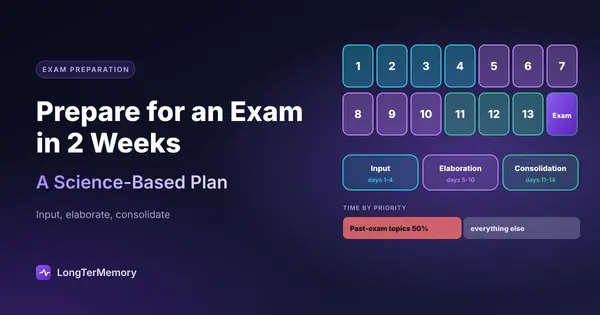
- Two weeks left: exam preparation in 2 weeks
- One day left: how to memorise chapters for an exam in one day
- One night left: how to study for exams in one night
- Cramming anyway: how to cram effectively without burning out
Common Mistakes
- Mistaking familiarity for knowledge. If you haven’t produced the answer without looking, you don’t know whether you know it.
- Studying topics in order and never going back. By exam day, the first topics are mostly gone. Mix reviews of old topics into every week.
- Spending the most time on what you already know. It feels good and teaches little. Your self-rating list from Step 1 should decide where the time goes.
- Never doing a timed practice test. Knowing the material and performing under time pressure are different skills.
- Making beautiful notes. Rewriting and color-coding take hours and build little memory. Questions beat summaries.
- Sacrificing sleep. Late nights before an exam trade long-term memory and attention for a little extra reading.
Do the Slow Part Automatically
The most time-consuming part of this method is Step 3: turning chapters, slides and lecture notes into good questions, then keeping track of when each one is due. LongTerMemory does both. Upload your PDFs or notes, and it generates question-and-answer cards from them and schedules every review with spaced repetition, so each study session starts with exactly the questions you’re about to forget.
Go Deeper
- Best study methods ranked by research evidence
- How the testing effect improves your active learning
- How to memorize fast and not forget
- How to memorize questions and answers for exams
- Interleaved practice for active learning
- How to study for high school finals
- The best AI study tools
FAQ
How many hours a day should I study for an exam?
Quality matters more than hours. Most students do well with two to four focused hours a day in the weeks before a major exam, split into sessions of 25-50 minutes with breaks. Beyond that, attention and retention drop. Spreading the same hours across more days beats packing them into fewer.
How far in advance should I start studying?
For a university final, three to four weeks of regular sessions is a good target; for large standardized or professional exams, usually two to six months. The earlier you start, the more spaced reviews each topic gets, and the less you need per day.
What is the best way to study for a test?
Test yourself. Answer questions from memory, check your answers, and repeat the ones you miss after a few days. Add timed practice tests in the real format in the final week or two.
Is it better to study in the morning or at night?
There’s no single best time; consistency matters more. What does matter is sleep: studying late into the night at the expense of sleep hurts memory. If you study in the evening, review the hardest material and then sleep on it.
Does re-reading notes help at all?
Once, to understand material you haven’t understood yet. After that, testing yourself on the same material is a better use of the time.
The Bottom Line
Studying for exams well comes down to a few habits: know what’s tested, start early enough to space your reviews, turn everything into questions, test yourself instead of re-reading, and rehearse the real exam before exam day. None of them require more talent or more hours. They require spending the hours you have on retrieval instead of recognition.