How to Prepare for the HESI Admission Assessment Exam
Master HESI exam prep with proven study strategies, practice test tips, and a smart nursing school prep plan that actually works.
Table of Contents
- HESI Sections: Which Subjects Your Program Requires
- Anatomy, Math, and Reading: The High-Weight HESI Areas
- Anatomy and Physiology
- Mathematics
- Reading Comprehension
- HESI Study Guides and Practice Tests That Match the Real Exam
- Official Elsevier Materials
- Recommended Third-Party Books
- Free and Low-Cost Online Resources
- Building a Realistic HESI Study Plan
- Test Day Tips to Keep Your Nerves in Check
- Retain What You Learn and Save Hours with LongTerMemory
- Final Thoughts
If you are applying to nursing school, there is a good chance you will face the HESI Admission Assessment Exam at some point in the process. This standardized test is used by hundreds of nursing programs across the United States to screen applicants and predict how well they will perform in a rigorous healthcare curriculum. For many students, the HESI feels like a gatekeeper standing between them and their dream career. The good news is that with the right preparation strategy, you can walk into that testing center feeling confident, calm, and ready to hit the score your program requires.
In this guide, we will break down exactly what the HESI covers, which sections deserve the bulk of your attention, and how to choose study materials that mirror the real exam format. We will also look at how to build a study schedule that fits into a busy life without burning you out before test day.
HESI Sections: Which Subjects Your Program Requires
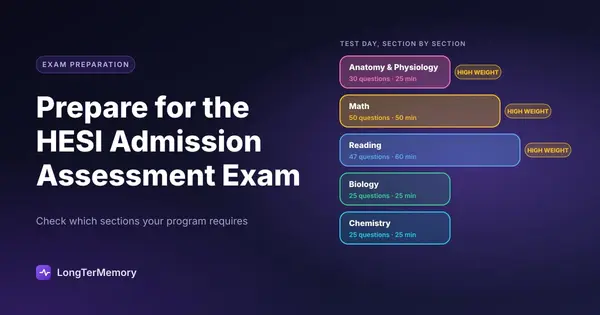
The HESI Admission Assessment Exam is not a one-size-fits-all test. It is actually a modular exam, meaning different nursing programs can choose which sections they want their applicants to take. This is why the very first step in your preparation should be to check with your target school and confirm exactly which modules you need. Do not assume you are taking the full battery just because someone else did.
The exam is published by Elsevier and typically includes the following subject areas:
| HESI Section | What It Tests | Typical Number of Questions | Time Limit |
|---|---|---|---|
| Anatomy and Physiology | Body systems, cellular biology, organ functions | 30 | 25 minutes |
| Biology | Cell biology, genetics, photosynthesis, metabolism | 25 | 25 minutes |
| Chemistry | Matter, chemical reactions, atomic structure | 25 | 25 minutes |
| Grammar | Parts of speech, common errors, sentence structure | 50 | 50 minutes |
| Mathematics | Basic math, fractions, ratios, dosage calculations | 50 | 50 minutes |
| Reading Comprehension | Main idea, inference, vocabulary in context | 47 | 60 minutes |
| Vocabulary and General Knowledge | Common healthcare and academic terminology | 50 | 50 minutes |
| Physics | Mechanics, energy, Newton’s laws, waves | 25 | 50 minutes |
| Learning Style / Personality Profile | Study habits and personality traits | 14 | 15 minutes |
| Critical Thinking | Analysis, bias recognition, problem solving | 25 | 25 minutes |
Most nursing programs require a subset of these, not all. The most commonly required sections are Anatomy and Physiology, Mathematics, Reading Comprehension, Grammar, and Vocabulary. Some competitive BSN programs may also require Chemistry, Biology, and Critical Thinking. A smaller number ask for Physics, so always verify before you start studying.
Here is a quick checklist to help you confirm your requirements:
- Check the admissions page of your nursing school for a list of required HESI sections
- Call the nursing department directly if the website is unclear
- Ask if there is a minimum score per section or only a composite minimum
- Confirm whether retakes are allowed and how long you must wait between attempts
- Find out if the school uses the most recent HESI version, as question formats do evolve
Wasting two weeks drilling physics equations when your program does not even require the physics section is a classic mistake. Get clarity first, then build your plan around only the sections that matter for your application.
Anatomy, Math, and Reading: The High-Weight HESI Areas
Even if your program requires multiple sections, three areas tend to carry the most weight in admissions decisions and cause the most anxiety for test takers: Anatomy and Physiology, Mathematics, and Reading Comprehension. These sections are almost universally required, and they are the ones where a strong score can really set you apart from other applicants.
Anatomy and Physiology
This section is often described as the hardest part of the HESI, and for good reason. It covers eleven major body systems, including the skeletal, muscular, cardiovascular, respiratory, digestive, urinary, reproductive, endocrine, nervous, integumentary, and lymphatic systems. You will need to know not just what each organ does, but how systems interact and what happens when something goes wrong.
According to data gathered from nursing student forums and prep course providers, the Anatomy and Physiology section has a national average score around 78-82%, which is lower than the math and reading averages. Schools know this, and many set their minimum cutoffs slightly lower for A&P than for other sections. However, scoring in the high 80s or 90s here sends a strong signal that you are ready for the intense biology coursework ahead.
Focus your study on these high-yield topics:
- Cardiovascular system: blood flow through the heart, electrical conduction, blood pressure regulation
- Respiratory system: gas exchange mechanics, oxygen and carbon dioxide transport
- Nervous system: sympathetic vs. parasympathetic responses, cranial nerves, reflex arcs
- Endocrine system: hormone functions, feedback loops, gland locations
- Urinary system: nephron function, filtration, reabsorption, and secretion
Flashcards work exceptionally well for this section because of the sheer volume of memorization involved. You are looking at hundreds of terms, structures, and pathways, and passive rereading is simply too slow.
Mathematics
The HESI math section is not advanced calculus. It is basic arithmetic, fractions, decimals, ratios, proportions, and household and metric conversions. For nursing school, the big emphasis is on dosage calculations and medication administration math. You will see questions asking you to convert ounces to milliliters, calculate IV drip rates, or determine how many tablets a patient should receive based on a doctor’s order.
The average HESI math score tends to hover in the mid-to-high 80s, partly because the concepts are familiar to most students. The trap is overconfidence. Many test takers assume they do not need to study math, then get thrown off by the word-problem format or by simple conversion mistakes under time pressure.
Key skills to master:
- Converting between metric units (grams to milligrams, liters to milliliters)
- Converting between household and metric measurements (teaspoons to milliliters, pounds to kilograms)
- Setting up and solving ratio and proportion problems
- Calculating percentages and solving for unknown variables
- Understanding basic military time, which appears on some medication orders
Practice with a pencil and paper, not just a calculator app. The test provides an on-screen calculator, but writing out your steps reduces careless errors and helps you catch mistakes before you submit an answer.
Reading Comprehension
The Reading Comprehension section presents short passages followed by multiple-choice questions that test your ability to identify the main idea, make inferences, understand vocabulary in context, and distinguish between facts and opinions. Passages often relate to health, science, or general academic topics.
This section is sneaky because it feels easy, but the time limit is tight. You have about 60 minutes for 47 questions, which means you are spending roughly 75 seconds per question including the time to read the passage. Many students report that they run out of time here, not because the questions are hard, but because they second-guess themselves.
To excel at reading comprehension:
- Read the question first, then scan the passage for the answer. This prevents getting lost in details.
- Watch out for extreme language in answer choices, like “always,” “never,” or “completely.” These are often incorrect.
- The correct answer is usually a paraphrase of a sentence in the passage, not a new idea.
- Practice with timed reading drills so the pace feels natural on test day.
HESI Study Guides and Practice Tests That Match the Real Exam
Not all HESI prep materials are created equal. Some third-party books reuse old NCLEX questions and slap a HESI label on the cover. Others focus on content review without giving you any sense of how the actual exam interface looks and feels. If you want to avoid surprises, you need resources that mirror the real HESI Admission Assessment Exam in both content and format.
Official Elsevier Materials
The safest bet is to start with the publisher’s own resources. Elsevier offers an official HESI study guide and an online practice test package that uses the same question bank style you will see on exam day. The official guide covers every section of the exam with concise review chapters and practice questions at the end of each unit.
The online practice exams from Elsevier are particularly valuable because they simulate the exact testing interface, including the on-screen calculator, the flag-for-review feature, and the countdown timer. Familiarity with the interface reduces cognitive load, which means you can focus more of your mental energy on solving problems instead of navigating buttons.
The downside is price. The full Elsevier Evolve prep bundle can cost between $75 and $150 depending on how many practice exams you purchase. If your budget is tight, consider buying just the official study guide used and supplementing with free or lower-cost practice questions online.
Recommended Third-Party Books
Several reputable publishers produce HESI-specific prep books that score well with students:
| Resource | Strengths | Best For |
|---|---|---|
| Mometrix HESI A2 Secrets Study Guide | In-depth content review with test-taking strategies | Students who need a full refresher across all sections |
| Kaplan HESI A2 Prep | Strong math and science explanations with video tutorials | Visual learners and students weak in math |
| The HESI A2 Practice Test Book by Test Prep Books | Two full practice exams with detailed answer explanations | Students who want realistic timed practice |
| Nursing.com HESI Prep | Video lessons, quizzes, and a mobile app | Students who prefer learning through video and short quizzes |
When evaluating any third-party book, flip to the anatomy section first. If it does not cover the endocrine and lymphatic systems in detail, or if the math section skips dosage calculations entirely, the book is probably too generic and not worth your time.
Free and Low-Cost Online Resources
You do not need to spend a fortune to prepare well. There are solid free resources available if you know where to look:
- Khan Academy has excellent biology, chemistry, and anatomy playlists that cover the foundational concepts tested on the HESI
- Quizlet hosts thousands of HESI flashcard sets created by students who have already taken the exam. Look for sets with high ratings and recent update dates
- YouTube channels like “Nurse Cheung” and “RegisteredNurseRN” offer free HESI math and anatomy review videos
- Your local library may carry physical copies of Mometrix or Kaplan HESI books that you can borrow for free
The key is to combine content review with active practice. Watching videos feels productive, but it is not a substitute for answering timed questions under exam conditions. Aim for a ratio of about 30% content review and 70% practice questions in the final two weeks before your test.
Building a Realistic HESI Study Plan
Cramming for the HESI the night before is a recipe for panic. Most successful test takers spread their preparation over four to six weeks, depending on how many sections they need to take and how recently they completed prerequisite courses like biology or chemistry.
Here is a sample four-week schedule for a student taking the five most common sections: Anatomy and Physiology, Math, Reading Comprehension, Grammar, and Vocabulary.
Week 1: Diagnostic and Foundation
- Take one full-length practice exam to identify your weakest sections
- Review basic math operations, fractions, and conversions if your math score was below 80%
- Begin daily anatomy flashcard review using a spaced repetition system
- Read one nonfiction health or science article daily to build reading stamina
Week 2: Content Deep Dive
- Complete the anatomy and physiology review chapters in your study guide
- Work through 20 math practice problems daily, timed at 20 minutes
- Study grammar rules: subject-verb agreement, pronoun usage, and common comma errors
- Build a personal vocabulary list of 50 unfamiliar words encountered in practice questions
Week 3: Practice and Pattern Recognition
- Take a second full-length practice exam under strict timed conditions
- Review every incorrect answer and write a one-sentence explanation of why you missed it
- Focus extra time on your lowest-scoring section from the second practice test
- Continue daily flashcard review, now prioritizing cards you have missed before
Week 4: Refinement and Test Simulation
- Take a third practice exam three or four days before the real test
- Review only high-yield notes and flashcards. Avoid learning brand new material
- Practice relaxation techniques, like box breathing, to manage pre-test anxiety
- Confirm your test center location, required ID, and arrival time
Students who follow a structured plan like this typically see composite score improvements of 10 to 20 percentage points between their first and last practice exams, based on self-reported data from HESI prep communities.
Test Day Tips to Keep Your Nerves in Check
The HESI is a computer-based test administered at Pearson VUE testing centers or sometimes on campus at your nursing school. Here is how to make sure test day goes smoothly.
First, sleep is more valuable than last-minute studying. A 2019 study published in the journal Sleep Health found that even one night of poor sleep can reduce cognitive performance on standardized tests by up to 15%. If you are torn between reviewing flashcards until midnight and getting eight hours of rest, choose sleep every time.
Second, arrive early and bring the exact form of identification required by your testing center. Many centers will turn you away if your ID is expired or does not match the name on your registration exactly.
Third, use the flag feature. If a question stumps you, mark it and move on. The HESI does not penalize you for wrong answers, so your best strategy is to answer every question even if some are educated guesses. Come back to flagged questions only if you have time at the end.
Fourth, watch the clock, but do not obsess over it. Glancing at the timer after every question creates anxiety. A better habit is to check your pace at the halfway point of each section and adjust if needed.
Finally, remember that one section does not define your entire score. If you bomb the grammar section because you panicked, take a breath, click Next, and attack the math section with a clean slate. Mental resilience matters just as much as content knowledge.
Retain What You Learn and Save Hours with LongTerMemory
Preparing for the HESI means memorizing hundreds of anatomical terms, drug conversion formulas, grammar rules, and vocabulary words. The hardest part is not learning it once, it is remembering it all weeks later when the information actually counts on test day.
That is exactly where LongTerMemory helps. Our platform uses spaced repetition, a learning technique backed by decades of cognitive science research, to automatically schedule your review at the exact moment you are about to forget a concept. Instead of rereading the same chapter five times, you spend a few minutes each day reviewing only the material your brain needs to reinforce.
With LongTerMemory, you can:
- Upload your own PDF study guides and lecture notes directly into the system
- Import web content from any anatomy or math resource you are already using
- Let the algorithm build a personalized review schedule that adapts to your memory strength
- Track your progress and see exactly which HESI topics are locked in and which need more attention
Students who use spaced repetition for exam preparation typically cut their total study time by 30 to 50% while achieving higher long-term retention compared to traditional cramming methods. If you are juggling prerequisites, work, and family obligations while preparing for nursing school, that time savings is not just convenient, it is essential.
Start your free trial of LongTerMemory today and turn your HESI study materials into a smart, self-managing review system that works in the background while you focus on everything else life is throwing at you.
Final Thoughts
The HESI Admission Assessment Exam is a serious hurdle, but it is not an impossible one. Start by confirming exactly which sections your program requires. Focus the majority of your energy on anatomy, math, and reading comprehension. Choose study guides and practice tests that replicate the real exam format, not generic nursing content. Build a four to six week study schedule that mixes content review with heavy doses of timed practice. And on test day, trust your preparation, manage your time wisely, and stay mentally flexible.
Nursing school will ask even more of you once you are in. Treat the HESI as your first chance to prove to yourself that you can handle a rigorous academic challenge with discipline and strategy. You have got this.