How to Cram Effectively Without Burning Out
Discover how to cram effectively without burnout. Use breaks, retrieval practice, and sleep to protect your memory and your exam score.
Table of Contents
- What Cramming Can and Cannot Achieve Neurologically
- Working Memory Is a Bottleneck
- Sleep Consolidates Fragile Traces
- The Smart Cramming Protocol: Breaks, Retrieval, and Sleep
- Triage the Material First
- Work in Focused Bursts With Real Breaks
- Test Yourself Instead of Re-Reading
- Protect Your Sleep
- Manage Your Environment
- How to Convert Cramming Gains Into Slightly Longer Retention
- Build Retrieval Cues
- Common Cramming Mistakes to Avoid
- A Quick Smart Cramming Checklist
- Make It Easier With LongTerMemory
Most students have faced the dreaded moment when the exam is tomorrow and the material is still mostly unread. The natural response is to drink another coffee, open the textbook, and try to soak up as much as possible in one brutal sitting. That approach can feel heroic, but it usually leaves you exhausted, anxious, and unable to recall half of what you just read.
The better path is smart cramming. It will not turn a semester of neglect into perfect mastery, but it can help you squeeze the maximum possible value out of limited time without frying your brain. The goal is simple: learn the highest-yield material, practice pulling it out of memory, and then give your brain the rest it needs to hold onto it.
What Cramming Can and Cannot Achieve Neurologically
Cramming can help you store a surprising amount of information in a short window, but only if you respect how memory actually works. Your brain encodes new facts through a combination of attention, repetition, and sleep-based consolidation. When time is short, you can still create fragile memory traces strong enough to survive an exam, but you cannot build the deep, durable knowledge that comes from spaced practice over weeks.
Think of last-minute studying like packing a suitcase in a hurry. You can fit a lot inside if you fold carefully and only bring what matters. If you just throw everything in and slam the lid, most of it will fall out the moment you open the case. That is exactly what happens when you re-read whole chapters at 2 a.m. while half asleep. The information feels familiar, but it is not securely stored.
The honest truth is that cramming is a damage-control strategy, not a learning strategy. It can raise a failing grade to a passing one, and it can help you recall key definitions, formulas, and procedures when it counts. It will not, however, produce the kind of long-term retention that lets you use the knowledge weeks or months later. Accepting this limitation is the first step toward cramming wisely.
Working Memory Is a Bottleneck
Your working memory can only hold a small number of items at once. When you try to rush through dozens of new concepts in one session, you overwhelm that bottleneck. The result is that ideas slide in and out without ever being transferred to long-term storage. Smart cramming respects this limit by focusing on a small number of high-priority items at a time and reviewing them actively.
Sleep Consolidates Fragile Traces
The hippocampus, the brain region that helps form new memories, replays the day’s experiences during sleep. This replay moves information into longer-term storage. Without sleep, those fragile traces remain unstable. That is why an all-nighter can leave you with a fuzzy head even when you spent hours with the material. Cramming works best when it is followed by real rest.
The Smart Cramming Protocol: Breaks, Retrieval, and Sleep
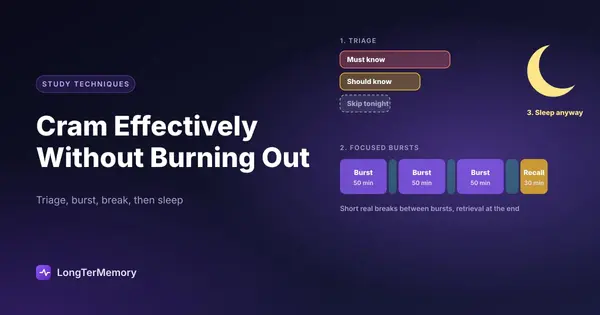
A productive cram session has three non-negotiable ingredients: frequent breaks, active retrieval, and actual sleep. Skip any one of them and the other two become far less effective.
Triage the Material First
Before you open a single book, decide what actually matters. Look at the syllabus, past exams, lecture highlights, and any study guide your instructor provided. Identify the topics that are both high-yield and still unfamiliar to you. Those are where your time belongs.
A useful rule of thumb is the 80/20 principle: roughly 80 percent of exam points often come from 20 percent of the material. Your job is to find that 20 percent. Do not waste your final hours on obscure details that might appear as a single throwaway question. Focus on the core concepts, repeated themes, and anything the instructor emphasized in class.
Work in Focused Bursts With Real Breaks
Your attention is a finite resource. After about 25 to 50 minutes of intense focus, comprehension and retention start to drop sharply. The classic solution is the Pomodoro technique: study for 25 minutes, then take a five-minute break. During those five minutes, stand up, stretch, drink water, and look away from any screen. Let your mind reset.
After four rounds, take a longer break of 15 to 30 minutes. This rhythm keeps your brain alert and prevents the fog that sets in during marathon sessions. It also reduces the chance of burnout. A four-hour cram with regular breaks usually produces more learning than a four-hour cram without them, because you spend more time actually absorbing information and less time staring blankly at the same paragraph.
Test Yourself Instead of Re-Reading
Re-reading feels productive because the text becomes familiar, but familiarity is not the same as recall. The single most important shift you can make is to replace passive review with retrieval practice. Close the book and try to explain the concept in your own words. Answer practice questions from the end of the chapter. Use flashcards. Write a quick summary from memory.
This works because the act of pulling information out of your memory strengthens the neural pathways you will need during the exam. Every successful retrieval makes the memory a little easier to access next time. Even failed retrieval attempts are useful, because they show you exactly what you still need to study. If you only re-read, you miss those signals.
Protect Your Sleep
Sleep is not lost study time. It is when your brain converts fragile new memories into more stable forms. Research consistently shows that cutting sleep to cram backfires: you may spend more hours with the material, but you remember less of it. A well-rested brain retrieves information faster and makes fewer careless mistakes.
If your exam is in the morning, aim for at least six to seven hours of sleep. If you must choose between two more hours of late-night review and two more hours of sleep, choose sleep for everything except the absolute most critical facts you can review in the final 10 minutes before the test.
Manage Your Environment
Your surroundings shape how well you cram. Turn off non-essential notifications, put your phone in another room, and use website blockers if needed. Have water, snacks, and all materials ready before you start so you are not constantly getting up. A clean desk and good lighting reduce friction and help you stay in the zone during each focused burst.
How to Convert Cramming Gains Into Slightly Longer Retention
Once the exam is over, most cramming memories fade quickly. That is normal. But you can slow the forgetting curve with a few deliberate moves.
First, review the most important material once more within 24 hours of the exam. This quick second exposure helps stabilize the memories before they decay. Second, connect new facts to things you already know. The more mental hooks a piece of information has, the longer it sticks around. Third, teach what you learned to someone else, even briefly. Explaining material forces you to organize it, which deepens retention.
You can also use a spaced repetition tool to schedule short follow-up reviews over the next few days. Even two or three extra retrieval sessions can dramatically extend the lifespan of what you crammed. If the subject matters for future courses or your career, this follow-up is well worth the small time investment.
Build Retrieval Cues
Another way to make cramming stick is to create strong retrieval cues while you study. These cues can be mental images, acronyms, or simple phrases that remind you of a larger concept. The more distinctive the cue, the easier it is to pull up the related information under exam pressure. For example, if you need to remember a list of steps, create a vivid but simple story that links them in order.
Common Cramming Mistakes to Avoid
Even smart cramming can go wrong if you fall into a few common traps. Watch out for these:
- Multitasking. Switching between study material and social media destroys focus and makes each review pass less effective.
- Passive highlighting. Highlighting without testing yourself creates an illusion of knowing.
- Ignoring sleep. Every hour of sleep you sacrifice reduces the value of the hours you spent studying.
- Perfectionism. You cannot learn everything. Chasing total coverage often means mastering nothing.
- Skipping breaks. Marathon sessions feel productive but produce shallow, fragile memories.
- Cramming everything equally. Not all topics deserve the same amount of time. Prioritize aggressively.
If you have a full day rather than a few hours, our guide on how to memorise chapters for an exam in one day turns these cramming principles into a complete 24-hour schedule.
If you only have a single hour, see our guide on how to memorize fast in 1 hour for a minute-by-minute plan.
For a plan that covers a single evening, see our guide on how to study for exams in one night.
A Quick Smart Cramming Checklist
Use this checklist the next time you are short on time:
- Triage the material and focus only on what is most likely to appear on the exam.
- Work in 25 to 50 minute focused blocks separated by real breaks.
- Spend at least half of your active study time testing yourself, not re-reading.
- Use practice questions, flashcards, or blank-page recall for every topic.
- Stop studying one to two hours before bed and prioritize sleep.
- Do a quick morning review of the highest-yield facts.
Make It Easier With LongTerMemory
Cramming will never be as effective as spaced practice, but the right tool can make both far more efficient. LongTerMemory turns PDFs, web pages, and lecture notes into automatic flashcards and quizzes, so you can focus on retrieval instead of copying notes by hand. Its spaced repetition scheduling keeps your hardest material in front of you at exactly the right intervals, whether you are cramming for tomorrow or building knowledge for the long term. If you are facing a high-stakes exam, start your free trial and see how much faster smart cramming can be when the flashcards create themselves.