How to Create Long-Term Memory: The Science of Making Knowledge Stick
Learn how to create long-term memory with proven techniques: encoding, retrieval practice, spaced repetition, and sleep. Make knowledge stick for years.
Table of Contents
- What Long-Term Memory Actually Is
- Why Most of What You Learn Fades
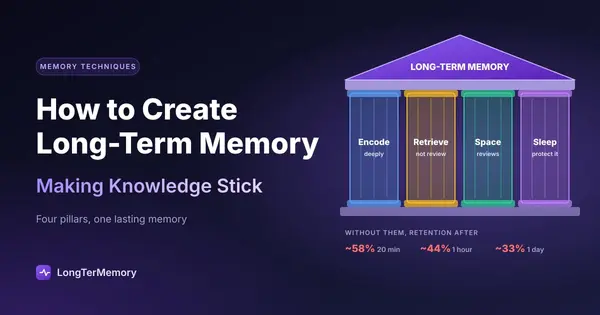
- The 4 Pillars of Creating Long-Term Memory
- Pillar 1: Encode Deeply, Not Superficially
- Pillar 2: Practice Retrieval, Not Review
- Pillar 3: Space Your Reviews Over Time
- Pillar 4: Protect Your Sleep
- A Simple Daily System to Create Long-Term Memory
- Lifestyle Factors That Multiply (or Destroy) Your Results
- The Mistakes That Prevent Long-Term Memory
- Frequently Asked Questions
- The Bottom Line
Here is a frustrating experience you probably know well. You spend an entire weekend studying a subject. On Monday, you feel sharp. By Friday, half of it is gone. Two weeks later, you can barely remember what the weekend was even about.
The problem is not your brain. The problem is the method. Most study habits are designed to create short-term familiarity, not long-term memory. If you want to know how to create long-term memory for what you learn, whether for an exam, a certification, a language, or your career, the answer comes down to four things: how you encode information, how often you retrieve it, when you review it, and how well you sleep.
This guide walks through each of those levers, with the research behind them and a practical system you can start using today.
What Long-Term Memory Actually Is
Long-term memory is the brain’s durable storage system, the place where information lives for months, years, or decades. It is fundamentally different from working memory, the mental scratchpad that holds a phone number just long enough for you to dial it.
Creating a long-term memory is not a single event. It is a three-stage process:
- Encoding: your brain converts an experience into a storable pattern of neural activity.
- Consolidation: over hours and days, and largely during sleep, that fragile pattern is stabilized and integrated with what you already know. The hippocampus, a small structure deep in the brain, plays a central role in handing new memories off to the cortex for permanent storage.
- Retrieval: every time you pull a memory back out, you strengthen the pathway to it, making the next retrieval faster and more reliable.
The key insight is that all three stages are trainable. You cannot force your brain to remember by sheer willpower, but you can absolutely create the conditions in which remembering is the natural outcome. The rest of this article is about doing exactly that.
Why Most of What You Learn Fades
The short answer: your brain forgets by default. Without deliberate intervention, new information decays fast, and this is a feature, not a bug.
In the 1880s, psychologist Hermann Ebbinghaus memorized thousands of nonsense syllables and then measured how quickly he forgot them. The result, the famous forgetting curve, is still one of the most replicated findings in psychology:
| Time after learning | Approximate retention |
|---|---|
| 20 minutes | ~58% |
| 1 hour | ~44% |
| 1 day | ~33% |
| 1 week | ~20% or less |
Your brain is constantly making a judgment call: is this information worth the metabolic cost of keeping? If a piece of information is encountered once and never used again, the answer is no, and it gets pruned. This is why cramming feels so effective on the night of the exam and so empty two weeks later. You built familiarity, not durability.
The good news is that the forgetting curve is not fixed. Every well-timed review flattens it. Every successful retrieval tells your brain: keep this one. You are about to learn how to send that signal on purpose.
The 4 Pillars of Creating Long-Term Memory
Four evidence-based techniques do almost all of the work in moving information from “I just read this” to “I will know this in ten years.”
Pillar 1: Encode Deeply, Not Superficially
The depth at which you process information during encoding predicts how well you will remember it later. This principle, known as levels of processing, means that thinking about meaning beats looking at words every single time.
Shallow encoding is what happens when you highlight, re-read, or copy notes word for word. Deep encoding happens when you:
- Connect new information to what you already know. Ask: what does this remind me of? Where have I seen this pattern before?
- Explain it in your own words. If you cannot paraphrase it, you have not encoded it.
- Ask “why” and “how” questions about the material, a technique called elaborative interrogation that makes facts stick.
- Use multiple formats: draw a diagram, say it out loud, write an analogy.
A practical rule of thumb: if a study activity feels effortless, it is probably shallow. Deep encoding feels like work, and that feeling is the signal that memory is being formed.
Pillar 2: Practice Retrieval, Not Review
Retrieval practice, also called active recall, is the single most powerful technique for creating long-term memory. Instead of re-exposing yourself to information, you force your brain to produce it from scratch.
The classic demonstration comes from a 2008 study by Karpicke and Roediger published in Science. Students who re-studied material retained about 33% after one week. Students who practiced retrieval retained about 80%. Same total study time, dramatically different outcome.
Why does it work? Because every retrieval attempt physically strengthens the neural pathway to that memory. Re-reading is like looking at a trail through the forest. Retrieval is like walking it. Only one of them wears the path in. If you want a full breakdown of the method, see our guide on active recall techniques.
Concrete ways to build retrieval into your routine:
- Close the book and write down everything you remember (the blank page technique).
- Turn every heading in your notes into a question, then answer it without looking.
- Use flashcards, but commit to an answer before flipping the card.
- Explain the concept out loud to an imaginary student.
Pillar 3: Space Your Reviews Over Time
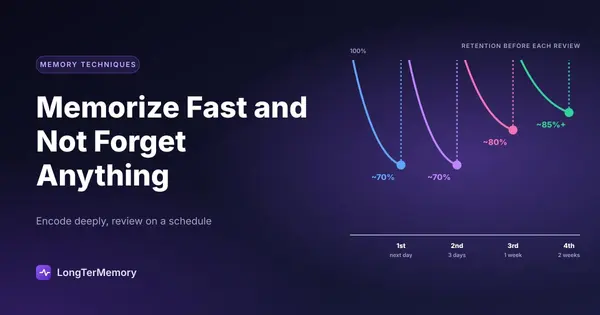
Spacing is the scheduling layer that makes everything else durable. Spaced repetition means reviewing information at gradually expanding intervals, catching each memory just as it starts to fade.
A meta-analysis by Cepeda and colleagues (2006), covering more than 250 studies, confirmed what memory researchers had suspected for a century: distributed practice beats massed practice, and it is not close. The same total review time produces dramatically better retention when it is spread out.
A simple starting schedule looks like this:
| Review | Timing after first learning |
|---|---|
| 1st | Same day (within a few hours) |
| 2nd | 1 day later |
| 3rd | 3 days later |
| 4th | 1 week later |
| 5th | 2 to 3 weeks later |
| 6th | 1 to 2 months later |
Each successful recall pushes the next review further out. Each failure pulls it closer. This is exactly the scheduling logic that LongTerMemory automates: it turns your PDFs and study materials into Q&A flashcards and schedules each review for the moment you are most likely to forget, so retention happens on autopilot instead of requiring you to manage a spreadsheet.
Pillar 4: Protect Your Sleep
Sleep is not downtime for memory. It is the shift during which consolidation actually happens. During deep sleep, the hippocampus replays the day’s new memories and transfers them to the cortex for long-term storage. During REM sleep, those memories get integrated with existing knowledge, which is where insight and “it just clicked” moments come from.
The research on this is blunt. Studies by Matthew Walker and colleagues have shown that sleep deprivation can reduce the brain’s ability to form new memories by up to 40%, and that pulling an all-nighter after studying sacrifices a large share of the consolidation you would otherwise get for free. For the full playbook, see our article on sleep and memory consolidation.
Practical rules:
- Study new material in the evening or a few hours before bed to ride the consolidation window.
- Never sacrifice sleep for extra cramming. The extra hours of input are worth less than the consolidation you lose.
- Do a 10-minute morning recall of what you studied the night before. It is one of the highest-leverage review sessions available.
To see exactly how does spaced repetition work in a real exam calendar, read our guide for college students.
A Simple Daily System to Create Long-Term Memory
Knowing the pillars is one thing. Combining them into a routine is where the results come from. Here is a system that takes about 30 to 45 minutes per day:
- Learn (15-20 min): study new material actively. Paraphrase, connect, question. Take notes in your own words, not the author’s.
- Encode (5 min): immediately convert what you learned into questions or flashcards. If it is not testable, it is not encoded.
- Retrieve (10 min): do today’s scheduled reviews with full effort. Answer before checking. Flag what you missed.
- Space (automatic): let a spaced repetition schedule decide what comes back tomorrow, next week, and next month.
- Consolidate (tonight): get 7 to 9 hours of sleep. This is a study activity, not a reward for studying.
Follow this loop for a month and the compounding becomes obvious. Material you learned on day one is still accessible on day thirty, and each day’s session builds on a foundation that is actually still there.
Lifestyle Factors That Multiply (or Destroy) Your Results
Memory formation is a biological process, and biology responds to how you treat your body. The evidence-backed multipliers:
| Factor | Effect on long-term memory |
|---|---|
| Sleep (7-9 hrs) | Enables consolidation; skimping can cut new memory formation dramatically |
| Aerobic exercise | Boosts BDNF, a protein that supports neuron growth and synaptic plasticity |
| Chronic stress | Elevated cortisol impairs hippocampal encoding and retrieval |
| Hydration and stable blood sugar | Even mild dehydration measurably hurts attention and recall |
| Focused, single-tasked study | Attention is the gatekeeper of encoding; multitasking blocks it |
None of these replace the four pillars. But if you are doing everything right with technique and everything wrong with sleep and stress, you are studying with the handbrake on.
The Mistakes That Prevent Long-Term Memory
Most failed retention comes from a handful of predictable errors:
- Re-reading and highlighting as your main strategy. These create the feeling of knowing without the substance. Recognition is not recall.
- Cramming everything into one session. Massed practice produces short-lived familiarity that collapses within days. See why you forget what you study for the deeper diagnosis.
- Checking the answer too soon. If you flip the flashcard after three seconds of blankness, you have converted retrieval practice back into passive review. Struggle for at least 10 to 30 seconds.
- Skipping the review schedule when life gets busy. Missing one day is fine. Missing a week lets the forgetting curve win. Consistency beats intensity.
- Studying while distracted. A notification every five minutes means nothing gets encoded deeply enough to consolidate later.
Frequently Asked Questions
How long does it take to create a long-term memory? The initial encoding happens in seconds, but consolidation takes hours to days, and true durability takes repeated retrieval over weeks. Most information needs 5 to 7 well-spaced, successful recalls to become stable for the long term.
Can you improve long-term memory as an adult? Yes. Neuroplasticity, the brain’s ability to form new connections, continues throughout life. Adults who use retrieval practice, spaced review, and adequate sleep reliably improve retention at any age.
Is long-term memory capacity limited? Practically speaking, no. Unlike working memory, which holds only a few items at once, long-term memory has no known storage limit. The bottleneck is never space, it is the quality of encoding and retrieval.
Do supplements or “brain foods” create better memory? The evidence for specific supplements is weak compared to the evidence for sleep, exercise, and good study technique. Fix the big levers first.
The Bottom Line
Creating long-term memory is not a talent. It is a process with known rules: encode deeply, retrieve actively, space your reviews, and sleep like it matters, because it does. Do those four things consistently and the forgetting curve stops being your enemy and starts being your scheduling assistant.
If you want the system without the manual work, try LongTerMemory free. Upload your PDFs or course materials, and it generates Q&A flashcards automatically, then schedules every review at the optimal moment for long-term retention. You bring 30 minutes a day, it handles the forgetting curve.
The knowledge you worked hard to learn deserves to still be there next year. Now you know how to make sure it is.