How to Prepare for the Insurance Licensing Exam
Step-by-step guide to passing state insurance licensing exams, covering life, health, property, and casualty lines with proven study strategies.
Table of Contents
- What Insurance Licensing Exams Actually Test
- How to Organize Your Study Plan
- High-Yield Concepts Worth Your Time
- Types of Life Insurance Policies
- Policy Provisions and Riders
- Annuities
- Property and Casualty Fundamentals
- State Regulations and Ethics
- Practice Questions Are Not Optional
- State-Specific Rules: Don't Skip Them
- Common Mistakes That Cause Candidates to Fail
- Exam Day: Practical Logistics
- What to Do If You Don't Pass
- The Bottom Line
So you’ve decided to get your insurance license. Maybe someone in your life is in the industry and keeps telling you it’s a great career move, or maybe you’re already working at an agency and need that credential to start selling. Either way, you’re looking at the insurance licensing exam and wondering: how hard is this, really, and how do I actually prepare?
The good news is that insurance licensing exams are very passable with the right approach. They’re not designed to trick you or test obscure academic theory. They test practical knowledge of insurance products, regulations, and ethics, things that have direct real-world relevance. That said, underestimating them is a common mistake. People sign up, skim a prep guide over a weekend, and then fail by a handful of questions. You don’t want to pay for a retake.
This guide gives you a clear, methodical path to passing on your first attempt.
What Insurance Licensing Exams Actually Test
Before you study anything, it helps to understand what you’re up against. Insurance licensing exams in the United States are administered at the state level, which means the specific content varies depending on where you’re taking the exam. However, there’s a lot of overlap across states because most exams pull from common insurance law principles and product categories.
At a high level, most exams cover some combination of the following:
Life and health insurance concepts: term life, whole life, universal life, group health plans, disability income, Medicare supplements, annuities.
Property and casualty concepts: homeowners policies, auto insurance, commercial liability, workers compensation, umbrella coverage.
General insurance principles: insurable interest, indemnity, subrogation, utmost good faith, the insurance contract.
State-specific regulations: producer licensing laws, unfair trade practices, consumer protection rules, the role of the state insurance department.
Ethics and professional conduct: agent responsibilities, duty of care, prohibited practices.
The exact weight given to each category depends on the line of authority you’re seeking. If you’re licensing for life and health only, you won’t see much property and casualty content, and vice versa. If you’re going for a full producer license covering all lines, expect questions across all categories.
Your state’s Department of Insurance website should have an exam content outline available for free. This document tells you exactly which domains will appear and what percentage of the test each represents. Download it before you study anything. It’s essentially a map of the exam.
How to Organize Your Study Plan
Most people preparing for insurance licensing have somewhere between two and six weeks before their scheduled test date. That’s a reasonable window. Going longer than that often leads to overstudying early topics and letting them fade before exam day. Rushing it into less than two weeks is possible but stressful, especially if you have no prior insurance background.
A workable structure looks like this:
Week one: Focus entirely on the foundational concepts. This means understanding how insurance contracts work, the core legal doctrines (insurable interest, indemnity, subrogation), and the basic structure of the product lines you’ll be tested on. Don’t try to memorize policy details yet. Build the conceptual scaffolding first.
Week two: Go deeper into each product category. Study the features and riders for life insurance products. Learn the structure of property and casualty policies, including what’s typically covered and excluded. For health insurance, understand the difference between major medical, HMO, PPO, and HSA-compatible plans.
Week three and beyond: Shift almost entirely to practice questions. If you have extra time, do a deep review of state-specific regulations and ethics content, which is a category many people underinvest in and then lose easy points on.
The specific topics and their subheadings matter a lot here. Don’t just read through your prep materials in sequence and hope things stick. Use active recall from day one, testing yourself on each concept rather than passively reading.
High-Yield Concepts Worth Your Time
Some insurance concepts appear on exams far more often than others. These are the areas that consistently generate questions, and they deserve extra attention in your study plan.
Types of Life Insurance Policies
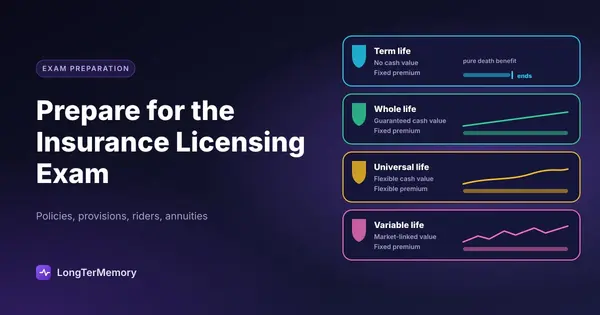
The distinctions between term life, whole life, universal life, and variable life are fundamental. Know how cash value accumulates (or doesn’t), how premiums work, how loans against cash value affect the death benefit, and what happens when a policy lapses. Know the specific features of term policies like renewability and convertibility.
| Policy Type | Cash Value | Premium | Key Feature |
|---|---|---|---|
| Term Life | No | Fixed | Pure death benefit, temporary |
| Whole Life | Yes (guaranteed) | Fixed | Permanent, guaranteed growth |
| Universal Life | Yes (flexible) | Flexible | Adjustable death benefit |
| Variable Life | Yes (market-linked) | Fixed | Investment component |
Policy Provisions and Riders
Expect multiple questions on the standard provisions that must appear in life and health policies. The grace period, incontestability clause, suicide clause, and free look period are perennial exam topics. For health policies, understand the coordination of benefits provision and how subrogation works when a third party is liable for medical expenses.
Annuities
Annuities are one of the areas where candidates tend to feel least confident. Know the difference between fixed and variable annuities, understand the accumulation phase versus the distribution phase, and know the different payout options like life only, joint and survivor, and period certain.
Property and Casualty Fundamentals
If your exam covers P&C content, make sure you understand the PAP (Personal Auto Policy) structure thoroughly. Know what each coverage part includes and excludes. For homeowners insurance, understand the HO-3 open perils policy versus named perils policies, and know which losses are typically excluded.
State Regulations and Ethics
This category is where confident test-takers lose points when they haven’t studied carefully. Know the licensing laws for your state: how long a license is valid, what continuing education is required for renewal, what activities require a license and which don’t, and what the penalties are for unfair trade practices like twisting, churning, and rebating.
Practice Questions Are Not Optional
If there’s one thing that separates candidates who pass on the first try from those who retake, it’s practice questions. Not just doing them, but doing them correctly.
The right way to use practice questions is to attempt each one honestly before checking the answer, even when you’re not confident. The act of committing to an answer and then seeing whether you were right or wrong is significantly more effective for retention than reading a question and its answer at the same time.
After you miss a question, don’t just mark it wrong and move on. Understand why the correct answer is correct and why each wrong answer is wrong. Insurance exam questions often hinge on subtle distinctions, and the explanation matters more than the score.
Most commercial prep programs include a bank of several hundred to several thousand practice questions. Try to work through at least three to four hundred before your exam, ideally more. In the final week, target your weakest areas by reviewing questions you previously got wrong.
A tool that many candidates find useful is spaced repetition, a method that shows you questions at increasing intervals based on how well you know them. This is exactly the kind of structured review that keeps material fresh right up to exam day. LongTerMemory is a platform built around this approach, letting you generate flashcards and Q&A pairs from your study materials and review them with automated spaced scheduling. You upload your prep materials and the platform generates the questions automatically, so you spend your time reviewing, not creating cards.
State-Specific Rules: Don’t Skip Them
One of the most common reasons candidates fail insurance licensing exams is underinvesting in state-specific content. It’s tempting to focus on the universal insurance principles and skim the state law section because it feels like bureaucratic detail. Resist that temptation.
State-specific questions typically cover:
- Producer licensing requirements (age, education, background check, application process)
- License renewal and continuing education requirements
- Definitions of unfair trade practices and anti-rebating laws
- The duties of the state insurance commissioner
- Rules around replacement of insurance policies
- How to handle premium trust accounts
Some of this material varies quite a bit from state to state, so use your state’s official content outline rather than relying entirely on national prep materials. If your prep program includes a state-specific section, work through it carefully. If it doesn’t, supplement with your state’s own regulatory materials.
Common Mistakes That Cause Candidates to Fail
Beyond the obvious (not studying enough), there are a few specific patterns that cause otherwise prepared candidates to stumble.
Confusing similar products: The distinctions between whole life and universal life, or between a PPO and an HMO, or between actual cash value and replacement cost, are exactly the kinds of nuances that exam writers exploit. Study these pairs specifically and make sure you can articulate the differences confidently.
Ignoring exclusions: Exam questions love to test what a policy does not cover. Know the standard exclusions for homeowners, auto, and health policies just as well as you know what they cover.
Overlooking the ethics section: Producer conduct questions are common and predictable once you know the relevant statutes. They’re also some of the easiest points to earn if you’ve studied the material, and some of the most surprising to lose if you haven’t.
Not reviewing feedback on missed questions: If you’re using a practice question bank, the explanations are the most valuable part. Candidates who read through every explanation, including for questions they got right, retain far more than those who only check whether they passed or failed each practice set.
Exam Day: Practical Logistics
Insurance licensing exams are typically administered at Pearson VUE or PSI testing centers. You schedule online, arrive with a valid government-issued ID, and complete the test on a computer.
The tests are typically 100 to 150 questions and have a time limit of two to three hours. Most candidates finish well within the time limit, so pacing isn’t usually an issue. If you find yourself stuck on a question, skip it, flag it, and come back. Don’t let one hard question derail your rhythm.
Expect a lot of scenario-based questions, especially on ethics and state regulations. These questions present a situation and ask what the producer should do. Apply your knowledge of licensing law and professional conduct to choose the most ethical and legally compliant response.
After you complete the exam, most testing centers provide immediate preliminary results. Official results come from your state’s licensing authority, which will also handle the actual license issuance.
What to Do If You Don’t Pass
Failing an insurance licensing exam on the first attempt is common and is not the end of the story. Most states allow you to retake the exam after a short waiting period (often 24 hours to a few days).
If you fail, use your score report carefully. Most states provide a breakdown of your performance by content area. Identify your weakest domains and spend extra time there before scheduling your retake. Don’t just go back and reread, practice more questions, specifically in the areas where you lost the most points.
The retake rate for insurance licensing exams is high because many candidates don’t treat the first attempt with enough seriousness. If you’ve read this guide, you’re already thinking about preparation more strategically than most. Give yourself the preparation you need, and you’ll pass.
The Bottom Line
Insurance licensing exams are achievable. They test practical knowledge, not theoretical complexity, and with a focused, structured study plan, you can pass on your first attempt. Invest in a quality prep program, use practice questions aggressively, don’t skip the state-specific content, and give yourself enough time to study without cramming everything into the last 48 hours.
If you can take one piece of advice away from this guide: the candidates who struggle are almost always the ones who studied passively, reading and re-reading without testing themselves. The candidates who pass are the ones who tested themselves constantly, treated every wrong answer as a learning opportunity, and used their time wisely.
Get your license. It’s closer than it feels.